
Alachua County Commission passes budget, hears update on roads, repeals firearms ordinances
BY JENNIFER CABRERA
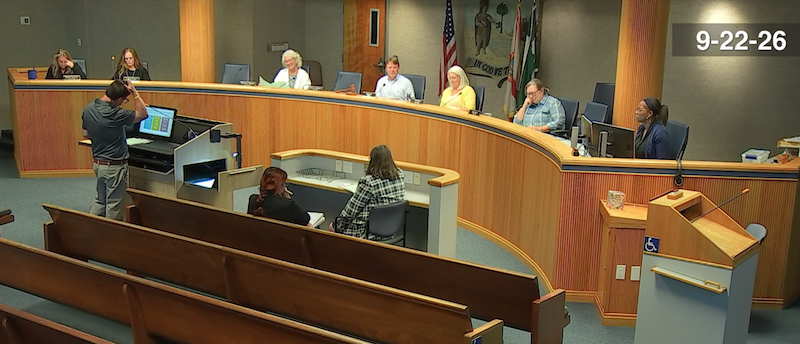
GAINESVILLE, Fla. – At the September 22 meeting, the Alachua County Commission finalized its FY2027 budget, heard an update on roads, decided against a Special Assessment District for Totem Pole Road, and repealed several firearms ordinances.
Last mile of SW 75th Street
During general public comment, nine people spoke about a one-mile stretch of SW 75th Street that is south of Archer Road, saying it hadn’t been paved in 46 years and has major potholes but is not on the County’s Transportation Capital Improvement Plan (TCIP).
The first speaker said the road serves about 500 residents, and Chair Ken Cornell said the board had received about 100 emails from them in the past week.
After the public concluded, Commissioner Mary Alford made a motion to ask staff to bring back a proposal to add 75th to the TCIP, and Commissioner Anna Prizzia seconded the motion. The motion passed 4-0, with Commissioner Charles Chestnut absent.
Public Works Director Ramon Gavarrete said he went out to look at the road yesterday and counted six potholes, “so the crew is down there today.”
Streamlining pothole repair: “We have a crisis right now on our hands”
Gavarrete said the crews are “going back to the olden days” by just cleaning the hole, heating it up, filling it up, compacting it, and moving on to the next pothole. He said, “We were taking too long cutting it out, which is the right way of doing it, by the way. But it was just too long, and we have a crisis right now on our hands… So I told my staff,… just clean it up and tack it.”
Referring to the speakers’ comments about SW 75th Street being on a previous capital program list, Gavarrete said there were a lot of roads on a previous capital program, but only two or three roadways were funded; he said they should never have been included on a list if they weren’t funded, and he made that change when he was hired: “So when we did the TCIP in 2023, I said I am not putting all the roads on the program because unless they’re funded, they’re not in the program.”
Commissioner Anna Prizzia: TCIP came from “a software system that helped us to prioritize roads, based on their condition, based on how much traffic went on them, based on equity — sort of how much attention those roads had gotten in the past — and it spat out a list of roads.”
Prizzia reviewed the process of creating the TCIP: “We used an engineering firm to go through all the roads in our county, give them grades, and put those into a software system that helped us to prioritize roads, based on their condition, based on how much traffic went on them, based on equity — sort of how much attention those roads had gotten in the past — and it spat out a list of roads.” She said they’ve tried to stick with the engineers’ evaluation, but “it doesn’t mean that that list is not without flaws, and we’re learning those flaws now… We’re learning, along with you, about the pains of not having taken care of an important asset for tons and tons of years, and now having the backlog of that and having to figure out how we do more with less.”
Prizzia said she knows it’s “not a consolation to all of you” when Commissioners say they’re spending more on roads than any other previous Commission, “but we’re putting in $24 million a year of this infrastructure surtax. Our overall budget for roads is closer to $100 million a year. That includes all of our gas tax, as well as other funds that we get from grants that Ramon and his team write, DOT funds and partnership funds that we get, mobility funds that come from developers.”
Special Assessment District to repave Totem Pole Road
Commissioners considered a Special Assessment District (SAD) for paving NE 225th Street and NE 69th Avenue, also known as Totem Pole Road. Cornell said that he has advocated for the use of special districts for over a decade, and when neighbors approached him about fixing this road, he suggested the Special Assessment District, which splits the cost among all of the property owners on the road. An initial poll of the affected property owners found that 64% supported moving forward. Since Cornell is an affected property owner, he recused himself from voting on the agenda item and passed the gavel to Vice Chair Prizzia.
Gavarrete said the County already plans to pave the road from State Road 26 to the Black Lake Preserve driveway in 2027 at a cost of about $51,000, and the property owners in the Special Assessment District will pay to pave the road north of the Preserve driveway, which will cost about $314,000.
The assessment for paving the road is estimated to be $10,480 for each of the 30 properties, or $1,048 per year for 10 years for each property owner.
Alford made a motion to approve the Special Assessment District for discussion, and Commissioner Marihelen Wheeler seconded the motion.
During public comment on the motion, eight residents of the proposed Special Assessment District opposed the special assessment, and one resident favored it.
After public comment, Alford suggested that the County pave to the entrance of the Preserve “and not do anything else until the residents come together, get the information that they need, understand the process, and decide whether they want to move forward or not.” Wheeler agreed that they “probably need to put this on hold until we’re sure that everybody is well enough informed.”
Prizzia said the County would not pave the road north of the Preserve any time soon: “As you’ve heard, we have a backlog of thousands of miles of County roads that haven’t been paved, and roads like this, where there are very few properties and [no through traffic], often don’t ever make the list for us, unfortunately.” She said the residents could get their own bid and pay for the work themselves, as long as it meets the County standards.
Prizzia reiterated that the request for the Special Assessment District had originally come from the property owners, but “it doesn’t make sense, from my perspective, for us to force it down the throats of the residents that don’t want it, until there’s at least some more conversations and consensus.”
Alford made a substitute motion to move forward with paving to the entrance of the Preserve and defer the SAD until the residents come back with a proposal. Wheeler seconded the motion. After some discussion, Alford added direction to staff to bring the process for creating a voluntary SAD to a policy meeting for more discussion about whether the board wants to increase the percentage of votes from property owners that would move a request forward. The motion was approved 3-0, with Cornell recusing himself and Chestnut absent.
Firearms ordinances
In response to a demand letter from Florida Carry, Inc., the board approved an ordinance repealing several provisions related to firearms that are preempted by state law. Florida Carry objected to ordinances that prohibit the sale or transportation of firearms during a declared emergency, prohibit possessing firearms on Bivens Arm Lake, and prohibit possession of firearms in the County courthouse.
Prizzia made a motion to adopt the ordinance, saying, “I’m not happy to make the motion because I believe that Home Rule — local authorities should have the ability to make ordinances and rules related to gun control in our communities to keep our residents and our public servants safe, but seeing as we are preempted from doing that, I move that we adopt the attached ordinance.” Alford seconded the motion. The motion passed 4-0, with Chestnut absent.
EcoLoop PD amendment with data centers prohibited
Commissioners also approved an amendment to the EcoLoop Planned Development that expands the permitted uses on the 260-acre County-owned property north of the airport. The amendment specifically prohibits “data centers or large-scale data centers, as defined by F.S. 373.203.”
Update on road repairs
During Manager Comment, County Manager Michele Lieberman provided an update on road repair, saying, “We do understand the frustration. If you hit a pothole or travel the same roadway that’s deteriorating, day after day, I understand they’re not really interested in hearing about budgets or plans. They just want it fixed.”
Lieberman said this Commission has made road funding a priority, “but I think we also understand that it doesn’t feel like enough.” She explained, “The pavement management plan [did not just look] at what is the worst; it takes into account a lot of other factors, which is a complex issue… The pavement management program is the long-term; the pothole issue is the short-term issue… This is a crisis, and we are taking it as such.”
Lieberman said Public Works is operating four pothole crews, Monday through Thursday, along with two crews on Fridays and two crews on Saturdays (overtime because the crews normally work four 10-hour days, Monday-Thursday). She said the County has also added telephone coverage on Fridays, but “the number of calls we have is exceeding even their capabilities,” so the County is “ready to pull the trigger” on activating a third-party call center. She said that emergency pothole reports can be made to the Sheriff’s non-emergency line (352-955-1818) when County offices are closed.
Lieberman said that neighboring counties and cities have expressed a willingness to provide help on their crews’ days off, with Alachua County paying their wages and possibly for the use of their equipment; existing contractors have agreed to help with strip milling and resurfacing. She said that availability of asphalt continues to affect the work, so Public Works has now ordered rock asphalt, which is more expensive and does not work as well as hot asphalt, “but it works.” The County is also planning to use a material called Mastic, but it has to be used during the winter months.
Lieberman referred to reports about a crew that dumped asphalt in a wooded area and hung out at a park instead of filling potholes and said, “That was back in June… I will say that we have since added safeguards to better verify completed assignments and the proper use of materials, and, of course, employees are expected to do their jobs — and when they don’t, it’s our responsibility to act promptly and hold them accountable and improve our controls. And I believe we’ve done that, in this particular case.”
Alford asked about the possibility of chip-sealing some roads, and Gavarrete explained why that wouldn’t work and concluded, “The only solution for the problem is milling and resurfacing all the roads. That is the solution.”
Gavarrete also repeated his plea for residents to refrain from reporting the same pothole multiple times, saying that each request has to be compared with existing requests to see whether it’s new or already in the database: “There’s residents that call and send 20 emails, and now they’re also using the reporting tool. The more requests we get, the more the system bogs down.” He said the reporting tool automatically generates a service request that goes to a staff assistant for review; the County is looking at using AI to try to group similar or identical requests and eliminate duplicates.
Alford said, “The public needs to know that if they are continuing to call over and over, every day, about the same pothole, that’s not helping us fix it faster.”
Prizzia said, “This backlog isn’t necessarily the fault of this Commission, but overall, it’s the fault of the County as a whole. It was our responsibility to take care of the roads, we didn’t do it, and now we’re doing our best to play catch-up. And so we just ask patience from the community and say thanks to the staff that are working on this.”
Property tax and MSTU rates
Lieberman presented the proposed property tax rate of 7.2107 mills, which is the rolled-back rate; the proposed rate is 0.3893 mills lower than last year’s property tax rate of 7.6000 mills. The property tax rate for the Municipal Service Taxing Unit (MSTU) for Law Enforcement is 3.5678 mills, 5.47% higher than the rolled-back rate of 3.3829 mills and the same as last year’s rate.
The rolled-back millage rate is defined as the millage rate which, exclusive of new construction, additions to structures, deletions, and property added due to geographic boundary changes, will provide the same ad valorem tax revenue for each taxing authority as was levied during the prior year.
Lieberman said the property tax revenue for FY2027 will be $3,421,068 greater than FY2026’s property tax revenue, and “the increase in property tax revenue is necessary to fund the appropriations to operate the general County and MSTU law enforcement taxing units.”
FY2027 budget
Assistant County Manager Tommy Crosby presented the budget; the All Funds budget for FY2027 is $974,151,842, $27.2 million higher than the FY2026 adopted All Funds budget of $946,936,554. The proposed General Fund budget is $327,354,558, and the MSTU Law Enforcement budget is $49,097,883.
Crosby said Alachua County is 52nd out of 67 Florida counties in aggregate millage (9.0492 mills) and 41st in General Fund millage. He said the property tax per capita is $761, compared to a state average of $991. Crosby said Alachua County has the 32nd lowest per-capita property tax and has reduced the property tax rate 10 years in a row; in FY2017, the property tax rate was 8.9290 mills, 1.7183 mills higher than the FY2027 rate.
Motions to adopt the proposed general County budget and MSTU budget and establish the general County property tax rate and MSTU property tax rate all passed 4-0, with Chestnut absent.
Imagine that—roads in disrepair aren’t funded but hotels for the homeless are.
Equally amazing is how quickly a road can get consideration when it’s an election cycle.
Gavarrete said, “there were a lot of roads on a previous capital program, but only two or three roadways were funded.” The logical question is, where have the funds the liberal idiot majority voted to impose on others been going?
The thing that should be remembered is that this abortion isn’t Mr. Gavarrete’s doing, he’s only playing with the cards the BOCC has dealt him.
Alachua County collected over $288 million for the past 18 years on their special gas tax that we pay per gallon for. What was that money spent on and how much of it went into General Revenue instead of Road repair. A lot of money was spent on changing roads into bike friendly use which is only caused more bike accidents where people were harmed or killed. These commissioner clowns, are not looking out for the average working person who needs safe roads for the transportation.
Bicyclists commute to work too. Less wear and tear on roads, better for one’s health. Better for my pocket book and our environment. Why the disrespect?
Any street corner hobo will count more cars going by in 10 minutes than bike commuters going past in an entire day.
Gainesville’s annual summer heat ensures this will remain the case no matter how much of the car drivers’ tax money the commissions siphon off to fund what are actually recreation bike trails.
If repairing pot holes were a priority, the commissioners would divert funds to provide 12 work crews Monday through Thursday and 12 more on Fridays and Saturdays.
Another issue that needs attention is these small roundabouts that have overgrown vegetation obscuring drivers’ ability to see who is approaching. I like roundabouts when I can see other vehicles before I’m actually in the roundabout, but some of these are accidents waiting to happen.
One comment in particular should be of concern, as it pulls back the curtain on the underlying agenda: “We used an engineering firm to go through all the roads in our county, give them grades, and put those into a software system that helped us to prioritize roads, based on their condition, based on how much traffic went on them, based on equity — sort of how much attention those roads had gotten in the past — and it spat out a list of roads.”
Anyone else catch that? Based on EQUITY. That’s the subtlety used in convincing voters to add another tax on themselves and their neighbors. Thanks to some voters, that’s Certainly to become the priority for the next four years.
The pothole repair people should fill the hole and compact the new material flat. Some repairs are left mounded creating a jarring bump where the hole was. I guess the theory is that after a while the extra material will compress into the hole but it never does.
“local authorities should have the ability to make ordinances and rules related to gun control in our communities to keep our residents and our public servants safe, but seeing as we are preempted from doing that, I move that we adopt the attached ordinance.”
She just said it out loud, they don’t give a damn about our constitutional rights
I doubt she swore to uphold the Constitution.
She clearly does not know how home rule works.
It does not mean local laws supersede state law. State law has always had supremacy.
Home rule establishes the right of local government to provide rules when the state does not expressly address a local issue.
I find it hard, if not impossibile, to believe the County can’t find a way to “filter” pothole complaints to identify duplications.
“…the County is looking at AI to try to group similar or identical requests and eliminate duplicates.” DUH.
Alford said, “The public needs to know that if they are continuing to call over and over, every day, about the same pothole, that’s not helping us fix it faster.”
Stop whining Alford – not a “good look” for an elected official. Isn’t it your job to find SOLUTIONS?
How is it, when reporting a Clay Electric power outtage via its automated phone system that Clay Electric can instantaneously tell the caller, “this outtage has previously been reported and Clay Electric is aware of the problem” ?
If it’s not yet obvious to Alford, then it is the Commission and the County who NEED TO KNOW the residents of Alachua County are beyond frustrated with deteriorating roads.
To the contrary, I strongly urge concerned and engaged residents to continue to flood ALL the pothole reporting mechanisms as frequently as possible.
Prizzia: “And so we just ask patience from the community…”
NO. The community has already been too patient for too long.
Given the community’s long-term frustration with deteriorating road conditions, it is the Commission and the County that should exercise patience with the community.
When home rule becomes tyrannical I am heartened that the state will preempt the do-gooder authoritarians.
The way some commissioners would have it only invites armed confrontation among peaceable people where none would otherwise exist.
Prizzia made a motion to adopt the ordinance, saying, “I’m not happy to make the motion because I believe that Home Rule — local authorities should have the ability to make ordinances and rules related to gun control in our communities to keep our residents and our public servants safe, but seeing as we are preempted from doing that, I move that we adopt the attached ordinance.” You CANNOT usurp the US Constitution! How hard is that to understand??!
Seems it’s the Liberal way of circumventing all the Laws.
I challenge each Alachua County Commissioner to travel the following route, at the posted speed limit, in both directions (about 8 miles), in their most prized personal vehicle:
From the intersection of NW 226 ST and 102 AV, travel along NW 234 ST and NW County Rd 2054, to the intersection of NW County Rd 2054 and NW 202 ST.
Over time, this narrow stretch of rural roadway, in both directions, has been “mended and patched” ad nauseum, to no avail. No sooner is it “mended” in one spot when it breaks down in a different spot. “Mended and patched” in so many spots, so many times, it is so rough and uneven that it is impossible to safely drive at the posted speed limit.
Good luck County Commissioners: I hope you safely complete this exercise and your vehicle incurs no damage. Please publicly report back to the community with your assessments.
If you ride around the backroads from County to County, which I have done many times, you will see exactly how the roads are when you cross over into a different County. They are much better than those in Alachua County. Most if not all of those backroads are State numbered roads. Alachua County Commissioners are ignorant to all of this as they must have been outcast by the DOT in this State for reasons unknown. Might be because of both County and City Commissions and thier Liberal Agenda. What have the Commissioners done for our roads to be put on the back burner of repair ?
SW 75th Street (south of Archer Rd) serves a lot more than 500 people. That is only counting the residents in Kanapaha Meadows. It also serves Longleaf Village with approx. 1450 residents. According to a quick estimate done by AI, a population base of around 2000 residents accounts for between 6,500 to 7,500 total one-way vehicle trips per day. On poorly maintained segments, this level of daily usage significantly accelerates surface wear, rutting, and pothole formation. Given these numbers I think this road beyond qualifies to be put in the County’s Transportation Capital Improvement Plan (TCIP).
I drive over 11 pot holes get to the beggars on University Avenue and Waldo Road! If not for this I might have more sympathy for spending money on homeless housing and bike paths that are not used in the same volume as the roads.
So, guns are now allowed in the court house?