
FBI: Investigation into GPD Detective began with tip that he passed information to a drug dealer
Staff report
Updated on October 9 with revised bail and release conditions.
GAINESVILLE, Fla. – Gainesville Police Department Detective Kelvin Eugene Mattair, 44, was arrested yesterday by the FBI and charged with eight felonies related to disclosing confidential criminal justice information to suspects, improperly using law enforcement databases to assist friends, and unauthorized interception of oral communications.
The FBI began investigating Mattair in late 2025 after several sources, including Gainesville Police Department (GPD) employees, Alachua County Sheriff’s Office (ASO) employees, and a confidential source, said that Mattair had been providing sensitive law enforcement information to known drug dealers or their friends or relatives, affecting “many” investigations; the sources said Mattair knew the suspects from the neighborhood where he grew up. One source reportedly said in November 2025 that Mattair knew many drug dealers, was “caught with bricks” when he was younger, and had been notifying drug dealers when they had upcoming warrants.
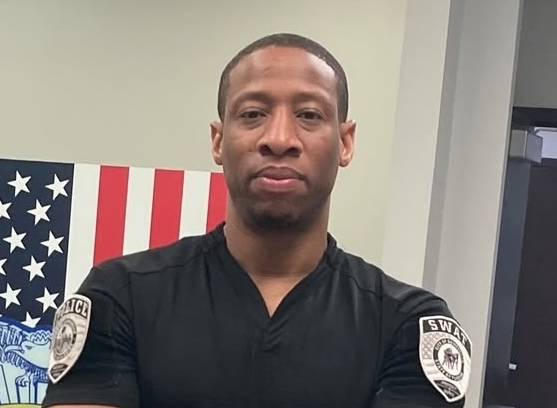
Mattair began working for GPD as a civilian at the Reichert House in 2018, and he became a sworn officer in 2021; at the time of the investigation, he was a member of GPD’s SWAT team and was a Detective assigned to the Gun Violence Unit.
Tipping off a drug dealer
In August 2025, GPD received a tip from Crime Stoppers about a convicted drug dealer who had just gotten out of prison and was still allegedly selling drugs and carrying guns. The tip said he was driving a red Hyundai rental car and provided the tag number.
On September 8, 2025, GPD officers responded to a call about a domestic disturbance involving the drug dealer and his girlfriend; while at the scene, the girlfriend reportedly told an officer that “the cop from the Reichert House” had seen the drug dealer at the Oaks Mall and told him that GPD was looking for his red car. The conversation with the girlfriend was reportedly captured on the officer’s body-worn camera.
The FBI Agent reported that he interviewed the drug dealer, and the drug dealer said Mattair had approached him at the Oaks Mall and told him he needed to “stop what he was doing,” that he was “being looked at,” and that he needed to stop driving the red car. The drug dealer said he returned the rental car after that conversation. He said he knew Mattair from the neighborhood and had played sports with Mattair when he was younger; he also knew Mattair from the Reichert House.
Mattair has been charged with disclosure of confidential criminal justice information, based on the investigation into this incident.
Using law enforcement databases to help friends — first incident
The sworn complaint describes a video call between Mattair and a woman on September 10, 2026, in which the woman asked Mattair whether he had gotten her friend’s reckless driving ticket “thrown out.” Mattair reportedly told her that her friend should take the ticket to court, and he would talk to the officer before the court date; he said, “If [the officer] doesn’t show up, then…”
The woman also asked Mattair to look up information on her car, which had been towed; she said it wasn’t her car, but she makes the payments on it and ASO had arrested the man driving the car. She said, “I kinda figured it was ASO because they been following him.”
There was a long pause on the recording while Mattair typed on his laptop, and then he said, “Wait, wait, wait, wait, wait, wait. Why they been following him?… You know why.” Mattair told her he couldn’t see ASO’s reports, but he would help if he could; she said she knew he would.
The agent reported that Mattair then looked up the driver in the driver’s license database.
Mattair was charged with two felonies in connection with this incident: disclosure of confidential criminal justice information and improper access of law enforcement databases (such as looking up personal data for non-law enforcement reasons, personal curiosity, or harassment).
Using law enforcement databases to help friends — second incident
On September 17, 2026, Mattair reportedly received a call from a man about his arrest early that morning for driving under the influence; Mattair reportedly told him to fight it in court because “they have to have a valid reason to stop you.” While looking up the police report, Mattair reportedly said, “I’m about to look that [expletive] up now, ASO, 10-50, can’t stand [expletive referring to ASO], traffic stop”; the report notes that 10-50 is the code used by local law enforcement agencies for a traffic stop.
Mattair reportedly complained that the traffic report isn’t available yet, even though it had been about eight hours since the traffic stop, and then he said he was searching the CAD (911) calls and said, “These [expletive referring to ASO] say reckless driving.” He noted that the police report stated that the man who had been arrested had a previous DUI conviction from 2010.
Mattair reportedly read the arrest report out loud to the man and told him he was pulled over because his window tint appeared to be too dark. Mattair said, “Ok, so now, this where you can get ’em at, this is the only thing you can get ’em at, so based on this report, you failed the, um, test. So they said that the front driver’s side window tint was measured at 3%.” Mattair asked whether the man received a citation or a warning for the window tint and said that if they pulled him over for something and didn’t give him a warning or citation, “I say that’s the best way to fight this [expletive].”
Mattair also reportedly looked up the incident in LINX (a law enforcement sensitive database in which different law enforcement agencies share information with each other) and then told him to get a lawyer and fight it.
The next day, Mattair reportedly called the same man, said he was going to check something for him, and then told him the driver’s license database said he couldn’t drive; Mattair offered to schedule an appointment for him to get a hardship driving permit and then scheduled the appointment for him and told him the judge would want to know if he was showing progress.
Mattair then reportedly looked up information about DUI school; when the man said he thought someone had called the police on him, Mattair reportedly looked up the incident in CAD and said there was no caller and an officer just saw the window tint.
Mattair reportedly talked to the man about how he could get his case thrown out due to “fruit of the poisonous tree.” He told the man he was running his name in LINX, read off the names of the deputies on the traffic stop, and told the man to write down the names.
Mattair has been charged with two felonies in connection with this incident: disclosure of confidential criminal justice information and improper access of law enforcement databases (such as looking up personal data for non-law enforcement reasons, personal curiosity, or harassment).
Using law enforcement databases to help friends — third incident
On September 17, 2026, Mattair reportedly received a phone call from another man and said, “I’m looking you up right now, man.” Mattair read back the man’s criminal history, discussed it with the man, and suggested going to the State Attorney’s Office to file paperwork to get his criminal history expunged.
When the man said he was pulled over near his home, Mattair reportedly said, “[Expletive], why didn’t you call me?… Tell them that you were working or whatever, because your job ain’t going to pull no police report.” When the man said that he is wearing an ankle monitor “for drinking,” Mattair reportedly said, “Let me know if you need a reference or story or something. We’ll come up with a story.” When the man said he was “over the limit but not high,” Mattair said, “I’ve been knowing you for x number of years. [Expletive] can’t lose that job, man.”
The FBI agent reported that records show that Mattair conducted a National Crime Information Center (NCIC) criminal history check for a man who matched the information discussed during the call.
Mattair has been charged with two felonies in connection with this incident: disclosure of confidential criminal justice information and improper access of law enforcement databases (such as looking up personal data for non-law enforcement reasons, personal curiosity, or harassment).
Intercepting a conversation and disclosing the information obtained
On September 8, 2026, Mattair reportedly called another GPD officer to say that he had received a call from an employee at the Juvenile Detention Center (JDC), saying that a boy there was in solitary confinement and was not eating. The JDC reportedly let Mattair call the boy’s mother in front of him, and Mattair allegedly made a recording of the boy crying and talking to his mother; Mattair then allegedly called the same GPD officer, held the phone with the recording up to his work phone, and played the recording for the other officer. The FBI agent was able to match information from that call to an individual who was in custody at that time.
Mattair has been charged with illegal interception of oral communication in connection with this incident.
Criminal history and bail
Mattair’s only criminal convictions are for traffic offenses in 2005 and 2008, but in 2004, a sworn complaint was filed that charged him with throwing a deadly missile into an occupied vehicle; the charge was reduced to misdemeanor property damage and then dropped with the notation, “NO INFO DEFENDANT ENTERING MILITARY.” In 2008, he was arrested for tampering with evidence, but the charge was later dropped with the notation that there was insufficient evidence.
Bail was set at $600,000 ($75,000 per charge) in the arrest warrant, and Judge Meshon Rawls affirmed that at Mattair’s First Appearance hearing this morning. He is also required to relinquish his passport before he is released from the jail.
On October 5, Mattair’s attorneys filed a motion for bond reduction, and on October 8, Judge James Colaw reduced his bail to $200,000 ($25,000 per charge); release conditions include a GPS monitor, prohibitions on possessing firearms and consuming or possessing alcohol or illegal drugs, and relinquishing his passport, if he has one. Mattair, who had been held in Levy County before he was returned to Alachua County for the bond hearing, has been released from the Alachua County Jail.
FBI press conference
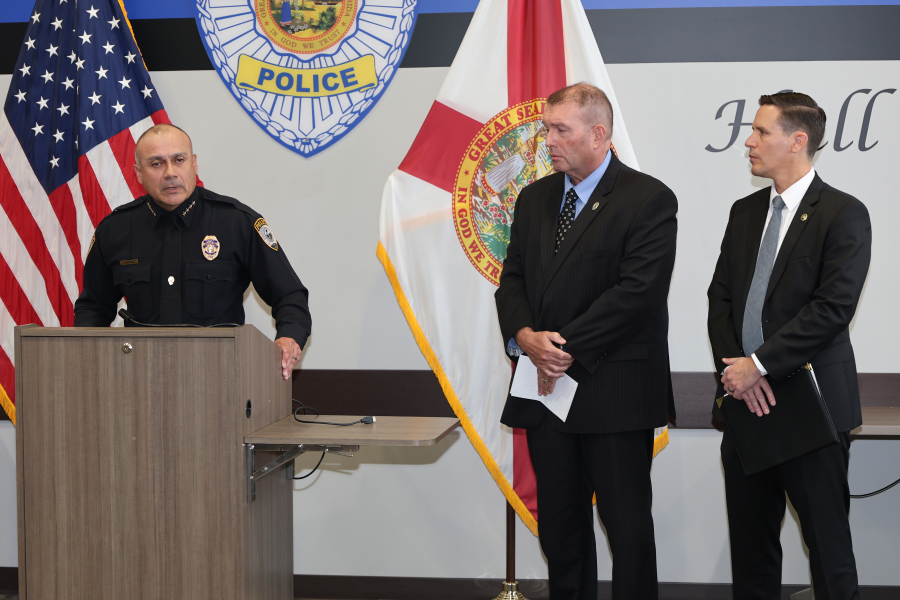
At a press conference this morning, the speakers provided no additional information about the case, saying it still an active investigation. State Attorney Brian Kramer said, “I want to make one thing explicitly clear with regard to this situation: the Gainesville Police Department has not been under investigation in any way, shape, or form. This investigation was conducted by the FBI. It has been ongoing… I want to be clear that the Gainesville Police Department has been a partner in that investigation and has not been subjected to a federal investigation.”
Special Agent in Charge of the Jacksonville FBI Office Daniel Dunn said, “The Detective is accused of using his position as a law enforcement officer to provide sensitive law enforcement information to individuals involved in drug trafficking throughout the Gainesville area… We will not tolerate actions that compromise the safety and confidence that our communities place in us. It is something we take very seriously.”
Dunn continued, “We continue to investigate any other instances where we believe he has used his position to compromise other investigations. This investigation is about the alleged conduct of one individual. One individual’s actions do not define an entire law enforcement agency or the dedicated officers who have served alongside us every day… Ultimately, this case is about accountability and the responsibility that comes with wearing a badge. The public expects law enforcement officers to uphold the law and protect investigations they are entrusted to support. When allegations of criminal conduct arise, we follow the evidence and hold those individuals accountable. That accountability is part of what makes strong law enforcement partnerships work.”
GPD Chief Nelson Moya said, “It brings me no pleasure to stand here,… because trust is a thing that is earned and not assumed… And so, for an active officer, an active one of us, to remotely taint that or betray that is one that I hold very dearly in terms of what betrayal stands for, and so I am saddened, disappointed.”
Moya continued, “To our community, I would say, you know that we have shown up every day, and will continue to do so, with tenacity, with ethics. I beg of you to judge us based on our collaborative work that we have already showcased to our community. I ask you to allow the process to continue, and not to let the actions of one define the moral fortitude of the rest of us.”
Speaking to his officers, he said, “I have complete faith in all of you, and what you bring to the table, and how you show up every day, and the work and ethics by which you do your job. Now that is a mandate, so it is, however, an expectation. But you show up to that every day, and you showcase it above and beyond what I’ve seen in many other places. So I want to thank you, and I want to encourage you that despite this one tough day, we will be ready for the next case, the next call that will come as we speak. So as we hurt in this moment, let that hurt mean something, because it is a reminder to us what our oath actually stands for, and ultimately what the betrayal of that oath results in. This here today. So show up. Do your job. We care for you. We support you. Take care of our community. Take care of your oath and your badge, like we’re always watching.”
Articles about arrests are based on reports from law enforcement agencies. The charges listed are taken from the arrest report and/or court records and are only accusations. All suspects are innocent until proven guilty in a court of law.
The irony that cross-eyed Kash Patel’s FBI is supposedly working to root out corruption in government…. FBI agents didn’t need to travel 775 miles from Washington D.C. to find it.
Another prime example why citizens refuse to accept dragnet surveillance like Flock and all other ALPR’s. The trust has been broken at all levels of governance.
I’m glad the FBI came to our rescue. Major corruption going on here. Trying to help someone out of a reckless driving and get them a hardship license. Telling someone to stop selling drugs. Trying to help someone from losing their job. Terrible, terrible person. I know what he did was wrong but he seemed to just be helping out his friends and community. He doesn’t appear to be profiting from it. The real corruption lies within local politicians. Mis-appropriating tax dollars and allowing the city to become a homeless haven. I guess they don’t remember Danny Rolling.
Nelson Moya should be on the Gator cheerleading team. I don’t believe for one moment that they didn’t know about the shenanigans going on with this officer Detective There’s no traffic enforcement in Gainesville bicycle accidents are rampant because of out of control drivers with four deaths already this year. Moya is a embarrassing disgrace to law enforcement. Moya should resign for the best interest of the citizens of Gainesville.
Unfortunely this situation only scratches the surface of corruption in Gainesville and across the country. GPD and ASO have had their fair share of badge abuse over the years. Patrol officers raping midtown girls and getting sexual favors from the nasty prostitutes. Good Ole Boy politics, theft of pay, unauthorized illegal investigations. Law enforcement used to be a career investment but has turned into a paycheck with a gun until the next opportunity opens. Unchecked logging of flock cameras and databases have led to illegal profits and gains for law enforcement and other officials.
Replying to Savage:
“Mattair reportedly talked to the man about how he could get his case thrown out due to “fruit of the poisonous tree.” He told the man he was running his name in LINX, read off the names of the deputies on the traffic stop, and told the man to write down the names.”
—Does that sound like he’s trying to help innocent neighborhood victims or does that sound like he’s working for his hood conglomerate?
Remember folks, when the city of Gainesville declares a state of emergency and disarms you, guys like this will still be armed.
Wrong is wrong but I Pray that GOD gives him a second at Life. Thankfully he’s not out here killing or beating people up. My Prayers are with him and I’m sure he has learned from his mistakes.
You can take a kid out of the ghetto, but sometimes you can’t take the ghetto out of the kid looking back on his history he’s never been hired to start with. He’s definitely disgrace to the badge and uniform, and may he serve a very long time in prison.
Savage, they remember Danny Rolling. This community only care about imagery; So much corrupt action happens behind the scenes. I am surprised he’s the only officer being investigated. GPD has been corrupt for years and even more so now that we hired all those new jockeys. They lie about simple things. More to fall keep watching. Only black officers currently. I am not surprised! Fire all of them and hire new officers and new swat members.
I hope the “eastsiders” are happy with their neighborhoods, knowing a SJW druggie sympathizer was on the inside working for them.
ACLUSPLCDNC Party approved this message 👺👹🤡👿💩
Because he’s a bad cop that got caught, Every criminal case that resulted in a conviction that he was involved in is now tainted and can be reopened which is very costly…
“Fruit of the poisonous tree”…
they will probably drop his charges if he resigns…they protect their own…
Nothing worse than a bad cop.
He isn’t the first one. Several years ago, a GPD officer lent her department issued to known drug dealers to monitor the police whilst they conducted pharmaceutical sales. Keep digging
Moya, you’ll find a few more.
I support our police. When you have hundreds of employees some will end up being bad. I’m glad he was identified and charged.
Is timeline from new officer 2021 to detective 2026 in less than five years common?
Invitado: it’s not uncommon when you have DEI hiring practices… the city hired a conman to do arbitration for them, and the guy was not a lawyer! …the story was here in the AC…the fake lawyer was a DEI hire…
This happens everywhere even in prison systems everywhere there is more than we know and more than will ever be exposed I’m just glad one down a million to go
Comment
Question: Why is he not being held in an adjacent county’s jail? I could see some real problems with him in such close proximity to fellow drug dealers on the pod not to mention his personal safety. Just curious.
He has been moved to Levy County.
Looks like he was helping his homeboys to make better decisions, or go back to prison. Also, coaching on how to challenge questionable tickets is not FBI worthy. ASO or FDLE could have cleared this up. Pretty much standard fair to lean on family and friends in Law Enforcement to provide guidance on such issues. Seems like a big NOTHING burger.
Boy Anthony you sure are a forgiving nothing Burger of thoughts and views. You’re the very kind of people that are running the corrupt law enforcement in Gainesville.
I totally agree!!
Frustrated Eastsider, I’m not. I’m just saying, suspend or fire him for violating policy, inappropriate use of LEO database. But this notion of some sort of El Chappo style operative is not matching the descriptive of what he’s done. It appears he did what a lot of officers do in helping family and friends with tickets and citations. Also, the telling your homebody to get out the trade or go back to prison, just sounds like he was being helpful. But I DON’T KNOW, he will have to have his say in court.
Comment
👍Thanks Jen.
I know Nelson Moya isn’t feigning moral indignation the Palm Bay police chief lawsuit king for quashing IA complaints and unlawful arrests and a death. I read the charging documents, the man accessed the computers for traffic tickets and tows. He should have been calling the FBI for himself as well.