
Gainesville City Commission hears update on City Manager search, discusses surplus lots and fencing around sidewalk cafes
BY JENNIFER CABRERA
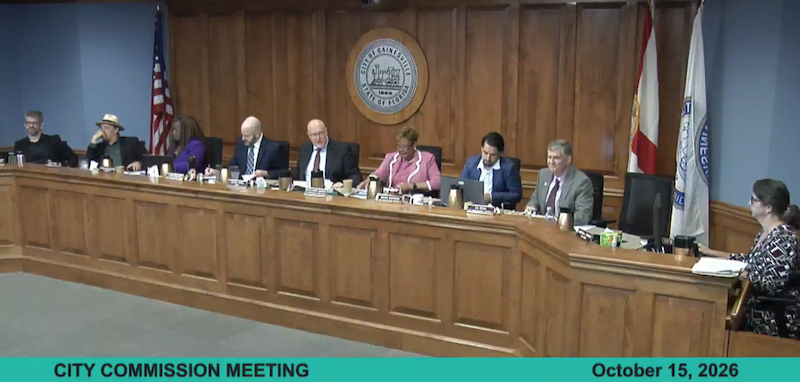
GAINESVILLE, Fla. – At the October 15 meeting, the Gainesville City Commission discussed surplus lots, established a program that reduces rent for City properties if tenants hold downtown events, heard an update on the City Manager search, and discussed limiting fencing around sidewalk cafes.
RFP for the disposition of six surplus lots
During the morning session, Commissioners considered a Request For Proposals (RFP) for the disposition of six surplus lots, ranging in size from 0.11 to 0.17 acres, primarily in the NW 5th Avenue area.
Commissioner Desmon Duncan-Walker said that “in the interest of resilient communities,” she was interested in “making sure that the parcels… are able to be returned to those individuals who previously lived there, who want the opportunity to come back.” She referred to her previous request for an Equitable Development plan but said she was “steering away from the name of it because we have to be mindful of how we use certain terms. But at the end of the day, it deals with community resilience.” She said that such a plan would “mindfully ensure” that “people who deserve an opportunity to come back to the urban core” can return to these neighborhoods. She said this should be the “foundation that… should be part of what we, as a Commission, focus on.”
Commissioner Ed Book asked how community engagement would be incorporated into the RFP process, and staff said community engagement was not part of the RFP, but it could be incorporated into the evaluation of the responses.
Commissioner Cynthia Chestnut said she wanted to see the community engagement plan before approving the RFP: “The whole 5th Avenue area has been displaced and moved out and moved on, and is turning into a student apartment area, losing its historic value. So I think we have to take some special precautions here as we look to developing it.” Staff later clarified that the properties are not in a historic district, but some of the parcels are in the Community Redevelopment Area (CRA).
Duncan-Walker said, “The displacement of the families that lived in Seminary Lane still has impact,… [and] we have an opportunity to make something right… And this was really why I came forward with the Equitable Development plan; it was keeping communities like this in mind, and we had to shift because of some things that we had to respond to at the state level.” She asked about the progress the City had made on “a resilience plan.”
Equal Opportunity Director Zeriah Folston said staff is not currently working on the plan because “we haven’t gotten any direction from the Commission… to move forward with anything in that space.”
Duncan-Walker said, “I am in support of using these lots in a way that will create access to the people who need it the most, and I think you do that by being very, very intentional.”
Duncan-Walker made a motion to bring back a robust community engagement process prior to engaging in the RFP. Chestnut seconded the motion.
Interim City Manager Andrew Persons asked if he could bring the engagement plan individually to Commissioners, and “once we have consensus,” bring back the RFP with the plan to the Commission for approval instead of doing it in two steps.
The motion passed unanimously.
Marketing contract with Colliers Florida International
Next, the board unanimously authorized staff to negotiate a contract with Colliers Florida International for the marketing, disposition, leasing, and sale of City-owned property within the Cornerstone development on SE Hawthorne Road, with a maximum commission of 6% of the total sales price or lease value.
City Manager search
In the afternoon session, Human Resources Director Laura Graetz gave an update on the City Manager recruitment process and said her department had looked at 16 executive search firms, specifically looking at their expertise in recruiting managers for Florida cities. She said four firms had the desired experience, and from that group, they selected Renee Narloch and Associates at a flat rate of $32,950, with an additional $10,000 allocated for travel and incidental expenses for the candidates. She said the next step is for Commissioners to meet individually with representatives from the firm about the characteristics of their ideal candidate, and then the firm will develop a recruitment brochure and begin the process. The position would be advertised for at least 30 days, and interviews will likely happen in January, with selection of a candidate in February.
Duncan-Walker asked why the City is not doing a national search, and Graetz said they are doing a national search; they just wanted the firms to have experience with recruiting for Florida cities.
Commissioner Bryan Eastman was concerned about bringing in someone new to develop next year’s budget if Amendment 3 passes: “It would be a uniquely hard time to come into a City, learn the City, make decisions, make a budget.” He said next year’s budget might be “one of the most difficult things that a City Manager has done here, maybe in… known history.” He asked whether Commissioners could decide in early November to make the Interim City Manager permanent instead of conducting the search, and Graetz said that would depend on the terms of the contract, which was still being negotiated.
Chestnut said, “If Amendment 3 fails, I think it will still come back in another form, so we need to be prepared.”
Mayor Harvey Ward: “I will tell you, as I have before, that I think we’re throwing away money here. I don’t think we should do a search.”
Mayor Harvey Ward said, “I will tell you, as I have before, that I think we’re throwing away money here. I don’t think we should do a search… Gainesville is unique within Florida… But we’ll go spend the money, and we’ll see… where it all goes.” He said the recommendation for the agenda item was just to hear the update, so he moved on to the next agenda item without any motions.
Arts, Cultural and Entertainment District Leasing Program
The board also unanimously adopted a resolution creating an Arts, Cultural and Entertainment District Leasing Program. Interim Sustainable Development Director Ralph Hilliard said the purpose of the program is “to encourage more activity downtown that will support the businesses downtown.” The program allows tenants in City-owned buildings to reduce their rent if they hold five “qualifying public events” that bring at least 250 people into the downtown area; those events can be held in the leased space or in places like Bo Diddley Park, the Streatery, or Depot Park, and they have to be open to the public but can charge a fee.
Hilliard said, “This is not an entitlement program; they still have to pay all their [event] fees. They still would have to get the services, security, all of those different things.” He said the City hopes the program will reduce requests for discounts on rent.
Hilliard said the City would establish the market rent for these tenants, and if they hold five events, they would get a 50% rent reduction in the first year. They would pay about 75% of the market rent in the second and third years, and then the program would end. He said, “So it does two things: it encourages… activities downtown, and it provides those businesses some relief… during the development years of their business, so… after three years, they can… stand on their own.” He said there are remedies if the businesses do not hold events as promised.
Property tax exemption for improvements to the Gainesville Lodge
Commissioners unanimously approved an ad valorem tax exemption for historic properties for the property at 413 W. University Avenue, commonly known as the Gainesville Lodge, on first reading. The exemption only applies to certain improvements, beginning January 1, 2027, and continuing for 10 years.
Fencing around sidewalk cafes
During Commission Comment, Eastman said he’d heard complaints about fenced-in areas outside businesses at the Streatery, and after some discussion about the City’s sidewalk cafe permit ordinance, he made a motion to ask staff to bring back an ordinance change to remove temporary fencing from sidewalk cafe permits. Commissioner Casey Willits seconded the motion.
During discussion of the motion, Interim Chief Operating Officer Brian Singleton said that when the Streatery framework was established, the Commission approved a regulation that allows sidewalk cafes to extend 27 feet from the front of the building.
Willits said he didn’t mind if businesses put tables out to 27 feet, particularly during a special event, but he agreed with Eastman that the area should not be fenced except for events.
Singleton said the ordinance currently allows fencing, planters, and any other movable barriers, but there has to be six feet of pedestrian clearance for the barriers to remain overnight.
Book said he wanted to hear feedback from the businesses and advisory boards before making a decision.
Eastman amended his motion to ask staff to come back with options for updating the sidewalk cafe permit ordinance, and Willits agreed. The motion passed unanimously.
Regulations for delivery trucks and rideshares
Ward said he was working on ideas for regulations for delivery trucks, and “I don’t know a single city that has effectively solved this, but I think it’s something we need to consider… I will be asking you all to direct staff to think about this more, at some point in the not-too-distant future, but I’m not quite there yet. I just want to let you know what’s on my mind.” He said rideshare issues also should be looked at.
Click here for our article on the evening session of this meeting.
The reason the cafes have to put up fencing is to try and stave off the hordes of drug-addicted homeless people from harassing their few remaining customers.
.
The City Commission created the problem by intentionally bringing in out of area homeless people for money laundering of taxpayer dollars, destroying the area with their stupid “Streatery” idea, and now they are even trying to prevent businesses from defending themselves. Who wants to eat outside with homeless people eating off your plate?
Fix. The. Roads.
The city can do whatever it wants downtown, I’ll never go there. I’m happy to drive an hour to Avondale in Jacksonville. Pedestrian friendly, dog friendly, outside restaurant seating, free on-street parking, and zero bums. I know the commissioners don’t understand my last two points.
To Gainesville Dad,
Please stop it – it’s ridiculous.
Comment
Nostalgia is commendable but not practicasl. Anyone that left the 5th Ave area long ago now wants to return? Really? I have seen blight in that area for 30 years. Most of NE and SE Gainesville is crime ridden and not a good investment. The students are coming in and somewhat elevagting it so let the market work. Nostalgia for this area, like a 100 yo+ elevator at the Hippodrome are not a good investment. Learn to manage money (( that is not yours’ ) more responsibly.
So the business’ on the “Streatery” are allowed to make their service area as big as they want ? I had to walk thru the Capones area at SW 1 st. Ave and Main which as I see they are way outside of the original sidewalk area adding many tables and fire pits already though Iv’e seen to business there this past year.
More stupid micromanagement from the Left. They brought the bums here and now who wants to go downtown to be harassed by your bums? Good luck to the Streatery businesses trying to make a living.
Little fences make it harder to run into a building when being attacked by a city encouraged drunk or homeless person or both. Fix the damn schools. Roofs, a/c, heat.
The Fifth Ave. historically African American neighborhood suffered Black Flight due to integration, race riots, and public housing. The race riots burned properties, making it less investment worthy. Integration allowed middle class Blacks to leave. Then the Housing Authority built nice modern brick subsidized apartments— which tenants subsequently neglected, and had to be torn down.
Student apartments pay much more property taxes. The city should stop crying about Amendment 3.