
Gainesville City Commission names Ed Book as Mayor Pro Tem, asks for more information on automated parking enforcement
BY JENNIFER CABRERA
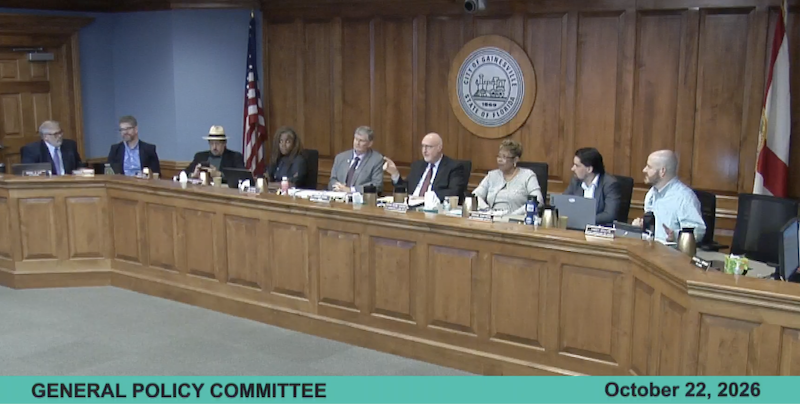
GAINESVILLE, Fla. – At the October 22 General Policy Committee meeting, the Gainesville City Commission named Ed Book as Mayor Pro Tem and asked staff for more information about an automated parking enforcement system.
Commissioner Willits steps down as Mayor Pro Tem, nominates Book
At the beginning of the meeting, Mayor Harvey Ward announced that he would have to leave at 2:30, so he asked to move Commission Comment to the beginning of the meeting, and the other Commissioners agreed.
During Commission Comment, Commissioner Casey Willits said, “I have a few things coming up in the next couple of months [that will] take a little bit of my time. Definitely some home repair, probably some tooth repair… If this Commission is amenable, I would like to step down from being the Mayor Pro Tem, and I would like to nominate Commissioner Ed Book to fill out the rest of his term as Mayor Pro Tem.” Book did not run for re-election and will step down in early January.
Ward said, “I love the idea.” He asked when that should be effective, and Willits said he wanted it to be effective immediately. Book said, “I’m very honored that you would even consider that, so thank you.” The motion passed unanimously, and Book moved to the Mayor Pro Tem chair.
Automated parking enforcement devices
Debbie Leistner from the Transportation Department spoke about an automated parking enforcement system that had been piloted earlier this year. She said the City’s Parking Enforcement team is small, and it patrols an area of about 1.5 square miles, generally around UF and downtown. She said, “The number of parking spaces on-street are scarce, and there are a lot of infractions, and we’re not able to effectively provide coverage.”
She continued, “Safety violations are a primary concern because they create blockages to bike lanes and crossings. They force people into travel lanes, causing potential conflicts. They affect the operation of some transit routes and block access to transit stops, also forcing people into traffic. Emergency access is also a problem in loading zones, as well, because if a vehicle is taking that space, then a large vehicle has to double-park.”
She said people often park in bike lanes, block access to crosswalks, or park on the street on narrow roads where parking is not permitted, preventing buses from using those roads.
During the pilot program, 48% of the violations occurred outside of normal enforcement hours, and 41% occurred on the weekends.

For the pilot program, the City selected the SafetyStick system with a bollard that contains a camera and radar; it takes a photograph of the tag of a vehicle parked in a location where there is a clear parking prohibition, as opposed to an area where permits are required. For example, it could be used in a tow-away zone. The photo is reviewed by a Parking Enforcement Officer and entered into the City’s regular system for violations. The pilot program included four devices at three locations: one at a bus stop, one at a loading zone, and one at a bike lane. No citations were issued during the pilot program.
Leistner said that no other cities in Florida use this type of device, but the City of Albuquerque uses about 158 of these devices. She said staff estimated that each device would generate about $3,000 per year; the vendor supplies the devices, there is no installation cost, and the revenue is shared with the vendor. Leistner said the pilot program did not cost the City anything.
A typical citation would be $34, with a cost-share model of 60/40 (City/vendor) for citations issued or 50/50 for the amount collected. Passport charges a fee of $4.90 to process each citation.
Leistner said staff recommended deploying some units, integrating them with the Passport parking app for citation payments and appeals, testing how the system works by issuing citations, and reporting back to the City Commission. She said an ordinance amendment would be necessary to allow citations to be sent by mail instead of being placed on the windshield of the vehicle.
Ward asked for clarification that the bollards would only be used “in unsafe spaces that are blocking things, and that sort of thing,” and Leistner said that was correct. Commissioner James Ingle asked whether the devices would be used in cases where people pay for parking but don’t leave when the time is up, and Leistner said it would only be in areas where parking is prohibited.
Ingle also asked Leistner to confirm that all of the enforcement is handled in-house and the photos are not transmitted to third parties, and she said there would be provisions in the contract to ensure that.
A vehicle can be towed if five unpaid citations are accumulated
Leistner said that if someone doesn’t pay a citation within 30 days, there is an escalation fee of $16, and if they accumulate three or more unpaid citations over 30 days, the vehicle can be booted; if they accumulate five or more unpaid citations over 30 days, the vehicle can be towed. She said the citations cannot be converted to a moving violation or result in points on a driver’s license.
Leistner said the City issued almost 25,000 parking citations (issued by Parking Enforcement Officers) in Fiscal Year 2026; the City collected about $790,000, and $175,000 is unpaid.
Commissioner Ed Book: “We’re talking about basically towaway zone types of areas for this parking enforcement: a bike lane, a sidewalk, a fire hydrant, or something like that.”
Book said it’s important to differentiate between this system, which takes still photos of vehicles that are parked illegally, and “other camera systems and technology that have been in the media for the last year… We’re talking about basically towaway zone types of areas for this parking enforcement: a bike lane, a sidewalk, a fire hydrant, or something like that.” He asked who would have access to the data, and Leistner said it would be available to the Parking Enforcement Officers and would be housed on the Passport platform.
City Attorney Daniel Nee: “I don’t know anything about this yet. This is relatively new.”
Book asked City Attorney Daniel Nee if he had any concerns with the system, and Nee said, “I don’t know anything about this yet. This is relatively new… I don’t even know if you can issue a citation by mail… Statutes contemplate putting citations on windshields, not delivering them through the mail. Whether we can send out 50% of the fine to a private vendor is also something I’m not sure of. But those are things we’ll look into. That’s the next step in this process.”
In response to a question from Willits, Leistner said the City would have the flexibility to move the units to different locations as needs change.
Ward asked if anyone wanted to make a motion, and there was a long pause, so he said, “Let the record show that we are comfortable with the current situation.”
Commissioner Bryan Eastman said he was willing to explore the program, but he had concerns about being the first Florida city to use it and whether there are any statutory issues.
Interim City Manager Andrew Persons said he was looking for direction on whether to move forward with exploring the various issues. He said the next step would be working with the City Attorney and bringing information back to the Commission before drafting an ordinance.
Motion
Eastman made a motion to “direct staff in the City Attorney’s Office to review the — legal, financial — to review the automated parking enforcement devices and come back with analysis about implementation at that point.”
Commissioner Cynthia Chestnut said she didn’t think they had “enough information to say to staff to proceed in any direction,… so I would be voting against it.”
The motion passed 5-2, with Chestnut and Willits in dissent.
Safety Stick = Flock in disguise. People may go off the chain again.
Availability of public parking, particularly for the handicapped and elderly, around UF and downtown, is awful.
Evidently, GNV is more concerned about how to use “high-tech” to reap additional benefits from parking fines than better accomodate its senior citizens.
They seriously need to know that at least 14 percent of the county does not have a cell phone. An even higher percent don’t understand “apps.”
These people have a right to go down town. Most of all they have a right to speak to their political leaders and those who work for the government.
You take that right away when you rely on technology.
Why should any of us have to pay to use these services? These people work for us.
Comment
Where did you get your statistics? I’m very curious – enlighten us (if they are true that is).
I hate illegal parkers, too, even if most are clueless tourists and new residents. If the city grosses over $500,000 in fines paid per year, how may parking staff would that cover? I mean meter maids who can be more out there to put tickets on those cars parked in the most egregious spots?
Then compare that to how much more the City would net if increasing the number of tickets using the stick system.
It needs to be posted the exact times those downtown paid parking spots are free. Now I see the States Attorney’s parking lot is posted for “Tenants Only” what exactly does that mean ?
You can google just as easy I can.
Regardless of the statistic: Right or wrong.
None of us should have to pay to play when it comes to using government services or speaking to our politicians at a meeting.
None of us should not be able to do this because of a technical, financial, or knowledge gap.
CONGRATULATIONS to Ed Book!
THE Adult in the Room!
PARKING Another good reason not to go to the dangerous for old people and disabled downtown Eastside businesses. Spend the money on security.
Comment because there is so much readily available parking, bad when i was an undergrad almost fifty years ago, same or worse now, how bout some more parking slots and dang near a million bucks in fines, wow
Good luck getting people to frequent the businesses downtown by adding parking
restrictions and hassels. More BS for the potential patrons won’t increase these businesses chances of making payroll. The so called Streatery can’t survive with bums and homeless and with parking hassles you can forgetaboutit.
👁️
There is a new government fraud hotline where you can get 1% of recovering fraud and Corruption money. The website is fraud.gov. if you have knowledge of PPP funds or arpa funds being used corruptly in city or County Government, you can receive 1% from what the government can retrieve from the fraud.
The parking problem is inevitable and will get worse due to policies enabling high rise development without parking. We are living in fantasy land when we claim students will not bring a car when living off campus…unless we hammer them for illegal parking. I say hammer those who illegally park but employ people not technology to do the job, employees with benefits and retirement.
Yet another reason to avoid downtown. Sigh.