
GRU Authority discusses legal victory, gives Bielarski a 3% raise
BY JENNIFER CABRERA
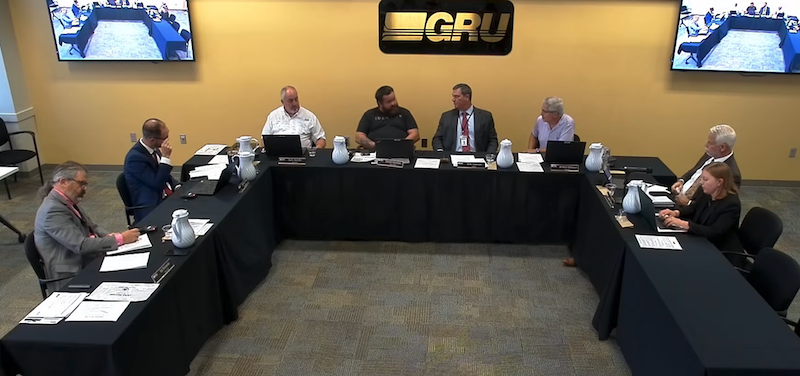
GAINESVILLE, Fla. – At the October 14 GRU Authority meeting, the board discussed their recent victory in the 1st District Court of Appeal and gave CEO Ed Bielarski a 3% raise.
Chair Comments and Director Comments
During Chair Comments, Chair Eric Lawson congratulated the legal team and GRU’s leadership “for your hard-fought, well-developed arguments, and congratulations on the most recent court of appeals win… I’m excited about the future and about moving forward from here.”
During Director Comments, Director Jack Jacobs added his congratulations and said the decision was a “slam dunk,… nothing short of that. So I hope to see the City finally not waste any more taxpayer money going after any type of appeal, because it’s just a waste of the taxpayers’ money at this point.”
Responding to comments from Jim Konish about his term ending, Director Chip Skinner said, “I started this process before my term expired, sir, so I am aware. However, it is also legal that I stay on the board, basically as a surrogate, until someone is named or I am removed.”
CEO Comments

During CEO Comments, CEO Ed Bielarski showed three charts. The first one showed the average residential electric bills under the GRU Authority, projected bills under the City Commission’s 2021 resolution that laid out rate increases through 2027 (assuming the fuel surcharges would be the same since they respond to market conditions), and the Florida Municipal Electric Association’s (FMEA) average.
Bielarski explained that the 2024 data point shows the rates for FY2024, which were set by the City Commission before the Authority took over on October 1, 2023.
The chart shows that the GRU and projected City bills diverged in FY2025, with the current gap at $14 per month; in FY2024, GRU’s bill was $31 higher than the FMEA average, and now it’s about $12 higher. Bielarski added that the gap between GRU and the FMEA average may be even lower after other utilities’ rate changes are incorporated in the October report.
Bielarski also noted that the gap between the GRU and City lines represents $17 million in revenue that would have been collected from customers in that three-year period, but customers did not have to pay that because the Authority held rates flat.

The next chart shows the change in the basket of services (electric, water, wastewater, and gas) for multiple cities between October 2023 and October 2026; GRU’s bill for the basket of services has decreased $12 since October 1, 2023, while all the other utilities except one have increased (Pensacola was flat), with two increasing by $62 per month.
Bielarski said, “You hear some of the rhetoric that’s out there in the community: ‘You’re not reducing our rates!’ By comparison, we’re stellar. We’re the ones that are producing those numbers.”

The third slide showed the outstanding debt for the utility, and Bielarski said, “We’ve heard a lot about that: ‘Not really reducing debt.'” He said the debt is down almost $110 million dollars, which includes $120 million in new debt and $92 million in repaid debt. He said the utility is still on track to get to a $400 million reduction in debt over 10 years, more than the City Commission’s plan, which required rate increases through at least FY2027 to reduce debt by $300 million over 10 years.
Bielarski said to the board, “So — lower bills, lower basket-of-service bills, and lower debt. Congratulations, folks. You did a good job.”
Attorney Comments
During Attorney Comments, Scott Walker said he hopes the 1st DCA ruling ends the litigation, “and it’s my hope that we can get down to business.” He said the City’s options at this point are to file motions for a rehearing or for an en banc (entire panel) hearing. October 22 is the deadline for filing those motions. He said there could be an opportunity to ask the Florida Supreme Court to review the decision, but “they don’t just accept every case, so the options are somewhat limited at this point for the City.”
Kiersten Ballou said, “Ultimately, what we have learned is exactly what we have been saying, and to quote just briefly from the order,… ‘the rule is well settled: municipalities may enact ordinances only to the extent they are consistent with general or special laws enacted by the Legislature.’ That is the law. That has been the law. The 1st District has approved your understanding and our understanding of that well-settled law.”
GRU Attorney Derek Perry added, “I staked my career on this cause and moved up here and joined the team, and it’s been incredible… [I’m] just really grateful to have the opportunity to work with the Folds Walker team, as well as all the other attorneys, and the opportunity to serve the Authority and work with the staff of GRU.”
Bielarski said, “I think it is that moment in time where it would be really nice for General Government and GRU to acquiesce and move toward solidifying some of these business relationships in a way that assists customers and taxpayers of the City, and frankly, we’ve done a lot of that behind the scenes.”
GRU Review
Moving on to the GRU Review, Bielarski said the utility reduced the fuel adjustment charge to 45 mills on September 29, and they have a plan to get that down to zero by the end of the year. He said the Kelly plant, the utility’s cheapest source, is back online. Also, the billing cycle is now 30 or 31 days instead of varying between 27 and 34 days.
Regarding the utility’s IT agreement with the City, Bielarski said it’s “kind of stalled” because GRU cannot provide the services at a loss under HB 1645; he said the City has not transitioned away from GRU’s services as rapidly as they hoped, so GRU’s costs are higher than anticipated, and GRU is looking at a cost of $4.3 million dollars, while the City wants to pay $2.8 million. Bielarski said GRU will be “sending them bills based on that $4.3 million.”
Bielarski also pointed out that the City’s consultant said the City would save 25% to 40% a year by creating its own IT department, but “if you look at the chart, there’s not [a savings]. And as a taxpayer of the City, I’m disturbed by that.”

Bielarski said the utility’s vacancy rate is down to 7.76%, the lowest since 2020.
CEO performance evaluation and compensation
Outgoing Chief People Office Cheryl McBride said the Directors’ performance evaluations for Bielarski were “consistently positive… Overall, he was scored a 4.4 out of 5. The reviews highlighted strong strategic and operational leadership and also emphasized successful financial management, especially the bond issuance and GRU’s financial stability. A major strength identified is his leadership through significant organizational and political change. There were just two developmental areas identified: one being improved communication and public engagement, and the other, increasing the visibility of development of senior leadership. But no significant deficiencies were identified; those were just suggested developmental areas.”
Lawson suggested splitting the agenda item into separate discussions about Bielarski’s evaluation and the compensation study.
Jacobs said he would like to see Bielarski using Public Information professionals more “to get the message out about GRU and its accomplishments” so it won’t be “the CEO versus complainants” on social media.
Lawson agreed and said he was “extremely pleased with Ed’s performance and the outcomes that we’ve observed this year.” He mentioned “aggressively managing” both utility rates and debt, the litigation, and the vacancy rate. He said the Authority had given Bielarski the budgeted increase of 3% the previous year, and the same increase is budgeted for the coming year, so his recommendation was to “stay with a 3% merit increase.” He said that if they decided to do a compensation study, they could discuss a different salary at a future time.
Director David Haslam said, “What [Bielarski] does is extremely hard. There’s a lot of CEOs… that don’t have the public scrutiny that Ed has.” He said Bielarski is always available to answer his questions and agreed with Lawson that Bielarski “easily deserves” the 3% increase.
Jacobs agreed that he didn’t see any reason to give Bielarski a different raise from the other employees, so he “would be agreeable for the 3%.”
Moving on to the compensation study, Lawson said it’s been six years since a compensation study was performed on Bielarski’s job, and the Authority just “took his salary when he left, and we rolled it forward 3% every year to when he was reemployed. That’s how we established his initial salary when he came back.”
Lawson recommended having an independent compensation study completed, and Jacobs agreed, saying GRU is doing compensation studies for all of its positions, one-third each year over the next three years, and he thought the CEO salary should be at the end of that process.
Skinner agreed with doing an independent study in the third year; McBride said the first year of the process is already complete, and the second group of positions will be evaluated in January. Lawson said that if the Directors want to wait until 2028 to consider a new salary for Bielarski (other than merit increases), they should probably wait until then to do the study. He suggested doing it “around the end of 2027, so that we’re ready for 2028.” Haslam said, “I’ll be here until September ’27. I’ll remember.”
Skinner made a motion to give Bielarski a 3% merit increase in his annual pay, Jacobs seconded the motion, and it passed unanimously.
General Public Comment
During General Public Comment, City of Gainesville Technology Director Ed Nagy said the City has already reduced some of the IT services they’re receiving, and they expect to decrease them more throughout the fiscal year. He had concerns about the portion of costs that is allocated to the City, along with paying for licenses for vacant positions; he said two of their internet circuits are priced well above market rates. He said the City sent GRU an agreement at $3.36 million that addressed many of the issues and said he hoped they could “move towards an agreement that both sides agree to.”
Haslam said he appreciated Nagy coming to talk to the Authority about the agreement, and Lawson asked Nagy to send information to the board by email.
Bielarski said he “didn’t want to get in a tit-for-tat here with Mr. Nagy,” but he disagreed with some of Nagy’s assertions and added, “We reduced [the price] last year based on a promise, and it didn’t happen… So, you know, these are not as simple as they’re coming across to be… There’s a little more behind the curtain than what you’re saying.”
Lawson thanked Nagy and adjourned the meeting.
If you want lower energy prices stop supporting the bastards in Congress that continue to support, without officially declaring, two unnecessary wars. Both of which continue to crush oil/gas and fertilizer supplies while simultaneously giving away resources that should be used here at home.
Why do we allow the White House, whether Biden or Trump, to unilaterally declare war. We’re gonna all get what we deserve if things don’t change!
GRUA and Bielarski are doing a good job. It’s nice to see GRU being managed responsibly once again.
Yes, it is. Dam nice to see the piggy bank gone. The mayor and city Council can’t get their greedy little hands on it.