
High Springs City Commission weighs options for police department
BY JESSE THOMAS FLETCHER
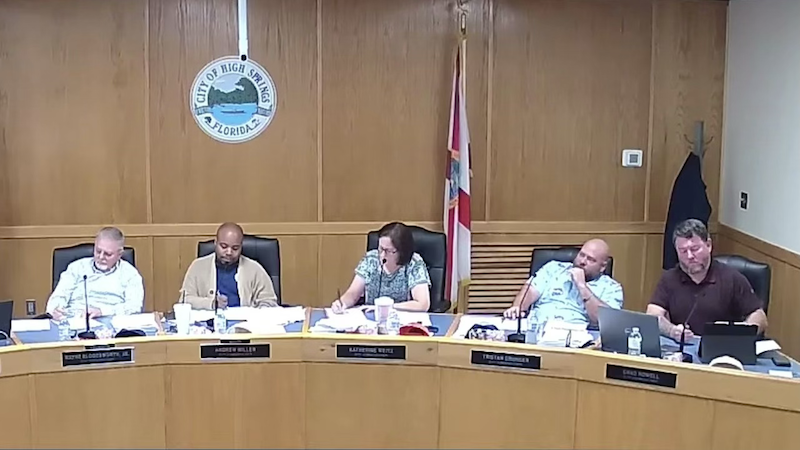
HIGH SPRINGS, Fla. – The High Springs City Commission voted unanimously on October 29 to continue exploring shared police services with neighboring cities and schedule a public meeting on the future of the police department.
On the same night, Commissioners voted 4-1 to approve a $215,000 water system planning agreement, an initial step toward a proposed project estimated at roughly $19 million to $20 million. Mayor Andrew Miller cast the dissenting vote.
Options for police services
Interim City Manager Jennifer Applebee said the 2026-27 budget fully funds the City’s public safety services, and staff recommended retaining those services while looking for additional revenue and possible savings, including sharing police resources with the City of Newberry.
Applebee said the police budget had already been reduced by 4.35% and could not be reduced further without risking litigation. She later acknowledged the City’s lack of reserves and financial difficulties but said she wanted to explore alternatives to eliminating the department.
“I cannot in good conscience direct you to get rid of an institution that’s been here 135 years,” Applebee said, her voice breaking.
Applebee said preliminary quotes for contracting police resources from the Alachua County Sheriff’s Office were $2.2 million for one dedicated deputy per shift or $4.4 million for two per shift. Officials clarified that those figures cover that level of staffing per shift, rather than the salaries of one or two individual deputies.
The Newberry discussion included potentially sharing the Police Chief and a detective, along with patrol resources. Officials cautioned that the arrangement could affect staffing in High Springs and would require further financial and legal review. No agreement was approved.
Vice Mayor Wayne Bloodsworth Jr. said the recommendation to retain the department conflicted with the choices the Commissioners had previously been given.
“It was either that or save the City,” Bloodsworth said of his earlier motion to eliminate the department. He supported another discussion to determine whether the City could keep the police department.
The unanimously adopted motion called for continued discussions with neighboring cities and a public meeting involving Commissioners, State Attorney Brian Kramer (see below), and the Police Chief.
Regulations on cuts to law enforcement
State Attorney Brian Kramer attended the meeting to clarify his position on budget cuts. Kramer said that a police budget reduction exceeding 5% does not automatically trigger a legal challenge.
Florida law allows the State Attorney or a member of the local municipal governing body to challenge a proposed reduction to law enforcement budgets exceeding the 5% threshold. Kramer said the law provides for a process rather than an outright prohibition on police budget cuts.
“My motivation isn’t to arbitrarily say you can’t change your budget under any set of circumstances,” Kramer said.
He supported a public meeting to review the City’s budget and discuss the best police services the community can afford. He compared the discussion to mediation before a legal dispute, with everyone able to review the information and explain their positions.
Kramer and City Attorney Kiersten Ballou also discussed competing interpretations of whether the law applies to eliminating an entire department. Neither offered a definitive answer on that question.
Cash flow concerns
Comments from Commissioners and the Interim City Manager prompted Finance Director Leslie Moyer to explain the City’s immediate cash flow situation.
Moyer said earlier concerns arose when the City had roughly $1 million in its checking account, more than $800,000 in outstanding contractor bills for one project, and over $500,000 owed for another project. Each month’s payroll requires about $150,000 to $175,000, with several payrolls due before substantial property tax receipts were expected.
The projects had previously operated on a reimbursement basis, requiring the City to pay the contractor bills and then wait for the State to reimburse the City. Moyer said a recent approval to wait for the grant money before paying the contractors had already relieved the major part of that pressure.
“We are not as dire as we were when I first brought the issue to you,” she said.
Moyer also said the annual budget funds all City services, but the timing of revenue leaves October and November particularly tight. Most property tax revenue arrives between December and March, she said.
“I have a whole year’s worth of budget, but I don’t have cash in the bank to pay the bills until the ad valorem revenue starts coming in,” Moyer said. “Cash flow is the biggest issue.”
Moyer cautioned that the City still lacks reserves for any major unexpected expenses.
Water planning
A 4-1 vote authorized the Interim City Manager to execute a task order for a water facilities improvement plan.
Engineer Mike New said the planning phase would cost $215,000, with half eligible for loan forgiveness, leaving a projected City cost of $107,500. The scope of work would be to update a plan prepared in 2021 that was never adopted.
New described a larger improvement project that could receive 50% loan forgiveness, with the balance financed at 0% interest over 20 years. The proposed improvements include a new well field, connecting water mains, and additional elevated water storage.
New said the City could stop after planning rather than commit immediately to construction. If the City stopped after planning, its share could be repaid over 10 years at 0% interest. Moyer said existing water rates could support that payment, roughly $10,800 annually.
Residents and Commissioners questioned whether the project would adequately address problems with older pipes and discolored water. New said the proposed plan would improve the system but would not replace every aging pipe or eliminate every dead end.
Miller dissented from the motion to approve the task order, opposing additional debt and the possibility of passing the cost to customers. New said a draft is due November 15.
Post office building
Commissioners voted 5-0 to retain ownership of the post office property and explore a lease with the U.S. Postal Service (USPS) when the current agreement ends in January 2027.
Ballou said the USPS would like to remain there. Staff will negotiate terms and bring a proposed agreement back for Commission review.
CRA approves roof and awning grants
At the Community Redevelopment Agency meeting earlier that evening, the board approved a $5,000 residential grant for Alice Brown to help replace her roof. Staff put the total project cost at $20,175.
The board also approved two commercial facade grants totaling $15,000 for a metal awning spanning two downtown storefronts. Staff estimated the combined project at $30,000.
CRA staff also reported a $17,911 County grant for farmers market improvements, including an entrance awning, signs, and marketing materials.
Other business
Commissioners voted 5-0 to approve an agreement with CPH Consulting for a vulnerability assessment funded entirely by a Resilient Florida grant. The study will examine flooding risks to infrastructure and help the City compete for future project funding.
The Commission also approved revised construction documents for Saddle Ridge Estates, a previously approved 30-lot subdivision, allowing the development to proceed in phases of 14 and 16 lots. The vote was 5-0.
Ballou confirmed near the meeting’s end that the election lawsuit discussed at prior meetings had concluded and no further legal fees were being incurred. The final invoice had not yet been completed. The City had authorized legal representation of City Clerk Angela Stone in the case brought by City Commission Candidate Ross Ambrose.
Again Shepoard needs to go. Joy also. He has his own business to run without doing it on city time. Sheppard is a problem for High Springs. His integrity and trustworthiness is questionable after stealing compensation. You can’t trust a thief to do the job of law and order.