
“We just tee up a bunch of things [for October 2027]”: Gainesville City Commission discusses post-SB180 code changes
BY JENNIFER CABRERA
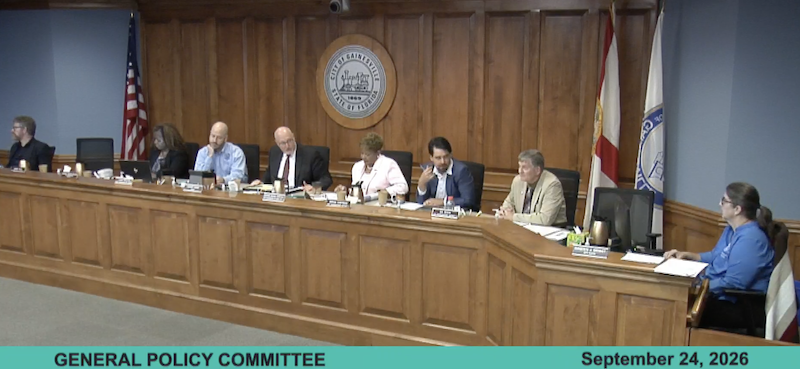
GAINESVILLE, Fla. – During the September 24 General Policy Committee meeting, the Gainesville City Commission discussed regulations for distances between bars and institutions such as schools and churches and also directed staff to start working on a fence height ordinance that is currently prohibited by SB180 but could take effect after October 2027.
Distances between bars and certain institutions
The first discussion item involved updating the City’s regulations on distances between bars and institutions such as schools and places of religious assembly. After an extensive discussion about which properties would potentially be affected, Commissioner Ed Book made a motion to authorize staff to engage the public and the City Plan Board regarding changing the required distance between schools and bars to 500 feet, to be consistent with state statutes; the motion also directed staff to update ordinances regarding bars to bring definitions and terminology up to date. The motion passed 6-0, with Commissioner James Ingle absent.
Commissioner Bryan Eastman made a motion to authorize staff to engage the public and the City Plan Board regarding the elimination of the 300-foot buffer between bars and places of religious assembly, along with an amendment to current distance separation requirements for residential zoning districts to exempt properties in the U9 and DT zoning districts. That motion also passed 6-0, with Ingle absent.
Fence height restrictions
Commissioners also discussed a 2025 proposal from Eastman to reduce maximum fence heights throughout the city to four feet in front yards and eight feet in back yards; the City cannot move forward with the regulations because SB180 prohibits municipalities from adopting restrictive or burdensome permitting rules for up to one year following hurricanes (currently viewed as expiring in October 2027).
Planner Ari Rabinovich said the goal of the discussion was to be “ready to act when the [SB180] restriction expires.” He summarized Gainesville’s current fence restrictions in the slide below.

Staff recommendation
Rabinovich said the staff recommendation was that after the SB180 restrictions expire, the City should initiate a land development code text amendment to Section 36.9, reducing maximum fence height to four feet within the front property setback, eight feet within the rear property setback, and six feet within the front setbacks of commercial and industrial uses, subject to further research and review on some open questions such as whether to have different rules for corner lots and dual lots.
Mayor Harvey Ward: “We’re in the free state of Florida; we are free to talk about what might be an interesting thing to do, but not actually direct staff to do it.”
Commissioner Casey Willits asked what Commissioners could do right now that would not violate SB180, and Mayor Harvey Ward said, “We’re in the free state of Florida; we are free to talk about what might be an interesting thing to do, but not actually direct staff to do it.”
Eastman asked how the City would bring existing fences into compliance, and Rabinovich said, “If it’s there and we change the code, it gets to stay… Now, if a hurricane comes and blows it down and they want to put it back, that’s a different story… You have to meet the requirements of the day.”
Commissioner Desmon Duncan-Walker asked whether hedges would be included in the restrictions, and Rabinovich said, “Walls are masonry, exclusively.”
Ward said, “There are very good uses for fences. There are also fences popping up around town… that are creating a more dangerous situation for everybody; it removes eyes on the street… It’s generally accepted that you want to be able to look out the front window of your house to see what’s going on outside your house, and we don’t have a way to regulate that right now.”
Motion
Eastman made a motion to ask staff to start the process, begin public engagement, and research the issues of protecting existing fences from retroactive enforcement, maintaining sightlines at corners, and allowing higher fences if they are more transparent.
Ward asked the City Attorney what the ramifications would be of passing that motion, and Eastman asked whether there was an issue with the staff recommendation.
City Attorney Daniel Nee answered, “I don’t understand the staff recommendation… [Does it] direct staff now to do something following the expiration [of SB180], or is the expectation that they would have some action now? If so, they’re directing something to be done more than a year from now?… It’s unusual.”
Commissioner Bryan Eastman: “So for me, it seems like, with SB180, we just tee up a bunch of things, we get everything prepared, and then we have a very busy October 7, 2027 meeting, with a lot of first and second readings.”
Eastman said, “I agree it’s unusual; SB 180 is also very unusual, Mr. Attorney. So for me, it seems like, with SB180, we just tee up a bunch of things, we get everything prepared, and then we have a very busy October 7, 2027 meeting, with a lot of first and second readings. I mean, if that’s the way we have to do things, that’s the way we have to do things, right?”
Eastman said it was also possible that the legislature would pass a “glitch bill” to resolve the issues with SB180: “We don’t know what’s going to happen, but we know that we can’t stop doing the work of the City and of our residents because the legislature passes odd bills that they don’t know what they’re passing or that have unintended consequences like this.”
Nee said, “You say that you may not want to stop doing the work of the people because the legislature tells you to stop, but that’s what they’re telling you.”
Ward said, “We’re asking staff to work on something,” and Eastman said, “Perfect.”
Ward said, “So a motion and second to ask staff to work on something for us and bring back information.”
Willits asked whether the Plan Board could “hear this” before October 2027, and Ward said, “Sure they could.” Nee said the Plan Board could have discussions about policy directions, but “not on a specific proposal.”
Commissioner Casey Willits: “We’re not proposing anything.”
Willits said he just wanted “to make sure that we’re under that same understanding, that we’re not proposing anything.” He added, “I hear the conversation about hedges, because if anyone can get a hedge to grow seven feet in their front yard, and hopefully not use a lot of water to make it happen — in general, we like that, you know, good greenery.”
Commissioner Cynthia Chestnut asked whether Eastman’s motion had included “a suggestion — since we can’t give direction — for public engagement,” and Eastman added “to include public engagement on the proposed changes” to his motion.
Book said he was uncomfortable with telling staff to get an ordinance “ready to rock” for late 2027; he preferred doing public engagement instead. He also supported adding safety and security exemptions to the fence height code.
Mayor Ward: “I don’t think they intended us to not be able to consider whether or not the community wants to do this, but here we are, and I’m sorry for being difficult about it, but I find this just absurd… I think we should be prepared for if and when it does change, right up to the letter of the law, what we are allowed to do, just in case.”
Ward said, “I do not have confidence that SB180 will change; I just don’t… Certainly, the Plan Board could study a model ordinance without taking action on that model ordinance.” He said he didn’t think the legislature ever intended to keep cities from changing fence heights: “I think they got stuck in an argument between Senate and House and just didn’t act. I don’t think they intended us to not be able to consider whether or not the community wants to do this, but here we are, and I’m sorry for being difficult about it, but I find this just absurd… I think we should be prepared for if and when it does change, right up to the letter of the law, what we are allowed to do, just in case. Because, man, if it changes, we’d better grab the moment before it changes again.”
Eastman’s motion passed 4-2, with Book and Duncan-Walker in dissent and Ingle absent.
Eastman made a second motion to direct staff to research safety and security exemptions from the fence height requirement, and the motion passed unanimously.
Ward concluded, “That was one of the weirder discussions we’ve had.”
Ward said, “We’re in the free state of Florida.”
That’s correct, Lardass!
The Free State of Florida refers to the state preventing you dictator-wannabe, human waste from lording over citizens as if we are peasants!
You’re describing our governor and state legislators perfectly!
The governor is THE one that prevented these parasites from locking freedom-loving Americans down like peasants during COVID! It’s the taxpayer screwing parasites that you government-needy thugs vote for that believe being elected gives them power to meddle in every aspect of our lives — other than killing babies and cutting off body parts! Thankfully, you are outnumbered in this great state! It’s the state legislature providing the citizens of Florida an opportunity to keep more of what WE EARN from these good for nothing, pieces of human waste!
Harvey ‘two-face’ says we’re ‘free to talk about what might be an interesting thing to do.’
Here’s an interesting idea: how about focusing on actual city issues instead of spending the next year ‘teeing up’ restrictions on four-foot fences for 2027? The Clown Commission wants to restrict front yard fences to four feet, but they’re spending hours trying to figure out how to bypass state law to do it? If they’re this obsessed with fences, maybe we can build one around City Hall, keep them enclosed, and call it a day.
Wait a second, they already have their private gestapo that protects them and City Hall from panhandlers and vagrants.
Hmmm. How can we circumvent state law to do what we want?
This pretty much sums it up….
“It’s generally accepted that you want to be able to look out the front window of your house to see what’s going on outside your house, and we don’t have a way to regulate that right now.”
No one needs the government to regulate this. If you want to do that, you can choose not to have an 8ft fence in front of your house.
What this lying POS Harvey Ward is really saying is that he wants OTHER people to be able to look INSIDE YOUR HOUSE and that’s why they want to reduce your fence size down to 4ft.
Did the GRACE Marketplace Mafia put Ward and Eastman up to this? Gonna make it easier for the homeless to find things to steal and people to victimize?
It’s impossible to hate these people enough.
Do none of them have gardens? 4 ft won’t keep deer out of your garden. Neither will 6 ft.
And those with ill intent wanting to access your yard will have an easier time with lower fences.
Why regulate fence height? People have different reasons for having a fence in the first place, and those reasons would call for different fence heights.
The FL State Building Code requires a permit for fences over 6-feet due to wind loads.
Well since they’ve ended homelessness, solved the affordable housing crisis, and have their brand spanking new bicycle plan that only took 22 years to create, they might as well get a head start on next years work, lol.
I actually Laughed out loud at this! Great response 😄