
‘We still, as a rule, don’t ask about immigration status’: City responds to demands to rescind General Order regarding ‘suspected unauthorized aliens’
BY JENNIFER CABRERA
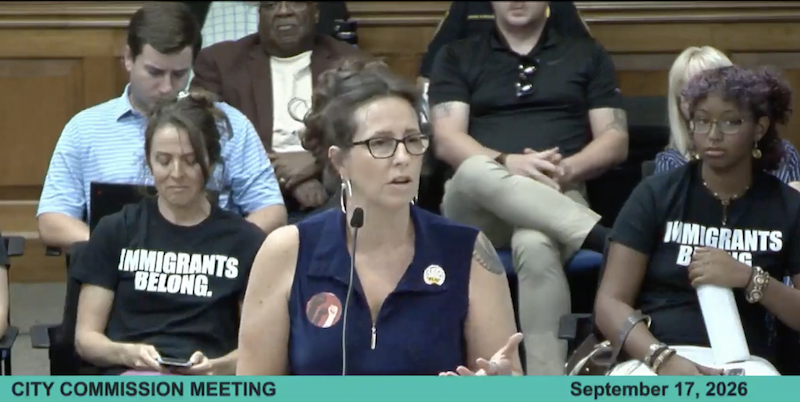
GAINESVILLE, Fla. – At a September 17 meeting, 19 people asked the Gainesville City Commission to rescind General Order 82.4, which requires officers to report contact with “suspected unauthorized aliens” to FDLE, and they were told that the rule is required by FDLE, but GPD will not be asking victims and witnesses for their immigration status.
During the General Public Comment period in the afternoon session, 19 people spoke about General Order 82.4, which was announced on August 27. The order requires an officer to complete an FDLE form (Suspected Unauthorized Alien Contact Form), upload a photo of the individual, and email the form to a GPD address by the end of the shift on the day of contact with a suspected unauthorized alien. The order also states that personal characteristics such as limited English proficiency are not sufficient to warrant an investigation, but if that person runs, for example, that “may contribute to reasonable suspicion.” Officers are permitted to conduct a consensual encounter to obtain additional information, whether or not there is reasonable suspicion that the person is in the country illegally.
The speakers characterized the order as a “Show me your papers” policy that is despotic, fascist, and part of a “racist terror campaign.”
“These are not optional”
After public comment, Interim City Manager Andrew Persons said, “Back in 2025, the state implemented some new statutory and administrative requirements… Rules were approved last year… that require daily and monthly reporting from local, county, and state agencies… These are not optional. That’s important. These are state-mandated obligations that all sworn personnel have to follow.” He said those requirements are not in Florida Statutes; they are in the Florida Administrative Code, Rules 11Q-2.002 and 11Q-2.006. He said GPD has not signed a 287(g) agreement, but “we do have to report now. Generally, our numbers have been zero or very, very low.”
However, the rules he cited are still in the rule-making process. The requirement to submit the forms is currently governed by an emergency rule, 11QER26-2.
“We still, as a rule, don’t ask about immigration status”
Persons continued, “We still, as a rule, don’t ask about immigration status… The policy is there to help provide guidelines and guardrails to implementing this mandatory requirement from the state.”
GPD Assistant Chief Efrain Torres said, “I think the concern here is that we’re going to go out into the community, and based on reasonable suspicion, we’re going to ask people their immigration status because we think they have a last name that’s Hispanic or they look Hispanic. I can assure you that is not the case.”
Torrew said that if an officer goes to a victim’s house to take a report, they’re not going to ask the victim about their immigration status: “That is definitely not something that we’re doing… We purposely did not sign that 287(g) because we understand that that is something that the community doesn’t want and because it was voluntary.”
GPD Major Jaime Kurnick said there have been only two reports since the policy was implemented, and she emphasized that they did not arise from proactive police work — one was from a traffic stop, and the other was a traffic crash.
Commissioner James Ingle said he wanted to set a date for “a very deep briefing” on the FDLE rules and the administrative code: “If there is any way to change this and make sure that people are being treated the way they should be, I think that is of paramount importance.”
Mayor Harvey Ward said, “I’m going to remind everyone that what comes out of Tallahassee is changeable in a couple of months.”
Torres also said that GPD uses the U visa program extensively: “If we have a victim of a crime, for example, that’s undocumented, the Chief can sign a U visa that authorizes that person to stay in the United States while the case is actively being investigated, and so it helps them get services that would otherwise not be available to people who are not U.S. citizens.” He said the program is used so victims “do not feel that they can’t come forward or cooperate with us.”
Commissioner Casey Willits said the order arose from “a very unclear policy sent down by an administrative board that is appointed.” He said the rule is “conveniently grayed-out” on the Florida Rules website (see the links above to the rules).
City Attorney Daniel Nee said the policy has been reviewed by GPD’s legal advisor. He added, “The reporting requirement is real; it’s not a choice by the City of Gainesville, and… that seems to be the heart of what you’re discussing here.”
Commissioners then moved on to the next topic.
“Show me your papers.” Democrats were pretty adamant about COVID vaccine papers. And also telling on your neighbors if they were in their own yard and not wearing masks. So they won’t get any sympathy from me with any of their garbage.
Covid hoax put everyone’s true colors on display. We saw exactly how many psychopathic authoritarians surround us.
To borrow a phase — Never Again
Except that here in the City of Gainesville and Alachua County, it would definitely happen again, as essentially the same people are running the City and County. The minority who saw what was happening would like resist harder, but the majority in control here would take as much freedom away from the citizens as possible. With the help of the same law enforcement officers who are required to tip toe around whether someone is in this country illegally now will have to respond to “neighbors” who report each other for make violations, ch and enforce curfews and lockdowns if another epidemic hits, if they want to keep their jobs. And they will be told they have to get mandated shots to keep their jobs. At least until saner voiced from Tallahassee prevail, and cases wind through the courts again. I have no doubt that if we allow Democrats to retain complete control of this city and county, we would see the same thing happen again
I don’t disagree with you but so long as enough people do not comply there isn’t much local government and local law enforcement can do. If we encounter another fraudulent plandemic mass non-compliance is the only way forward. I truly believe we have the numbers now…unlike 6 years ago.
The “hoax” data shows that those wo did not get vaccinated were 2.5 tiomes more likely to croak from Covid than those who did. Thank our MAGA overlords for that.
“A total of seven studies with 21,618,297 COVID-19 patients were included in the meta-analysis. The odds ratio (OR) for mortality among unvaccinated patients compared to vaccinated patients was 2.46 (95% CI: 1.71-3.53), indicating that unvaccinated patients were 2.46 times more likely to die from COVID-19.”
https://pmc.ncbi.nlm.nih.gov/articles/PMC10492612/
You must then be very grateful to Trump for his operation warp speed, I imagine?
“Hilarious! You type as if MAGA are the ones believing taxpayer-dependent, government trash are valued by the majority of this red state! That’s a figment of the imagination of you government-dependent/needy thugs! One day, you people will learn the citizens are waking up to how the government-dependent grift works! Makers losing interest in being slaves for the good-for-nothing, waste-of-breath grifters that are government trash is problematic for you thugs!
Nice call out for the hypocrites Beardy.
As for the idiots who want the rule rescinded, legal immigrants do belong—illegal immigrants need to go back to their own countries and fix what caused them to leave. They may even appreciate your assistance.
Many of the undocumented were born here, many in our military, and an asset to our country you have been led by your nose to hate for a horrible immigration system making it hard for us to legally get the people we desperately need for our economy and our future.
The GOP has been playing this tune for decades because the “issue” appeals to simple minded nativism.
It’s not a horrible immigration system. It’s a system that needs some revision and overhauling, but there is legislation and laws that govern our immigration policies. For you to naively state the military is somehow responsible for many of the ‘undocumented’ immigrants in this country is idiocy.
It’s obvious where your nose is.
“None are more simple-minded than those who believe what others earn should be stolen by good-for-nothing, taxpayer-dependent trash, e.g commissioners, paying for your pathetic lives! I look forward to the day you pathetic, entitled thugs run out of other people’s income! Yeah, I know you are a “contractor”; nothing like a leech cosplaying as a contractor!
Plus, when illegal aliens crash and kill US CITIZENS, Or County or City Commissioner’s or relatives, Just Maybe they will change their tune, But dont hold your breath!😢
Yeah, and what about people from Georgia and Alabama commit crimes or drive drunk!! Let’s keep them out of Florida too!
Americans BELONG DF! Illegal Foreigners DO NOT! We know you parasites need a dependent class in order to receive enough votes to win! You simple no longer get to import those votes under the current administration!
Illegal aliens are diverting needed assistance from the elderly and regular citizens. They’re here illegally Breaking United States law. They are literally stealing from the American citizens that need the help. Most of them work under the table for cash thus not helping with taxable income or Social Security. The Democrat Party is the party of corruption and lawbreakers.
They are an asset economically, including taxes. Don’t let your prejudice rule your intellect.
2/3 of undocumented immigrants pay SS, Medicare, and income taxes and all are barred by law from receiving federal services. they only get public school education and emergency medical care, the former insuring most of the young – who enter our military and become defacto citizens – will be assets.
You are being BSed by the biggest, most shameless liar in our long history, Trump.
Isn’t that obvious to everyone now?
I call BS I don’t know how many you know personally but I know for a fact in Suwanee Gilchrist Columbia, Lafayette, Dixie Levy most works for cash in Pinestraw and chicken houses on farms dairies and they don’t pay a damn time towards Social Security or Income Tax however they do send a pile of money back to Mexico every payday yeah you see their ebt cards getting groceries if you don’t believe it how about visit these counties Scaffs in Branford, scaffs in Gilchrist County Foodway in Lafayette County and see for yourself on Friday and Saturday
So….liberals are too dumb to figure out what happens when we are over-run with illegal immigrants? Taxes will go up and services like healthcare will go down. Most Conservatives have worked to obtain Medicare and employer provided insurance and don’t want to wait a year to see a doctor or go to a hospital or ER to have a room full of illegals waiting to be seen. I guess liberals are OK with this?
A police traffic stop is not proactive? Who knew lol.
It is a requirement that the shallowest, self-defeating group of people are liberals. People with bumper stickers and people who let Hollywood celebrities do their thinking for them.
ACLUSPLCDNC Party approved this message 👿💩🤡👹👺
I guess I’m gonna show my age here when we used to say alien we are referring to people from outer space when we referred to people who come across the border as illegals
Two words…excellent comments!
You had me at the “big lie”
C19! …
I don’t mind if you ask me for my papers…I’m a tax paying United States citizen…I get carded for a beer to make sure I’m 21!
If you circumvent the law, they call that racketeering…should those commissioners be replaced by DeSantis for conspiring to break the law fot not filling out and submitting that required paperwork? Each officer should have a quota of filling out that immigration info daily like they do with speeding tickets and parking tickets..
They should be held **personally** liable for the injuries and crimes committed in their counties by the very people they refuse to report and deport. I’m here with the popcorn for those litigations, and so thrilled that they went **on record** to announce their desire to be held personally liable and to give up their qualified immunity. Especially grateful for the Alachua Chronicle for documenting their pronouncements. They are about to discover that virtue signaling is very, very expensive… The personal injury lawyers in AC are taking careful notes, and more importantly, names.
As a Citizen, anytime ever Applied for Aid, we were Required to provide a Current ID or go get ID if not a Driver’s License, to confirm Residence and if had Employment to supply Employers Name and Address, prior Pay stubs sometimes were asked for as a White Man, Are you saying There are 2 Standards, one for White Men and the Other for everyone Else. Like Ignoring the 2020 Census that listed by race those living under poverty level, 6-8% Of Blacks, 8-105 Hispanics and the Lowly 18% of White families that live under Poverty Level in USA that Qualify for Almost NO ASSISTANCE
The Alachua Chronicle recorded it: Gainesville officials will, “as a rule,” not ask immigration status—and treated doing the job as “racist” and “fascist.” That is a knowing refusal of Fla. Stat. §§ 908.104, 908.105, and 908.107, not a misunderstanding. Qualified immunity does not cover willful noncompliance. If someone they refused to flag later injures or kills a resident, those speeches are Exhibit A. Resign if you will not enforce the law. Personal injury lawyers are taking notes, and more importantly, names. Declaring your unwillingness to enforce the law is declaring your willingness to shed your qualified immunity. Good luck with that.
Yes I think the illegal trespass supporter missed that. And the stupid thing is that it makes it that much easier for “Big Brother” to step in when you don’t do the job you are supposed to do or uphold the morals and ethics your swore to protect.
Showing your papers to be allowed to buy groceries? Sounded reasonable to Democrats just a couple years ago.
Showing your papers to be allowed to vote in our elections and decide how other people’s tax dollars are spent? Whoa now, that’s too far!
If you see someone wearing an “Immigrants Belong” t-shirt, just know that you are looking at someone with a room-temperature IQ.
Unauthorized Alien = Illegal Trespasser= Criminal
The left when going after the right: “No one is above the law!”
Except for illegal invaders: “No immigrant is illegal” despite clearly stated immigration laws.