
Bielarski: Fact or Fiction, Part 1

Letter to the editor
As the general manager under the Gainesville City Commission for several years and the CEO under the nearly new GRU Authority, I am uniquely qualified to provide perspective on the rhetoric you may be hearing about GRU’s current governance. To help navigate this rocky road, I plan to write a series of articles addressing talking points that I think need to be clarified or, in some cases, are simply untrue. If you have specific questions about GRU or want to clear up something you’ve heard, please feel free to email me at bielarskiej@gru.com.
Claim
At a June 12, 2025, City Commission meeting, Commissioner Bryan Eastman stated that the city is raising property taxes “not by our own volition… What we’re doing is simply taking the pain that has been imposed upon us and finding a way to solve the problem, right?” He went on to cite the new GRU Authority Board as the cause of that “pain.”
Facts
GRU was turned into the city’s piggybank:
The reality paints a much different story. The past 21 years of city commission actions have placed today’s city commissioners in their untenable position. Between 2003 and 2023, commissioners systematically and unapologetically stripped GRU of resources that should have gone to utility system modernization and reduced customer rates.
GRU was compelled to turn over 96% of its profits to the city in what was labeled a general fund transfer, or GFT – to the tune of $713 million. Imagine owning shares in a company that paid 96% of its profits in dividends to its shareholders. I can’t. Profits should be first used by companies and enterprise funds, like GRU, to 1) pay down the principal on its debt, 2) modernize its assets, 3) attract and retain employees in future years, and 4) maintain the organization as a sustainable business. Instead, $713 million of customer-funded GRU monies were diverted to the City of Gainesville’s ever-growing budget.
Key Point: Because GRU had to pay such a large amount of money to the city, utility rates had to be inflated to cover that transfer. Today, with a new GRU Authority reducing that transfer from its peak of over $38 million to approximately $8 million, GRU electric customers have seen no base rate increase since the city commission last raised rates in 2023, and no increase is planned for FY26.
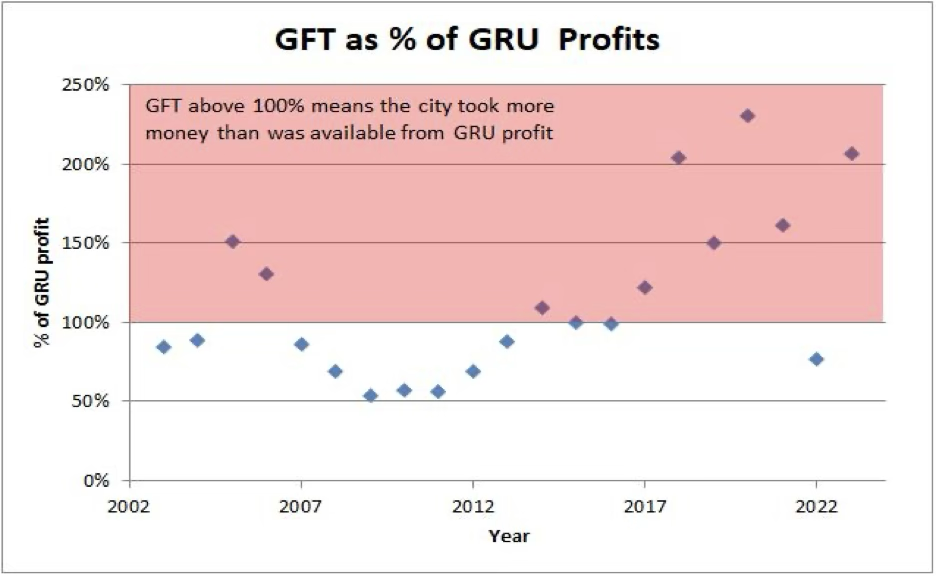
What’s particularly disturbing is that between 2018 and 2023, after city voters rejected a referendum to create a separate board to govern the utility, the city commission escalated its assault on GRU’s financial health, when, against my advice, the city took $221 million from GRU on $147 million in profits (see chart).
As I wrote in my book, “The City that lost control,” former Mayor Lauren Poe seemed to telegraph this escalation when he told a reporter at the Gainesville Sun during a late-night celebration, “It’s been a major distraction and it’s been a major anchor around our staff and our elected officials for many, many years. We’re turning the page.” Indeed.
Digging a little deeper, as the following chart reflects, in three of those years between 2018 and 2023, the city took more than 200% of GRU’s profits. In comparison, GRU’s peer group of utilities – Jacksonville Energy (JEA), Orlando Utilities (OUC), Tallahassee, and Lakeland – transferred between 30% and 70% of their profits during the same periods.

City Commission forced GRU into ill-advised biomass PPA:
In 2009, the City of Gainesville entered into an unbreakable, ironclad power purchase agreement (PPA) with an outside contractor (Gainesville Renewable Energy Center) to build a 102-megawatt biomass power plant; the agreement obligated GRU to pay $2.5 billion over 30 years, whether the plant ran or not. When the plant went into commercial operations in 2013, the die was cast.
Key Point: Through a series of 5 bond downgrades, GRU struggled to maintain its financial health while its expenses skyrocketed, along with its debt, which almost quadrupled from approximately $500 million in 2008 to just under $2 billion in 2015 (see chart).

While GRU was able to negotiate a way out of the biomass contract in 2017, saving $1 billion from its PPA’s obligations, the utility was still left with considerable debt and scant ability to continue paying such a high general fund transfer. The city commission at the time wouldn’t heed the warnings from GRU management and staff, resulting in S&P’s issuance of GRU’s first-ever historic double-rate downgrade of its bond ratings in 2021.
Summary
The idea that the city is somehow the victim in the city’s budget crisis is preposterous and devoid of any historical context. The proverbial chickens are simply coming home to roost at city hall – city commission misfeasance, fiscal laxity, and failure to exert its fiduciary responsibility to the utility have placed the current commission in its current budget bind.
House Bill 1645 took the governance away from a city commission with a documented track record of fiscal abuse of its captive utility, along with the disenfranchisement of almost 40% of its non-city customers, starting long before this budget year.
Key Point: If not for the city commission’s misguided two-decade-long series of actions, GRU could have a much more manageable debt today, leaving it in a healthier financial condition. Seriously, imagine: 1) not having to pay $750 million to get out from under the original biomass PPA and 2) limiting transfers to the city to 40% of GRU profits ($400 million savings). That’s approximately $1.15 billion in debt that GRU wouldn’t have to carry.
The city only has itself to blame for the financial state in which GRU was left before HB 1645 became law (which will be another topic in my series).
As American politician and diplomat Daniel Moynihan once wrote in the Washington Post, “Everyone is entitled to his own opinion, but not his own facts.”
GRU CEO Ed Bielarski, Gainesville
The opinions expressed by letter or opinion writers are their own and do not necessarily represent the views of AlachuaChronicle.com. Assertions of facts in letters are similarly the responsibility of the author. Letters may be submitted to info@alachuachronicle.com and are published at the discretion of the editor.
I work for GRU for 22 years and
the last half of it, the city took so much money from GRU, we didn’t even have money for maintenance of our system. City Commissioners stole money from GRU and GRU customers. Greedy democrats.
And thank you so much for doing what you do! Even if some do not appreciate you, there are those of us that know where the blame lies, and you are not the one to blame!
The GNV CC thinks they’re saving the planet with paper straws…how’s that working out? Plastic cup, plastic lid, paper straw.
… and they want to run GRU?
The idiotic idea of trying to stop climate change by going biomass is what bankrupted GRU to begin with…
Leave electrical generation to the experts!
The GNVCC needs to stay in their jurisdiction and out of the ionosphere!
I would like to see an ordinance passed such that ALL GRU customers would be entitled to vote on any voting matter related to GRU.
Heck yeah!!
Never gonna happen with the current crop of commissioners. They’d be ceding their power to a group who don’t share their political ideologies.
I wonder if getting a petition together and signed by enough voters could make it happen?
Seems to work for all the far-left proposals.
I mean the petition that was put together to help get the board in place along with the other issues that proved to JLAC the city was not running the Utility right and extreme bills along with being one of the two highest municipal utilities at the time. all evidence is the way I look at it and if the is the case we should have another petition.
Well Big Daddy Eddie B all I have to say is this, ANYTHING YOU SAY BOUNCES OFF ME AND STICKS TO YOU!!!! Now since I clearly won that argument I am off to the doNUTZ store to put some doNUTZ in my mouth. The good thing is the people I rule over are so dumb they will actually believe any you say does bounce off me and stocks back to you. It is so easy ruling over these underlings.
Has anyone ever investigated who was paid off for the biomass joke. No one would make that deal unless they were getting a free house in the islands along with a nice boat!
Mr. Bielarski fails to mention Service Level Agreement (SLA) losses, fails to include this ongoing multi-million ANNUAL GRU financial burden in the Flow of Funds as required by the City Charter, and even fails to disclose it on the GRU Financial Statements, which is a fraud. For the proof of this, go to whypaygrumore.com. While everything Mr. Bielarski says is true, as usual. Mr. Bielarski says the right things but does the wrong things in order to retain his status as the highest paid employee in the City’s history. GRU has no internal auditor, and the Authority appointees are either unqualified, disengaged or both. Bielarski is leading us toward a FINANCIAL CLIFF and will simply retire when the truth about the inter fund exchange between GRU and the City comes out.
Ed says he saved us a ton of money by buying the biomass plant that Hanrahan stuck us with.
@j — How does the city have the money for all of these lawsuits, and why does the city need to keep running a golf course? Sell it instead of increasing our property taxes and blaming GRU!
So you’d rather support leaders who are not only financially reckless, but also rely on legal doublespeak to mislead voters into approving policies they don’t want? Leaders who deny a voice to people outside Gainesville who are still forced to pay for GRU but do not support the high prices and theft of funds? All while protecting a power structure more concerned with optics, political echo chambers, and preserving their own influence than with serving the actual community.
Gainesville’s leadership has become a cautionary tale—self-serving, ethically compromised, and obsessed with virtue signaling over responsible governance. They manipulate data, reward loyalist mouthpieces, and retaliate like petulant children when they’re denied access to money that was never theirs to begin with.
No thanks.
Ed acts like he wasn’t complicit in any of this. He played the political game and never spoke out. In fact fought against the concept of an independent board and then got fired. Then the revenge tour started.
Ed is a political animal and shouldn’t be trusted. He’s playing the game with this editorial too.
Ed was not against an INDEPENDENT board; he was against a board selected by the city commissioners of their obedient cronies, as it was proposed on the ballot.
Exactly. Ed has selective memory and a savior complex. He plays both sides milking the GRU cow to fund his retirement.
oh Susan is that you ms. botcher? I mean you are part of the reason for the debt along with that lady that rhymes with green. you and those followers make me sick. you lie to the less fortunate for your benefit! but there are many of us that actually know the truth. There are many of us that live in the areas that you never visit. so sit down, you do not care about the less fortunate.
So, Peggy, you are either Bryan Eastman or one of his little thugs who loves his lying stories… lying Bryan, smh!
GFTs to the city should be $0.00 annually. If the city won’t even cut non-essential services, that we pay for, during this budget crisis, they never will.
Now my property tax, fire fee, & garbage fee go up and I can’t make ends meet because they are taxing me too much . They need to cut spending and focus on essential services:..they need to stay within their urban services boundary line and stop trying to save the planet from climate change with the United Nations “big lie” agenda 21 great .
reset. Ed, just run the utility using best management practices. Clean coal is good.
Meet the new boss, same as the old boss.
Maybe Bielarski has turned over a new leaf and seen the error in his ways, maybe he’s more interested in being the highest paid city employee. Either case, my rates have not gone up since the Authority has taken over. That is quite the accomplishment given the prior idiot Mayor Poe had stated utility rates would increase at a rate of 3 – 5% per year until 2027(?).
What’s concerning, as others mentioned, is his having been complicit with the GRU profit taking by City Commissioners for years. It would seem that someone of his expertise, and vast knowledge could have, and would have sought legal advice, (whistleblower?), to do what was best for the utility and its customers.
The greatest trick the devil ever pulled was convincing the world he didn’t exist. The devil comes in many shapes and sizes.
They need more tax revenues to “fix” their own self-inflicted policy actions that harm he city. That’s what Dem cities do: sow discord then profit off the misery. Gainesville is the poster child of Florida. I fear state leaders are using us as a dumping ground of bad ideas and the results all within our city borders. 🤡👹👺👿💩
I’ve often wondered why we’re a tiny blue island in the middle of a great red sea. It can’t just be the academic aspect, several other Florida cities have similar demographics but no registration anomalies.
It’s the university – Tallahassee is the same. The other universities are either less “prestigious” (i.e., don’t attract the progressives who get status from virtue-signaling) or are in larger metro areas that are less influenced by a relatively small number of academics.
Finally someone that gets it.
For those saying Ed should’ve spoken up sooner need to remember “who he would have been complaining to…GRU/THE CITY?” Neither cared. Complain to the state/governor? Maybe that’s how they got involved. I moved out of the city because of GRU’s mismanagement and over taxation by the city.
Until Gainesville is debt free all the pet/pork projects should be tabled. No more spending the “fix the roads” tax money to buy up “conservation land” (limiting development to drive up land prices), or hotels renovated to house the homeless (that attracts more homeless to the area rather than easing the crisis). THE CITY HAS BEEN MISMANGED FOR DECADES.
You voted for it, you got it.
The city wasted money & F’d things up near the police station turning 2 whole car lanes into bike lanes on NW 8th Ave and they want to run GRU? Glad we have the utility authority. Ed, you don’t have to comply with lowering CO2 emissions. C02 is good for photosynthesis. Plants make the oxygen that we need to live.
They can’t control the squatting vagrants and panhandlers in the medians and they want to run GRU? Good thing we have the Utility authority.
All of this misses the MOST basic point. The City of Gainesville owns GRU. Control of GRU was taken away from its owners without compensation. That is wrong. People may not like the way the owners managed the property that they owned – but that doesn’t give them the right to steal it. Ed ran for mayor and lost and now he wants to punish us for not voting for him. People who live outside the city are mad that they don’t get to vote on matters of city ownership – why would they be able to? If people who live outside the city don’t want power from GRU, they should be allowed to disconnect from the power grid – but they shouldn’t be able to tell the owners how to use their property. I don’t come over to your land and tell you how to mow your grass – because it doesn’t belong to me. If you don’t live in the City of Gainesville – then GRU doesn’t belong to you.
By your own admission GRU is still owned by the city, they just no longer get to control it. No compensation required.
+1 FlaRich.
Ownership and Democracy aren’t optional in America, keeping in mind that both include responsibility as well as benefits. It’s the city and it’s voters problem to sort out and it’s leaders who should suffer whatever consequences that brings.
From the guy who wanted gillum
Ethically questionable confiscation happens all the time in the name of the “public good”. Eminent domain is one example. Drug crime seizures are another.
And as I’ve mentioned before, you can own a car, but if you drive it in a way that presents a danger to you or others, someone’s going to take your keys– and they are right to do so. The best thing you can do in that situation is mend your dangerous driving habits and humbly ask for another chance.
$713 million. That’s how much of GRU profits that was ‘stolen.’
Don’t even try the BS about the City not telling us what we can do on our property. Try cutting down a tree you don’t want, or watering your lawn on the wrong day.
At the end of the day, the City Commission abused GRU profits. I never saw or don’t have any neighbors who can recall the City asking if they approved the 8th Ave fiasco, the downtown parking mess, raising utility rates, or painting crosswalks to look like rainbows.
You seem to miss the real point, that the city saddle GRU with almost $2 Billion in debt, most of it for their pet projects and the disastrous GREC PPA. They should be the one who have to pay off GRU’s debt before GRU transfers another dime to the City.
I love your thinking!!!
FlaRich – those of us who live outside the city limits should just disconnect? That’s the whole point: WE CAN’T. It is our only option for power within a certain geographic area.
We are FORCED to use GRU and couldn’t vote for the thieves who ran it as their slush fund. It’s taxation without representation.
I don’t like DeS but am just fine with him appointing anyone other than city commissioners to run GRU. It was long overdue.
You fail to understand that the city only exists at the will of the STATE! So, no, the city did not have it stolen from them since the state is the parent. Consider this for a moment: the charter must go through the state for approval.
GRU was really cookin in the 2008-2013 timeframe. Well run utility during that time until the commission decision for biomass.
I think that played a big role in this mess.
Over the years I’ve never had an issue with GRU other than how the city managed it.
In fact, my bet is the rank and file employee is probably pretty awesome at their job doesn’t need the heat the management issues have created for them.
What things really boil down to is wants and needs.
We need better roads, for example. Sometimes, just like your home budget we have to think twice about the extras.
How many times we will see same graphs? I assume you are cutting your force and trimming even more to pay the debt. Are you ready for geopolitical response from Iran? Will we have electricity/water/gas and whatever else you sell? Where are you on that? Do you even watch the news?
Lol
One, you do not make sense. Two, those graphs are new ones that have been updated to the current version. Also, you’d better be able to ask the same questions of Lyin’ Bryan.
I’ve only been a GRU customer 32 years (last 25 in the unincorporated sector outside the city limits) and have NEVER had any trouble or complaints about the services at the worker bee level. Ed B. and his team are fighting an uphill battle as well over a third of the customers have zero say in the matters. It’ll be expensive but I hope he will fight this all the way to Tally again if the 10-12% (who even bother to vote) city slickers vote to reverse the current GRU programs. It isn’t perfect but this transformation takes time. Harvey & Co. need to just shut up and sit down and let the pros do what they do best.
Never trust an old man with a ponytail.
The only reason a man should have a ponytail is he…is a Samurai.
I love it. Samurai Ed. Well, maybe not. Lol.
Many of us believe in you, Sama Ed.
See comment below…
GRU currently is DISCONNECTING approximately 3% of its customers monthly for inability to pay their all or nothing bundled (juiced) bills. This hardly suggests that our GRU bills are in the “middle of the pack”. These numbers will rise with the heat.
I’m sure the loving, caring & sharing liberals are lining up at the GRU offices to pay those bills for the less fortunate… NOT!
They’re hypocrites in sheep’s clothing.
You are absolutely right!! Especially the ones that are in several groups posing as different people, so to speak, with the same names. I am sure Susan Botcher will see and read this, oh and the Mermer guy will too, let’s see if they will put in to pay over 30,000 a piece to help the less fortunate! I am sure if they have read this by now they spit out that starbucks frape and said hell no!!! but hey lets consider this a challenge to these people and their groups since they can help the city fund many things.