
County’s opposition to federal priorities drives discussion about street outreach to the homeless

BY JENNIFER CABRERA
GAINESVILLE, Fla. – At the August 25 Alachua County Commission meeting, the board’s debate about an RFP for street outreach to homeless people highlighted a philosophical disagreement between the County’s approach and the Trump administration’s policies.
The meeting’s consent agenda included approval of an agreement between Alachua County and the TaskForce For Ending Homelessness for outreach services and permanent housing services; the TaskForce is the area’s Continuum of Care Lead Agency and is designated by the federal government as the entity that receives federal funds for homelessness.
The agreement, which becomes effective on October 1, provides funding of $350,000 for the FY2027 Fiscal Year to TaskForce for street outreach to homeless people and requires TaskForce to procure and oversee housing-focused street outreach services in Alachua County, six days a week, with four providers dedicated to the effort. The providers are required to respond to wellness checks or service calls related to homelessness within one business day within the urban cluster and within two days outside the urban cluster, and they are required to spend the majority of their time helping people make progress toward housing, with the remaining time dedicated to locating new people to serve and building trust with those people.
GRACE asked Commissioners to pull the item for discussion
Mark Bonner, Interim CEO of GRACE Marketplace, sent an email to Commissioners before the meeting, asking them to pull the item from the consent agenda because “as currently drafted, [the agreement] fails to implement the County’s housing-focused approach to homeless outreach services and appears to permit [TaskForce] to subvert that approach and replace it with a treatment-first model championed by the Trump administration.”
President Donald Trump’s Executive Order 14321, “Ending Crime and Disorder on America’s Streets,” requires federal agencies to “[end] support for ‘housing first’ policies that deprioritize accountability and fail to promote treatment, recovery, and self-sufficiency.” On August 17, the U.S. Department of Health and Human Services (HHS) and U.S. Department of Housing and Urban Development (HUD) issued a joint letter that “pairs safe housing with services that address addiction and serious mental illness, rather than treating housing alone as the solution” by “abandoning ‘Housing First’ policies to the fullest extent possible.” The initiative includes $100 million “to expand outreach, comprehensive treatment, and recovery support services and housing connections for homeless Americans with mental illness and addiction.”
Prizzia: TaskForce’s RFP is “in conflict with our expectations and goals around a housing-first approach”
Commissioner Anna Prizzia said she had pulled the agreement from the consent agenda because TaskForce has a current RFP out for street outreach (issued on August 19), using the funds from this agreement.
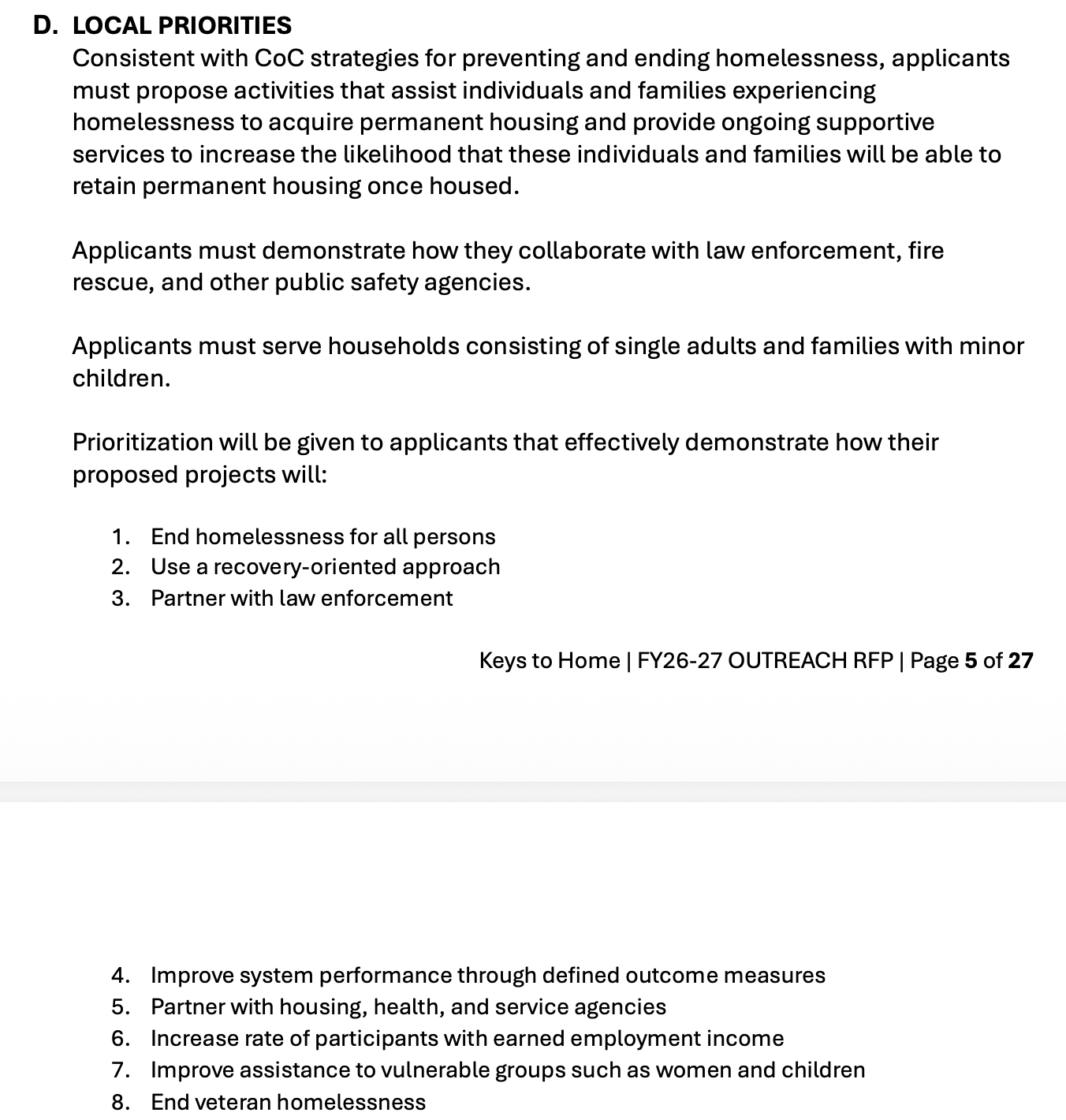
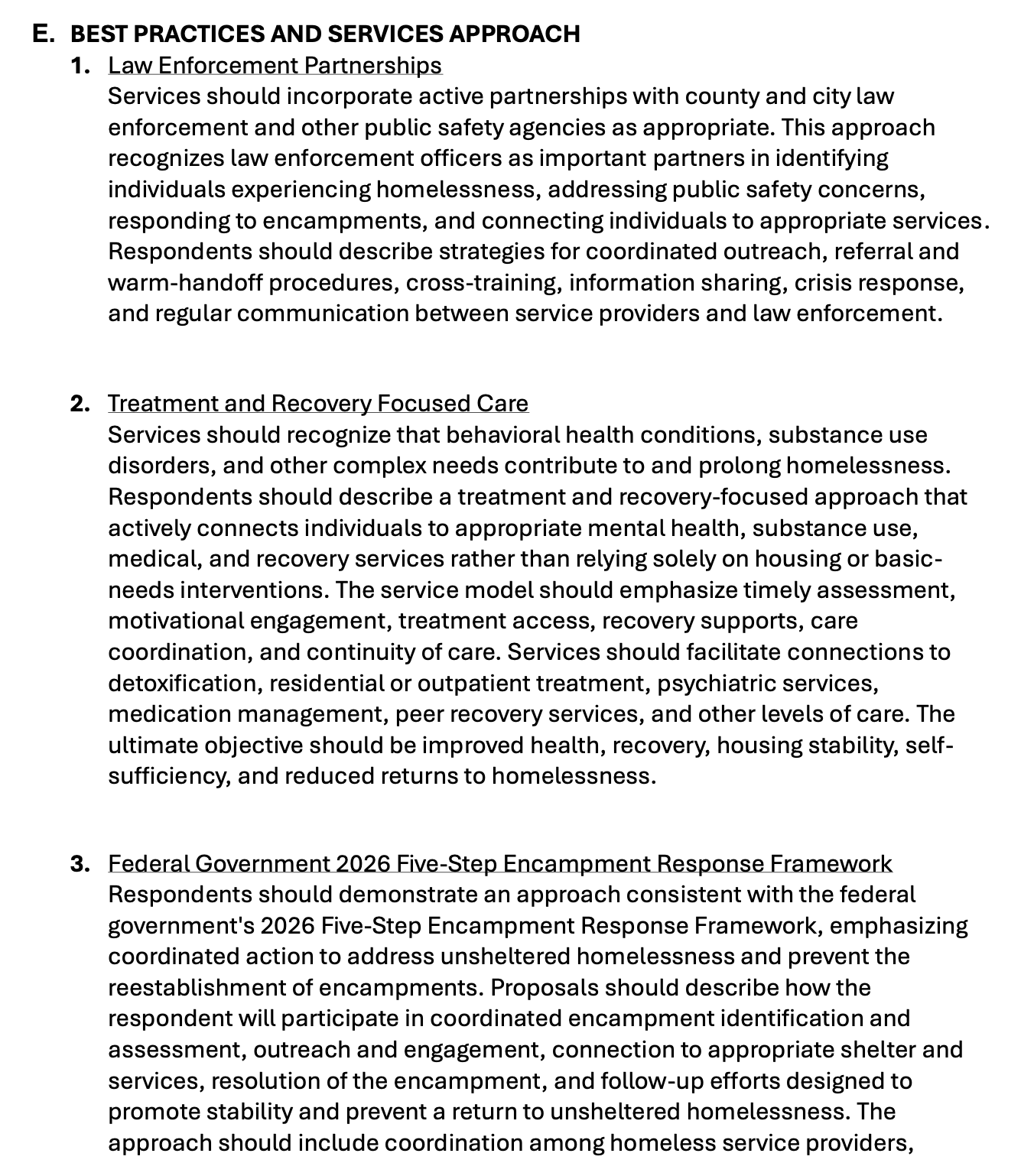
Prizzia said her concern was that TaskForce’s RFP mentions acquiring permanent housing, but the prioritization section (see excerpts below this article) emphasizes using a “recovery-oriented approach,” and the “Best Practices” section “talks about treatment and recovery-focused care, and rather than focusing on the national standards that we’ve adopted as our approach for housing, they talk about the federal government’s five-step encampment response framework as a framework that they expect [applicants] to follow, which, from my perspective, is kind of in conflict with our expectations and goals around a housing-first approach.”
Prizzia continued, “A recovery-first approach sort of says that people have to get clean and be in recovery and be in counseling, everything, before they can get housed. They need to show that they’re, you know, making strides, and I think, as we all know, in those instances, it’s really hard to do that if you don’t even have a roof over your head.”
Commissioner Anna Prizzia: “Our street outreach people should not be involved in the displacement of people in encampments.”
Prizzia also said her own perspective is that “our street outreach people should not be involved in the displacement of people in encampments — like, that should not be their job. They’re working with those people. They’re trying to help those people get housed. They shouldn’t also be primarily focused around busting up encampments.”
Prizzia said she knew the agenda item wasn’t about TaskForce’s RFP, but “I don’t feel comfortable moving forward with approving our contract with them, with their RFP having this language in it, unless we add some stronger language to our contract with regards to our expectations for housing-first.”
“A fine line”
Director of Community Support Services Claudia Tuck said, “We do have a fine line we’re walking right now with the federal government and requirements. Not only are they looking at what we do for outreach, but they’re looking at everything we do.”
Jacob Torner, Director of Operations for TaskForce For Ending Homelessness, said the agreement, which arose from the County’s 2024 evaluation into the best ways to improve street outreach services, “is directly responsible for supporting the County’s obligations to respond to… Florida’s public camping law.” However, he said, the applicants for TaskForce’s RFP would not be responsible for enforcing that law; they would be responsible for “making sure that people… have access to services and get those services… So I want to be very clear about that position… I appreciate this Commission’s interest in ensuring that… services are performed in a way that prioritizes dignity and ensuring that people have the best chance of success.”
Jacob Torner, Director of Operations for TaskForce For Ending Homelessness: “We have more than 60% of the people in our community who are experiencing homelessness with a mental health or substance use disorder.”
Torner said the RFP was issued before the agreement was approved to make sure the funds could be awarded in time for programs to start on October 1 and “so that the service provider can take care of the actual services and hopefully never get to a point where enforcement becomes necessary because the services are of such high quality that people are able to receive assistance.” He added, “We have more than 60% of the people in our community who are experiencing homelessness with a mental health or substance use disorder.”
Prizzia asked Torner, “So you’re telling me that you’re still taking a housing-first approach, and… your RFP respondents cannot require recovery support services or treatment-focused care in order to receive housing?”
Torner: “There is absolutely no requirement that participants agree to become sober or that they are sober prior to or during the delivery of services.”
Torner responded, “That’s correct, Commissioner Prizzia. There is absolutely no requirement that participants agree to become sober or that they are sober prior to or during the delivery of services.” He said TaskForce would be willing to amend the language in their RFP to make that clear.
First motion
Prizzia made a motion to approve staff’s recommendation to approve the agreement but make it clear “that there can’t be any expectation or requirement for somebody to be enrolled in recovery or treatment prior to receiving support for housing.” Commissioner Marihelen Wheeler seconded the motion.
Public comment
During public comment on the motion, an attorney representing GRACE Marketplace said the motion was not sufficient because “the RFP, as it’s drafted, contains section after section that refers to seeking a recovery-based or treatment-based approach, which in fact is favored by the Trump administration and is antithetical to the National Alliance [to End Homelessness’s] approach to street outreach.” He said the scoring sheet for the RFP requires the applicant to implement recovery-focused care and follow the federal government’s five-step encampment response framework. He concluded, “The point is that these are the County’s dollars, and the County is entitled to specify that they be used for homeless outreach that actually implements the County’s preferred housing-focused approach.”
After public comment, Prizzia said that “if in fact [TaskForce] is concerned about their need to align with the federal government priorities, versus the National Alliance priorities, due to their funding requirements, then are they perhaps not the right contracting partner for this contract?”
Chair Ken Cornell: “I do have a concern about encampments popping up around our county. I don’t like that; I don’t want that; I think that’s bad, and I do have a concern about the number of folks on the sides of the road.”
Chair Ken Cornell said, “I do have a concern about encampments popping up around our county. I don’t like that; I don’t want that; I think that’s bad, and I do have a concern about the number of folks on the sides of the road.” He asked whether the County is going to focus on housing first or “kind of align with what this RFP is doing.”
Director of Community Support Services Claudia Tuck: “Housing-first is the model we align with. We have to make those other services available to align with what the federal government… is saying.”
Tuck said, “Any entity that would put out an RFP for outreach… is going to have to look at what the federal government is saying now; they’re looking at anything that communities are putting out,… and that’s the fine line we’re walking.” She said TaskForce was not saying that the County favors housing-first: “Housing-first is the model we align with. We have to make those other services available to align with what the federal government, who’s providing over a million dollars to this community, just in homeless services, is saying. So what we’re trying to do is walk that fine line in the middle… We don’t want someone going in, breaking up campgrounds. We’re not saying you can’t come into housing if you don’t do this and this, but we have to offer [those services].”
Prizzia said, “I’m not having a problem with the fact that you need to thread the needle; what I’m having a problem with is the way that this RFP is worded,… as if the people you’re soliciting for this proposal are going to require recovery or enrollment in programs in order to receive housing support, and that they’re going to be coordinating directly with law enforcement to bust up encampments, when that’s not the goal of this program.”
Prizzia withdrew her motion, saying she wanted to see a revised RFP first, “so that we can know that our funding is being used the way that we anticipate it being used.”
Second motion
Prizzia made another motion asking staff to bring back a revised agreement, along with a revised RFP, but Cornell said that would mean that there would be a funding gap until that happens, and there was no second.
Tuck: “I’m the strongest advocate of housing-first,… so this is tough for all of us. This is not an easy day, but [the federal government is] looking at everything.”
In response to a question from Wheeler, Commissioners said that the $350,000 is from Alachua County’s General Fund and is being granted to TaskForce, which has issued an RFP for applicants to provide the street outreach services. However, Tuck said that because the County, through TaskForce, applies for federal funding for homelessness, “anything that we do locally,… the federal government has made it clear… that they will be looking at communities and how they’re handling their approach to services… I’m the strongest advocate of housing-first,… so this is tough for all of us. This is not an easy day, but they’re looking at everything.”
Wheeler said, “I think that we can overthink this… I’m ready to let it go with whatever staff is recommending, particularly if it’s going to put us late in terms of getting the funding we need or draw scrutiny to the questions we’re asking.”
Prizzia said that moving to a recovery-first approach would “draw scrutiny… [because] our housing advocates are going to fill this room.”
Third motion
Wheeler made a motion to approve the staff recommendation, and Commissioner Charles Chestnut seconded it.
Commissioner Charles Chestnut: “Look, I don’t like what the federal government is doing,… but if it’s going to affect our funding down the road, I do have issues with that, because now we have to come up with that money, and where is that money going to come from?”
Chestnut said, “I’ve always trusted staff. I don’t think staff would bring us something to not follow our policies,… and I’m kind of upset with this kind of last-minute stuff here… Why hasn’t this been addressed early on in this process?… Look, I don’t like what the federal government is doing,… but if it’s going to affect our funding down the road, I do have issues with that, because now we have to come up with that money, and where is that money going to come from?”
Torner said TaskForce would be “happy to amend any of the language that this Commission directs… And if this is approved today, we’re happy to make that amendment expeditiously, get it republished today with amended language.”
Cornell said his priority was to get the agreement approved today, and he thought that if they required the RFP to come back to the board for approval, that would delay the award by at least a month, “and I don’t want them not funded on October 1.”
Commissioner Mary Alford entered at that point; she’d had to leave early in the meeting to attend a Canvassing Board meeting, and she returned after that meeting was concluded.
Prizzia said she agreed with Chestnut that this was “very last-minute, and it’s actually really frustrating to me that an agreement with an organization to give them money is coming to us when they already have an active RFP on the street — like, that’s problematic to me.” She said she understood that TaskForce has had the contract for several years, and it’s more efficient to issue the RFP before the agreement is approved, “but why didn’t we get the agreement a month ago or two months ago?”
Substitute to the third motion
Prizzia made a substitute motion to move forward with the agreement with the requirement that TaskForce align “any procurement processes and strategies in their street outreach services with the Alliance to End Homelessness housing-first priorities, and that we ask for a revised RFP, ASAP, that ensures that that’s the focus and that we’re not requiring treatment and recovery to receive housing services or coordinating for busting encampments… as a part of the work that the street outreach individuals are doing.” Alford seconded the motion.
Cornell asked Tuck whether the motion would put anything at risk with the federal government, and she said, “Not if we can get it back out on the street, Mr. Chair.” He asked Torner the same questions, and Torner said he agreed with Tuck.
Commissioner Mary Alford: “The money that we spend here is going to pay for itself very quickly when you look at the fact that more than half of the people sitting in our County jail are estimated to be unhoused, and at $127 per person per day, that adds up pretty darn quick. So this is money that I expect will come back to us many times over.”
Alford said she’s been getting a lot of comment on social media about the money the County spends on social services while the streets “are in such bad repair. But the money that we spend here is going to pay for itself very quickly when you look at the fact that more than half of the people sitting in our County jail are estimated to be unhoused, and at $127 per person per day, that adds up pretty darn quick. So this is money that I expect will come back to us many times over.”
Wheeler withdrew her motion, and Prizzia’s substitute motion passed unanimously.
After the vote, TaskForce posted a notice on its site that an amendment to the RFP will be published around August 28, including “clarifications regarding RFP best practices and adjustments to the RFP scoring criteria.”
Wake up you elected idiots….all you have to do is look at LA, San Fran, Seattle, Portland, etc. to see where this train is headed. Fund them and they WILL (have) come.
TDS is their decision guiding principle 💩👺👹👿🤡
When it comes to the homeless situation and Alachua County, the County Commission has created the disaster. Now because of politics they do not want to accept money or suggestions from the federal government. They are sick individuals who care very little about the plight of the homeless. Shame shame shame.
I have no doubt the county commissioners will handle the homeless problem as well as they have handled the pothole problem.
What the Commission has been doing hasn’t worked. The homeless problem has increased rather than decreased over the years. I’m not sure what the answer is, but I think this Commission has demonstrated what NOT to do.
The answer is simple and the BOCC attitude proves it. If you want to end the encampment problem, stop welcoming professional bums, drunks, dopers and career criminals to GNV and Alachua County. First step is to NOT give benefits and housing to everyone except permanent local citizens.
So they want to spend $350,000 of taxpayers money to keep these bastards around us to steal, rob and assault us I sure hope a passing amendment three does away this kind of nonsense waste of taxpayers money
While I’m looking forward to voting on Amendment 3, I’m still waiting for the real story on why Darius Williams suddenly left Grace Marketplace. I’m sure there was something scandalous going on.
May have been “in over his head”.
Government will shift the tax burden elsewhere. Might be in what you spend for food, gas, wastewater tax, etc.
It is not going to die. It will likely make even more money.
True, but at least you will not lose the property yet you have paid off because of it
They will get your money. One way, or another.
They can’t let you get away with this…they will figure out how to tax you the same amount in other ways…if not more.
The hydra will live.
Sure. The property will be paid off.
You will pay more taxes in other places.
You don’t think the government is going to let you keep your own money do you?
GRACE Marketplace was founded by and is staffed by ex-cons. 99% of the residents are ex-cons, which is why they couldn’t get into a real homeless shelter like St. Francis House.
The natural result is that you get a mafia-like criminal organization that blends legal and illegal activities to enrich themselves.
The legal activities include lobbying city and county governments for more and more and more and more funding to provide vague “services” to their homeless population, who function as both a money-generating crop for the legal side, and as street-level soldiers for the illegal-side of the organization.
The illegal side is the drug trafficking, burglary, theft, etc. rackets that are based and coordinated at the GRACE facility, with the homeless “soldiers” receiving compensation in the form of drugs, money, and of course continued access to taxpayer-funded beds.
Like the mafia, there are gray areas as well. The “Recycling Project” thrift/consignment store has a partnership with GRACE, this is public knowledge. What may not be public knowledge is that material donations to GRACE are first picked through and claimed by GRACE employees, then the rest are transported to the Recycling Project. These items are converted into cash, and that cash…disappears. Essentially money laundering as donations are provided as tax deductions and turned into untraceable cash.
The other gray area is intimidation and bribery of public officials. It is obvious from the way they interact that certain weak, effeminate members of our local government (Harvey Ward, Bryan Eastman, Chris Cornell) are terrified of GRACE Marketplace leadership. Whatever GRACE demands, they get, even though their visible political influence should be far smaller.
I believe that our members of local government are incentivized to continue non-stop and ever-growing funding of GRACE because they receive something back in kind; namely, anonymous “donations” to their political funds if not straight envelopes of untraceable cash for their continued support. There are other less tangible benefits to having access to the army of anonymous, immoral criminal zombies that roam our city. They are happy to take down campaign signs or perform other services for a small compensation in drugs or cash.
This is all merely my opinion of course, but personally I think the FBI should be investigating the operation of GRACE and the personal finances of our local government. “Where there’s smoke, there’s fire”, and where there is liberal government, there is corruption.
Well, no federal money for you then prizzia.
The bums should recover and be clean before they get free housing à la taxpayers…
the bums get a federal check too…
if they are not clean, why are we giving them free housing to crap up and be a flop house?
Prizzia: there an old saying…”don’t make your problems, my problems”
What I’m hearing is that the county commissioners are in the business of enabling addicts. They’re going to spend taxpayer money on housing for addicts, but they’re not going to require the addicts get into treatment — that’s called enabling. All the money that was spent on remodeling those rooms on 13th St is going to be flushed down the toilet when those rooms are trashed and/or burned down by addicts. Great job as usual, commissioners. 👍
They won’t stay in taxpayer funded housing, and we’re paying for new courthouses instead. Send them to Cuba and Puerto Rico, repeat offenders and mental homeless who refuse to clean up their acts.
Fix OUR county roads with OUR tax money. Send the vagrants back to where they came from.
I would love to run Grace. I would turn it into a boot camp instead of daycare. There are homeless who really want help and a lot of people who are just lazy bums. Here’s my plan:
– You get 3 weeks of help at Grace. You must show improvement or you’re out.
– You must do community service to earn the right to some off-campus housing, and keep it up.
– When you get housing you must keep it clean and continue to show improvement.
– You will receive help for getting a job.
– When you get a job a small portion of your income will be used to pay for your housing, so you learn how rent and budgeting works.
Grace:
– A police substation will return to Grace.
– Everyone entering the property will go through a metal detector and their belongings will be searched. Every time!
– Everyone entering the property will get a background check – every time! If you are wanted on a warrant you will be arrested on the spot.
– No “camping” on the property. You will live like a civilized adult.
– You will get intense counseling.
– You must improve enough to do community service, and keep it up to get off-campus housing.
– Break any of the rules and you may be kicked out for good.
I would post statistics on a web site constantly to show money received and how it was spent, how many people were admitted, how many graduated to housing, etc. Nothing hidden, no money pit!
And one other thing. No more using Grace as a “resides at” or mailing address. Who knows what illegal things are coming in the packages, and they can’t be inspected. Let city hall accept the mail.
I can’t tell if these commissioners are insane or they should be wearing helmets and licking windows. The homeless people ABSOLUTELY need to get treatment for addiction or mental illness BEFORE they get housing. Otherwise, the housing will become flop houses and drug dens. This is just mind-boggling how these commissioners stomp their feet and refuse to TRY SOMETHING DIFFERENT to address the rampant homeless problem in Alachua county!