
Newberry celebrates America’s 250th with Lexington and Concord battle reenactment, Liberty Tree dedication

BY JENNIFER CABRERA
NEWBERRY, Fla. – Today, the City of Newberry celebrated America’s 250th birthday with a reenactment of the Lexington and Concord battle and the dedication of a Liberty Tree in the City Hall complex.


The festivities began with “Paulette Revere” on a horse, warning the residents of Lexington and Concord that the British were coming, and it was followed by a skirmish on the Lexington Green between reenactors representing the colonists and the British Army. The second act depicted a battle at the Old North Bridge, at the end of which the British Army retreated.


Liberty Tree dedication
A few hours later, Newberry Mayor Tim Marden and Randy Highsmith, President of the Gainesville Chapter of the Sons of the American Revolution, dedicated a Liberty Tree.

Marden said he wanted to do more than celebrate Independence Day on July 4; he wanted to bring to life “what it means to be an American.” He said the City will host fireworks at Countryway Town Square on July 3, and a parade on July 4 will have 100 elements that portray 100 significant events and inventions in American history. In September, the City will decorate its Municipal Building like Independence Hall in Philadelphia.
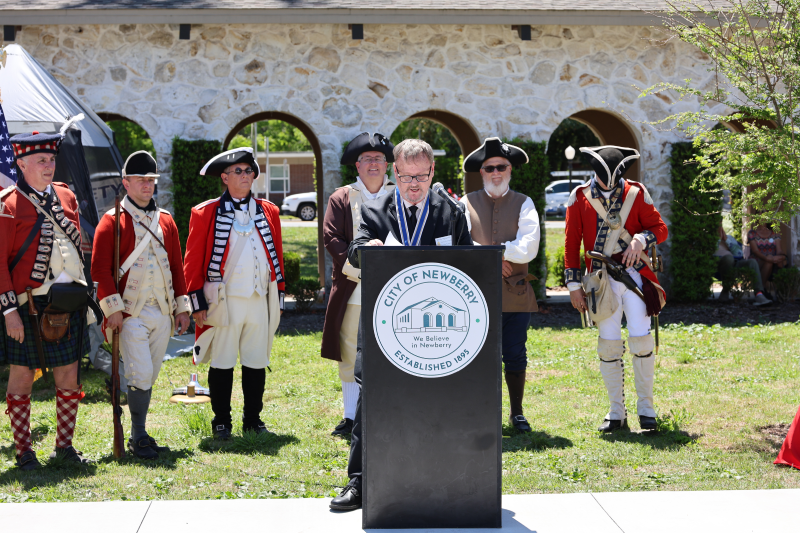
Highsmith said that in 1765, Boston colonists gathered beneath what was known as the Liberty Tree, an American Elm with wide, spreading branches that created a natural meeting place for ordinary citizens who assembled to protest unjust taxation and to speak about their rights.
Highsmith said, “It was not a grand hall or a seat of government. It was simply a place where people came together. Yet in that simple setting, something extraordinary began to happen. Men and women who had once thought of themselves mainly as subjects began to think and speak as citizens. Under that elm, something important happened. Neighbors became patriots, conversations became convictions, and the idea of liberty began to take deeper root in America. The Liberty Tree quickly became a powerful symbol throughout the colonies, reminding that freedom begins with citizens who gather, speak, and stand together in defense of their rights.”
Highsmith continued, “In 1775, British soldiers cut down the Liberty Tree in Boston, believing that it would destroy the tree and would crush the movement it represented. But liberty does not live in wood and leaves; it lives in the hearts of people. Today, as our nation approaches the 250th anniversary of independence, communities across the country are planting Liberty Trees again — not in protest, but in remembrance and renewal. We do so because anniversaries like the 250th are not only a time to look back with gratitude, they’re also a time to look forward with renewed responsibility. Liberty is not just a word from our history; it is something each generation must preserve and practice.”
Highsmith said that Newberry’s Liberty Tree is a Winged Elm, which is more suited to our climate than the American Elm. He concluded, “It stands here as a reminder to all who pass by, that freedom is never merely inherited. It must be remembered, valued, and defended by every generation — because liberty is worth remembering, because freedom is worth preserving, and because the story of America continues with each generation.”


Very nice article, thank you.