
‘The way it looks now, I don’t think we’re going to catch up’: Alachua County Commission discusses ways to accelerate road maintenance

BY JENNIFER CABRERA
GAINESVILLE, Fla. – At a special meeting on August 13, the Alachua County Commission discussed the poor condition of roads in the county and ways to accelerate the repair of the roads generating the most complaints.
Overall pavement condition in 2020 was just above “poor”
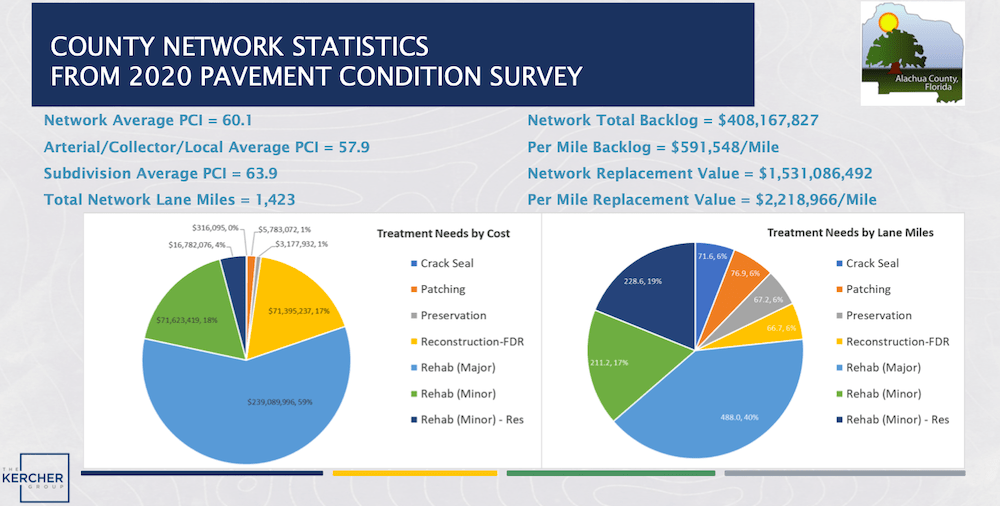
Public Works Director Ramon Gavarrete began his presentation by reminding Commissioners that the average Pavement Condition Index (PCI) for the county was 60.1 in 2020, with collector roads averaging 57.9; anything below 60 is considered “poor” condition.
In 2021, the board was told that it would cost over $41 million a year to raise the average PCI to 70, and it would cost over $31 million a year to maintain the current condition of the roads; the board has allocated $25 million per year for the next 10 years to road projects, meaning the average condition of the roads will be lower than the current PCI at the end of the 10 years. Gavarrete said the current estimate to maintain the condition of the roads is about $42 million a year, well above the allocation of $25 million.
Gavarrete said, “If you wanted to bring [the pavement condition] up 10 points to 70… — by the way, for engineers, 70 is still failing,… that’s closer to $55 million a year [in today’s dollars].”

Public Works Director Ramon Gavarrete: “A lot of our roadways now are actually in this downward curve… We’re not catching up. We’re losing ground.”
Referring to the curve on the right side of the slide shown below, Gavarrete said, “Unfortunately,… that line has now moved in the wrong direction… A lot of our roadways now are actually in this downward curve,” which means they have to be milled and resurfaced.

Gavarrete continued, “So that’s part of the challenge that we have today. We’re not catching up. We’re still losing ground.” He said 520 of the county’s 700 centerline miles of roadways are not even in the 10-year plan.
Gavarrete showed Commissioners a long list of collector road segments that are not in the 10-year plan although some portion of the roadway is in the plan (see slide 7 in the presentation) and said it would cost an additional $86 million to repair them. However, he said, the “even worse number” was on slide 8, the longer list of collector road segments on roadways that are not in the 10-year plan at all: those would cost $174 million to repair.
Road conditions now are worse than in 2021
Gavarrete also noted that the PCIs on those lists were measured in 2021, and they are probably worse now.
Chair Ken Cornell said the presentation “screams” that the County should issue a bond against future local option gas tax revenues and “move those projects up.” Gavarrete reminded Commissioners that the road paving program they already approved assumes that a $30 million bond will be issued in 2028, with a 30-year repayment schedule. He said he believed that was the full bonding capacity of the local option gas tax. Cornell asked whether they could issue the bond before 2028, and he was told they could.
Gavarrete said he had originally recommended a five-year program because of the possibility that the County might want to re-evaluate the plan before the 10-year mark, but the board wanted a 10-year plan because the surtax lasts for ten years.
County has expanded to four pothole repair crews
Gavarrete said the County is now using four pothole repair crews, at a cost of $300k-$450k per crew, so adding the two crews previously requested by Cornell would cost another $750k-$1 million. Gavarrete said he could also hire a contractor to strip-mill and resurface for about $150k-$200k per mile and do pothole repairs for $10k-$15k per road.
Gavarrete also recommended using a material called Mastic One for wide crack filling; he said an example can be seen on CR 235 near Savannah Station. “It’s a very rubberized material, and they strongly recommend only doing it in the cold months,” he said. He added that the sections the County has done with Mastic One are “holding up very well.” The material is more expensive than asphalt, leading to an estimate of about $85,000 a mile if done in-house; however, if the County contracts the work out, the vendor is estimating a cost of about $350,000 per mile. Gavarrete said the material lasts about 10 years “up north,” but it hasn’t been used much yet in Florida.
Gavarrete also mentioned a company called Roadway Management Technologies (RMT) that would allow the County to passively monitor road conditions by attaching sensors to vehicles; the cost for that would be around $100,000 per year. The information provided by that program could be used to update the paving priorities.
Staff recommendation
The staff recommendation was to direct staff to implement an enhanced Pavement Maintenance Program, authorize staff to pursue the necessary procurement actions to accomplish that, and authorize the creation of 13 additional Public Works positions to backfill the maintenance crews that have been reduced to staff the pothole repair crews.
700 emails sent to address for reporting potholes over just a few days
After the County publicized the rbmaintenance@alachuacounty.gov email address last week for reporting potholes, the County received over 700 emails, although many are reporting the same road segments; Gavarrete said his staff will likely take a few weeks to work through that backlog and weed out the duplicates.
Commissioner Anna Prizzia said they should be able to use AI to filter out the duplicates, and Gavarrete said his team is looking into that.
Commissioner Marihelen Wheeler asked whether residents could put something into the deep potholes to improve them temporarily, and Gavarrete said that “is not encouraged.” She also asked whether the County has a mechanism to reimburse damage to residents’ vehicles, and Crosby said there is “a process by which we take calls and investigate what’s being requested… That is reviewed by Risk Management.” Wheeler said, “I would imagine that opens a Pandora’s box, for sure,” and Crosby replied, “We don’t want to open Pandora’s box.”
Hiring recent inmates to work on maintenance crews
Wheeler brought up using jail inmates to help with the mowing, and County Manager Michele Lieberman said that when the County did that in the past, they used state detainees because the Sheriff at that time did not want to participate; she said that replacing those crews with employees added about a million dollars to the 2018 budget. She said she had asked staff to look at a program that would train inmates “so that when they did step out from their time served, they would walk into a government job that is good-paying and with benefits.”
Wheeler said she was in favor of that, while Commissioner Mary Alford pointed out, “That’s not a next-week program.”
Gavarrete: “There are contractors that would bid on your projects today… “I’m not ready to say that we do not have the contractor industry to be able to handle increased projects.”
Alford asked Gavarrete how much of the pavement repair is limited by money, as opposed to the availability of material and contractors, and Gavarrete responded, “There are contractors that would bid on your projects today.” Picking a random large number, he said that if they spent $200 million a year, that might be more than local contractors could handle, but there are other contractors in nearby counties. He added, “I’m not ready to say that we do not have the contractor industry to be able to handle increased projects.”
Alford asked about the availability of asphalt, and Gavarrete said that Watson, for example, produces their own asphalt now: “Where we do have issues is for our pothole crews.” Gavarrete said that is because they need small quantities, and asphalt needs to be made in much larger batches to be economical.
County Manager would not say how much the County is paying in damage claims
Alford asked how much the County is paying out in damage claims, and Lieberman said, “That’s something that we [don’t] really want to get into here. We are monitoring those claims.”
Alford also wanted to make sure that the road crews know how much the board appreciates them because all the negative social media posts about the roads take “a mental toll.”
Gavarrete also mentioned that regulations require crews to take frequent breaks because of the combined heat of the weather and the asphalt, and he has encouraged supervisors to stop the work if the crews appear to be fatigued. He said they are also going to start rotating the crews, “basically four weeks, and then we’re gonna be rotating out and putting others in because, quite frankly, I don’t want to lose [more] people.”
Commissioner Anna Prizzia: “I’m not sure I’m in favor of us just expanding two more pothole crews, because I don’t think that actually solves the problem, and it’s $750k to a million [dollars].”
Prizzia said the additional pothole crews should lead to “sort of a rapid improvement in the response time and the ability of our crews to fill potholes and fix minor projects on roads. So I have to say, I’m not sure I’m in favor of us just expanding two more pothole crews, because I don’t think that actually solves the problem, and it’s $750k to a million [dollars].” She said she was more interested in hiring a contractor to do strip milling.
Prizzia asked what it would cost to do the strip milling in-house, and Gavarrete said the County is currently doing it in-house and has $446k in infrastructure surtax money set aside for strip milling this year. She asked why he would recommend contracting it out in that case, and Gavarrete said, “Because you probably want to do more.”
Prizzia was also in favor of continuing to explore the use of Mastic One.
Commissioner Prizzia: “I am in favor of a fully structured workforce development program that supports inmates and reentry for developing their skills, giving them fair wage jobs, and getting them moving in the direction of being able to have County positions.”
Regarding hiring inmates, Prizzia said, “I am in favor of a fully structured workforce development program that supports inmates and reentry for developing their skills, giving them fair wage jobs, and getting them moving in the direction of being able to have County positions… I am not in favor of garnishing wages. I’m not in favor of 50% wages. I’m not in favor of this being a cost-saving opportunity for us to reduce the cost of labor, but I am interested in… [having] a conduit to good-paying jobs and to workforce development in the future.” She said that type of program could also help staff Animal Resources or other County departments.
Assistant County Manager Tommy Crosby: “I would recommend doing this because of the immediacy of the needs and the longer-term implications if we don’t do it.”
Commissioner Charles Chestnut supported the staff recommendation and said safety is his top priority, but he asked whether the funds were available to do everything that was recommended. Crosby said he could move funds around, and that might affect the long-term plan, but he recommended doing it because “the cost of roads is going up a whole lot faster than our interest rate cost of money… Some things you just have to deal with, as it comes… We’re prepared to leverage anything we can leverage as quickly as we can leverage it to get things done… We will fund [this plan]… I would recommend, yes, let’s do this… I would recommend doing this because of the immediacy of the needs and the longer-term implications if we don’t do it.”
“A little baited and switched”
Prizzia said she felt “a little baited and switched” because when the consultant presented the pavement management plan, they didn’t make it clear that roads would “fall off the cliff” once they reached a PCI of 50. She said, “I feel like that should have been hammered into us a little bit harder, that those roads were going to fail during this program, because had I known that, I would have probably made different decisions about how we prioritize the roads.” She said she didn’t want to change things completely, but she supported doing an updated analysis of the roads.
Commissioner Charles Chestnut: “We know that in the past, money was never spent towards roads, from previous commissions… I’m just saying, we’re going to have to do another referendum, maybe two or three more referendums, to even catch up — if we catch up. The way it looks now, I don’t think we’re going to catch up.”
Chestnut said, “We know that in the past, money was never spent towards roads, from previous commissions. We have a 20-year backlog of roads in Alachua County.” After other Commissioners chimed in to correct him, he said, “30? 40? Wow! Well, I thought it was 20… But I’m just saying, we’re going to have to do another referendum, maybe two or three more referendums, to even catch up — if we catch up. The way it looks now, I don’t think we’re going to catch up.”
Commissioner Chestnut: “I’ll never forget we did the tax referendum just for roads two times, and it failed. And then they said, ‘What you all need to do is find it in your budget and do it that way.’ That’s what the citizens said, and so it makes me frustrated when people are complaining.”
Chestnut continued, “We’ve got to do the best we can with what we have, and we have to… be honest with [our citizens] and tell them the truth, what is actually happening. It’s not embarrassing. It was what our previous predecessors have done that put us in this position to try to solve [this]… Kicking it down the road to a later date is what has happened to us. And I’ve been here 14 years, and we’ve been trying to address this issue, and I’ll never forget we did the tax referendum just for roads two times, and it failed. And then they said, ‘What you all need to do is find it in your budget and do it that way.’ That’s what the citizens said, and so it makes me frustrated when people are complaining.”
“I want us to do even more”
Cornell said he’s been telling people that the County can’t fix in four years what happened over 40 years, “but what I’ve also said is that there hasn’t been a Commission that has invested this much capital and resources into attempting to fix that situation than this board. That being said, I want us to do even more.”
Cornell said he wanted staff to immediately pursue issuing a bond against the local sales tax option revenue and use the funds from the bond to fix the roads that are partially in the 10-year plan with a PCI under 70. He also supported the RMT contract for pavement monitoring and a “fully structured workforce reentry program.”
Alford said, “So moved,” and Wheeler seconded the motion. The motion passed unanimously.
Cornell asked Gavarrrete if two more crews (a total of six) would help, and Gavarrete said, “Obviously, I’m not going to tell you it won’t help,” but he warned that it could take six months to staff them. Cornell said he would bring up the idea again before the end of the calendar year, after staff has had a chance to evaluate the results of having four crews.
How can these people sit here and think that social programs are more important to prioritize than basic infrastructure, such as safe roads? You can’t just tax people to death for everything. It is mind boggling.
After crying poor mouth watch them switch gears and try to get another 1% referendum because half the voters don’t remember how many times this was done before to little effect.
Lou, If you remember, those so called road tax referendums weren’t that at all. The first attempts had over 1/2 of the money for cute modal projects the GNV commission demanded. Bike lanes, new buses, RT ‘hubs’, etc. Even the pitiful vote you got was for luxury money ‘Wild Spaces and Public Places and you can see how the other group has wasted that.
INFRASTRUCTURE. Get rid of the other, social stuff that belongs in the cities.
That’s what happens when you keep kicking the can down potholed roads.
Can’t fix roads any more than you can fix stupid.
Chestnut is partially correct about the two referendums for roads failing to pass. As I remember it, every city in the county squabbled about what share they get of the collected funds and they wanted to spend those funds on other projects. The language of the referendum did not specify the funds going directly to road maintenance. So they failed.
Try it again with ironclad guarantees that all monies collected would go towards road maintenance and nothing else and see how fast it passes.
Instead of going by “generating most complaints”, the lazy asses need to go out and actually assess each road completely. Their newest property taxpayers including new rental homes built by hedge funds are being built on rural roadways. Nobody will want to move there if the roads leading to them are falling apart.
It is because of “SOCIAL IMPROVEMENT PROJECTS” like this that there is no money to fill the potholes in our roads.
The road improvement project on NW 8th Avenue between NW 6th Street and N Main Street, including the lane reconfiguration, bicycle facilities, crossing improvements, and related work.
The City of Gainesville reports the completed project cost as $714,481. It was completed in 2025 in cooperation with FDOT.