
“This is a survival guide”: Alachua County Commission discusses Climate Action Plan

BY JENNIFER CABRERA
GAINESVILLE, Fla. – During the evening session of the August 26 meeting, the Alachua County Commission discussed the County’s Climate Action Plan.
Plan will be ceremonially approved at the County’s Climate Festival on Nov. 15
Environmental Protection Director Steve Hofstetter said he was not looking for a motion at that meeting, but he proposed a “formal approval” of the plan at a future Commission meeting and a “ceremonial approval” at the County’s Climate Festival on November 15. He said he used the word “approve” rather than “adopt” because all of the action items require action by the Commission before they are enacted, and he also wants the document to be “fluid,… a document that kind of adjusts to the information we receive, with the concerns that are being raised.”
The plan currently has eight chapters, but Hofstetter said there will be a ninth chapter, the Circular Economy chapter, which will focus on economic and workforce development opportunities.
In a presentation lasting over two and a half hours, Resiliency Specialist Jennison Kipp laid out the 264-page plan with 180 action items, beginning with the purpose statement: “To guide, develop, and cultivate environmentally, socially, and economically resilient strategies and solutions to climate change for the whole community.”
Kipp: “It’s getting increasingly challenging to survive and thrive [in the climate that’s here today].”
Kipp began, “I think everyone here today knows… the realities of climate change. It’s not something into the future that we’re looking at. It’s here today… It’s bad, and there are no easy solutions, but there’s hope… It’s getting increasingly challenging to survive and thrive [in the climate that’s here today].”
Kipp said Alachua County is the first inland Florida county to develop a Climate Action Plan, “so this can serve as a model for other inland communities and our neighboring, adjacent counties.”
Target: reduce greenhouse gas emissions by 80% from the 2009 baseline by 2050
The climate target, Kipp said, is to reduce greenhouse gas emissions by 80% from the 2009 baseline by 2050.
Kipp said the primary threats “to our community here are extreme heat; heavy rainfall; sea level rise, [which] is a core root of climate migration… We are receiving migrants from neighboring counties and coastal counties throughout Florida who already have been migrating into Alachua County.”
Kipp continued, “We know extreme heat is one very real way that we are already feeling climate change today. Last year, globally, was the hottest year on record, that’s from the World Meteorological Organization.”

Kipp: “The number of extremely hot days are projected to increase ten-fold by the end of the century in Alachua County.”
Kipp showed the chart above and said, “We’re seeing the same increasing trends… The number of extremely hot days are projected to increase ten-fold by the end of the century in Alachua County.” Kipp did not provide a source for the chart, but the Climate Action Plan states, “The average daily maximum temperature is projected to increase by approximately 6°F by the end of the 21st Century. The project data also show that the number of extremely hot days will increase by ten times by 2100.” Both statements are sourced to the Alachua County Spatial Vulnerability Assessment Report, 2024.
Kipp also said, “Another new piece… is the number of billion-dollar-plus disasters that have affected Florida since 1980… Last year, there were 11 billion-plus events that affected Florida — eleven — and in total, the cost of just addressing those 11 events in 2024 exceeded $200 billion, so it makes economic sense to do this, as well.”
Click here to read the Climate Action Plan, and click here to submit comments.
In response to a question from Commissioner Anna Prizzia about how the Climate Action Plan would “inform the way the County goes about the budgeting process and strategic priorities for the various departments,” Hofstetter said, “It’s kind of like your strategic guide… It is not a legally binding document, like a Comprehensive Plan.”
Chapter 1: Agriculture and Food Security
The purpose of this chapter is to ensure the continued viability, sustainability, security, and accessibility for all to the food system in Alachua County in the face of climate change and to promote locally produced foods and goods to reduce food distribution impacts, reach those most in need, and promote local economic benefits.
The key goals of this chapter are to strengthen local food systems, build on workforce and entrepreneurship programs, incentivize the use of local organic waste compost as fertilizer on agricultural lands, build a local food system culture, and expand protection of agricultural lands. The priority action items are shown below and include protecting 30% of Alachua County land and waters through acquisitions and conservation easements within five years (the “30 by 30” goal).

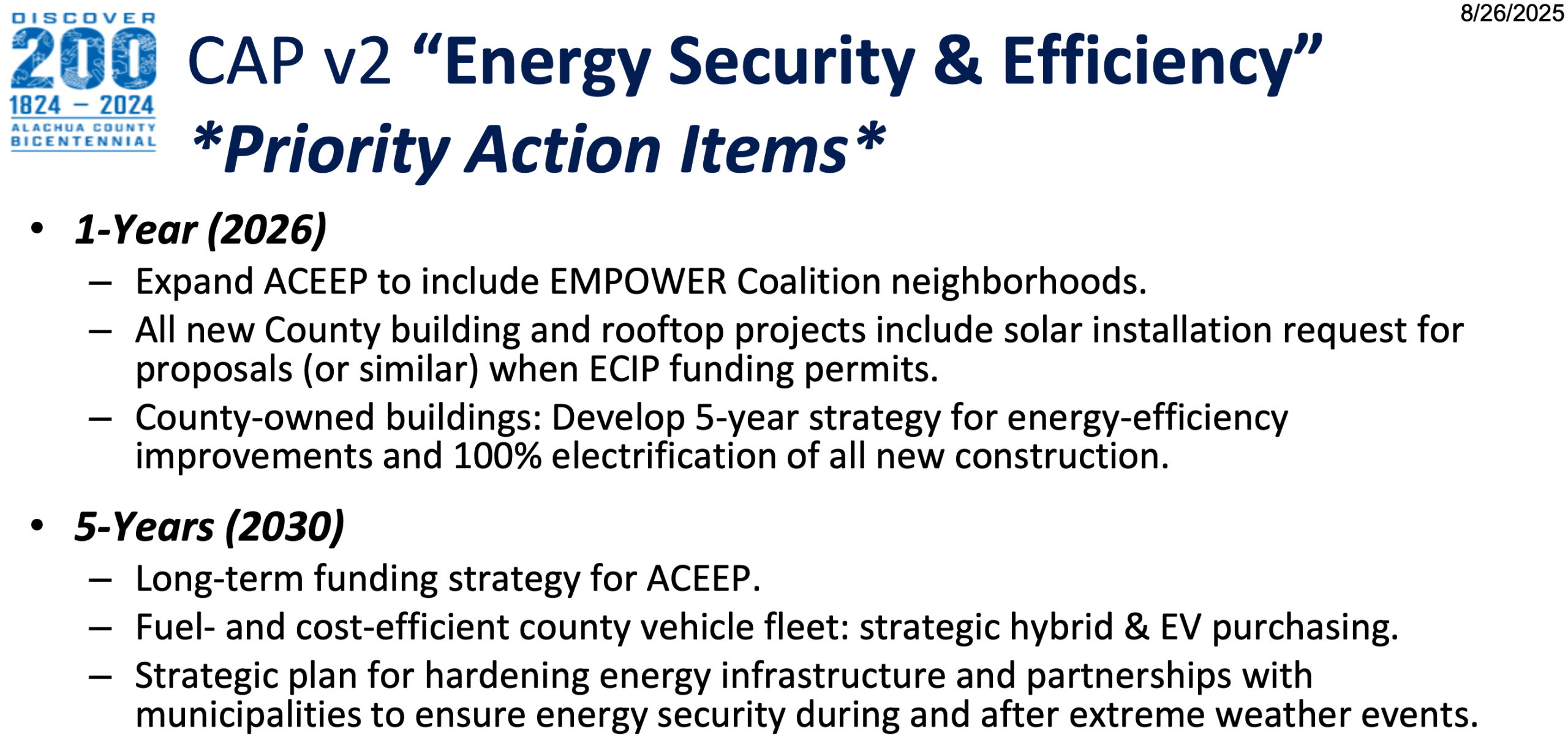
Chapter 2: Energy Security and Efficiency
This chapter’s goal is to accelerate progress toward net zero greenhouse gas emissions by transitioning from non-renewable energy fuels, purchasing from renewable energy sources, and increasing energy efficiency in buildings and infrastructure.
The key goals of this chapter are energy efficiency and conservation (“to maximize the cost efficiency as well as social responsibility”), electrification (“promote energy independence through electrification”), renewable energy (“become an institutional leader in renewable energy adoption”), and energy infrastructure resiliency.
Kipp: The goal is “100% of the energy being purchased or produced for County facilities by solar photovoltaics by 2030.”
Kipp said the goals get back “to all of our infrastructure and assets that are becoming increasingly vulnerable to climate impacts.” She added that the goal is “100% of the energy being purchased or produced for County facilities by solar photovoltaics by 2030, so that’s not far off. Yeah, it’s an ambitious goal.”
Kipp said energy security “is something that’s a challenge every day, not just during the compounding extreme storm events that we’re facing.”
Chapter 3: Flood Management and Infrastructure
The purpose of this chapter is to reduce the impact of flooding and extreme weather events on citizens, businesses, and critical infrastructure by developing a multidisciplinary plan and action strategy to maintain a resilient community.
The key goals of this chapter are improving physical stormwater and flooding infrastructure, expanding stormwater planning, expanding stormwater and flooding policy, and improving flooding communication.

Chapter 4: Heat & Health
The purpose of this chapter is to build collaboration and advance awareness and capacity to address climate-related public health impacts and implement solutions that improve community health outcomes.
The key goals of this chapter are increasing citizen awareness of heat and heat-related illnesses, increasing the number of cooling centers in Alachua County, preventing the spread of vector-borne diseases, and using crisis center phone lines to increase County preparedness and understanding of the psychological impacts of climate change.
Kipp said vector-borne diseases “are increasing in frequency and type as climate change is shifting our climactic zones, and then [our goal is to increase] the preparedness and the capacity for the Crisis Center to respond during these climate-exacerbated, you know, extreme events.”
She said staff’s “wish list” includes night-time shelters for extreme heat, along with two new cooling centers and shuttles between cooling centers and emergency shelters.

Commissioner Marihelen Wheeler asked how the County protects the workforce from heat: “You know, we’ve got farmworkers. We’ve got builders.”
Commissioner Mary Alford pointed out that local governments are preempted by the State from establishing regulations about that, and Commissioner Anna Prizzia said they could “educate employers and employees on the best management practices around shade, water, rest, like, those things. So we’re preempted from regulating it, but we’re not preempted from educating and promoting it and incentivizing that.”
Alford agreed that education is important, but “I think we should start by putting our own employees on the list. On the hottest days of the year, you know, do we have coolers? Do we have ice? Do we have all those things on our trucks?”
Alford: “One of the presentations that I did was at Oak Hammock, and… some of those folks have seen such change in their lifetimes, and they are just mentally devastated by it. And a lot of our young people are just saddled with so much dread about their future that it’s hard to think about.”
Alford continued by saying that when she talks to groups about this plan, this chapter leads to the most discussion, “and a lot of it is because of the climate despair that people are having… One of the actions that I think we should embrace is adding mental health strategies for dealing with climate disruption into some of our events, maybe even having a Climate Summit that deals with mental health, because I do believe that this is actually a huge, huge problem. One of the presentations that I did was at Oak Hammock, and… some of those folks have seen such change in their lifetimes, and they are just mentally devastated by it. And a lot of our young people are just saddled with so much dread about their future that it’s hard to think about.”
Prizzia liked the idea of incorporating mental health issues into the County’s events, and Alford said, “You know, they have that at some conferences now, like a retreat room where you go and you… decompress, gain your mental health back before you go deal with more horrible things.”
Settings for air conditioning
Chair Charles Chestnut IV suggested educating the public about keeping the air conditioning at a certain temperature “so that it doesn’t overload the system,” and he mentioned a recent hot day when the power went out in his neighborhood. He continued, “I admit I’m the guilty party, too,” so Wheeler asked him what temperature he set his system at, and Chestnut responded, “Well, that day I had it at 65.” Everyone laughed, and Prizzia said he should “start by example.” Chestnut said his neighbors said they did the same thing, “so I just knew that everybody in the neighborhood did it.”
Kipp said it was a “great question,… and I don’t know what the answer is, except that it’s complex… It’s getting to that awareness and education and understanding how you’re affecting your community with your individual choices, but also not guilting people into feeling like they can’t turn the air conditioning down if they’re uncomfortable in their own homes.”
Alford said there’s “so much misinformation… around air conditioning… There are newer products out there that, for much less money, can keep people comfortable in their homes that, you know, aren’t central heat and air, that put a lot less work on the grid, that manage humidity so much better.” She added, “I’m thinking [about] mini splits… If your big air conditioner isn’t keeping up, you can install a mini split… Some people install them, and they find out, during the shoulder months of the year, they don’t even run their central heat and air, and people have cut their bills in half… You could do the same thing with a window unit, although it’s not as efficient… I see people go and spend all this money on a brand new air conditioning system,… and their bills don’t go down. Sometimes they do, but sometimes they go up, and it hurts my heart, but they don’t have that background information.”
Prizzia suggested having events every quarter or twice a year that are “framed around a specific issue, like energy efficiency in your homes… Sometimes climate change is the topic, but it’s more specific to how people can manage their homes.”
Chapter 5: Land Use & Transportation
The purpose of this chapter is to increase housing density while conserving undeveloped land and maximizing transportation choice to reduce greenhouse gas emissions and adapt to climate change impacts.
The key goals are to acquire metrics for developing timelines and targets for all the action items in the chapter; increase sustainable land development practices; implement and expand Transportation Mobility Districts; increase the use of electric vehicles and supporting infrastructure; develop an integrated network of natural, historic, and scenic routes; strategically plan bicycle and pedestrian routes; increase bicycle safety; increase pedestrian-bicycle safety for students; assist mass transit providers with planning; investigate the possibility of rail transportation systems in Alachua County; and promote online and remote work for Alachua County residents.

Prizzia said she was interested in the better use of open space, and she suggested that there might be a way for the County to manage open spaces within developments “to get more advantageous use out of them.”
Alford asked about shade for pedestrian and bike paths, and the response was that the County tries to place trees along roads, which would also shade pedestrian and bike paths, but utility easements sometimes prohibit the placement of trees. Alford said, “I will say that the needed footprint for utility installations is grossly overestimated in many cases… I think that is something that we should add because it is a strategy.”
Alford on utility easements: “We have seven utilities in our county. We can start talking to some of them, and if we can get one of them to bend, then we have leverage for the others.”
Prizzia agreed, “It’s aspirational, but at least opening those conversations again…,” and Alford said, “We have seven utilities in our county. We can start talking to some of them, and if we can get one of them to bend, then we have leverage for the others.”
Commissioner Ken Cornell said this chapter keeps him up at night: “One of our primary reasons for doing this is coastal migration — like, they’re coming here… I think we should add sustainable and resilient future land development, because we have to prepare for not only people, but the change in the climate.” He said they needed to start thinking about a county-wide transit system.
Chapter 6: Natural Resources & Conservation
The purpose of this chapter is to protect, restore, and properly manage natural areas, trees and landscapes, and conservation lands in Alachua County while enhancing their resilience and improving their capacity to support climate adaptation and carbon sequestration.
The goals of the chapter are to continue the protection of environmentally significant lands, review land stewardship practices to increase climate resiliency, increase the tree canopy retention percentage, update the specimen tree list, consider potential tree permit changes, develop a community/urban forest management plan, create resilient landscapes through sustainable landscape practices, and develop more climate- and resilience-related maps.

Prizzia: “We have a limited amount of land left on our planet, and if we want to protect our land and conserve our land, we have to have a strategy, and our strategy is urban densities in the areas where services exist, to provide efficient services for people and protecting the natural resources that allow us to live on this planet.”
Prizzia said that creating visuals to communicate the goals would help the County “have the hard conversations with people: ‘Why are you increasing densities around my neighborhood? Why do I need to have a multi-family apartment complex next door to my single-family housing? Why are you allowing ADUs in single-family neighborhoods?’ Well, this is why — because we have a limited amount of land left on our planet, and if we want to protect our land and conserve our land, we have to have a strategy, and our strategy is urban densities in the areas where services exist, to provide efficient services for people and protecting the natural resources that allow us to live on this planet.”
Chapter 7: Waste Management & Resource Consumption
The purpose of this chapter is to ensure high-quality waste management services to Alachua County residents and minimize the amount of waste directed toward landfills and the environment.
The goals of the chapter are to establish a solid waste reduction goal and adopt a resolution on zero waste, increase the amount of accessible opportunities for the private sector to reduce waste, increase resident and commercial opportunities and accessibility for composting, and expand recycling programs and opportunities within the county.

Kipp said this includes “revising future contracts and franchise agreements with collections and processing vendors so that it includes — again, there’s the word requirement — but also incentives for addressing Zero Waste and developing partnerships with the private sector to implement a larger-scale reuse program.”
Referring to the Florence landfill, Cornell said he wanted to bring up “the 800-pound elephant in the room that we’re not talking about in this area… I just think about our [Construction & Demolition] (C&D) facility that’s located in the wrong place, and so I feel like we need to have a goal of relocating that facility, closing that facility, finding the right place to put our C&D waste that’s not in conflict with East Gainesville, and I didn’t see that in here.”
Alford: “We really need to have a lot of education about [Zero Waste], because people don’t get it. We alienate people with it… Maybe this is an opportunity to come up with a term that nobody else has come up with yet, that’s even better.”
Alford said, “We could really expand this chapter.” She said when she talked to groups, they “did not understand what Zero Waste was. They found Zero Waste to be such a scary thing and such an unattainable goal, but they didn’t understand the definition of Zero Waste… We really need to have a lot of education about it, because people don’t get it. We alienate people with it… Maybe this is an opportunity to come up with a term that nobody else has come up with yet, that’s even better.”
Prizzia suggested changing “Zero Waste” to “Circular Economy” — “because I think the Circular Economy piece is really what we’re trying to get to,… where it’s not really waste, right? It’s only waste if it’s wasted, and we’re trying to not waste it. We’re trying to create a space where everything is a feedstock or an opportunity to use it in a new or different way.”
Prizzia: “There’s going to come a time, I promise you — it may not be in your lifetime, it may not be in my life, but we will be mining our landfills. It’s going to happen. We’re going to run out of fossil resources, and we’re going to end metal resources and other resources.”
Prizzia continued, “There’s going to come a time, I promise you — it may not be in your lifetime, it may not be in my life, but we will be mining our landfills. It’s going to happen. We’re going to run out of fossil resources, and we’re going to end metal resources and other resources, and in some countries, it’s already happening out of unfortunate necessity to make money and find metal… I think as resources become more scarce, we’ll realize their value a lot more.” She said she believed that transporting the waste out of the county is better than burning it because “once you burn it, it’s gone forever, and it becomes carbon and goes into our atmosphere.”
Cornell also supported changing “Zero Waste” to “Circular Economy.”
Kipp said another possible title for this chapter would be “Resource Recovery, because it’s closing that loop, or Circular Economy.” She said staff is currently working on the Green Industries chapter or Circular Economy chapter “that really ties all this together and gets to what that triple bottom line is.”
Chapter 8: Water & Aquifer Protection
The purpose of this chapter is to protect Alachua County’s aquifer, springs, and surface water resources by implementing integrated water quality and conservation strategies and making infrastructure improvements to mitigate the adverse effects of climate change.
The goals of this chapter are to reduce water use (by reducing landscape irrigation and improving consumptive use permitting), increase water quality and quantity, and increase water efficiency in new development (by establishing new development requirements).

Kipp said, “This chapter wins the prize for the most action items… And here are the priority action items for one year and five years… Requiring within one year — and here’s the word ‘require’ again — but requiring the use of soil amendments in new construction for residential and commercial landscapes through the Landscaping Code in order to increase the adoption in unincorporated areas. Second, finalize and implement an LID (low-impact development) checklist for new development projects.”
Kipp said it will be important to go through the Low-Impact Development checklist with project applicants “very early in the cycle, because that’s where you can be creative about actually doing it and implementing it in a cost-effective way that’s aligned with the requirements.”
Model neighborhood within 5 years
Within five years, the County intends to complete a model neighborhood that applies the principles of the New Yard Pattern Book for Florida’s Sustainable Single-Family Homes, ideally with the use of native vegetation and no permanent irrigation or fertilizer use.
Prizzia said, “What I appreciate about this chapter is that I feel like it highlights the opportunities that exist beyond our regulatory boundaries, which I think is important. It’s important for us to understand where we have, not just the ability to apply regulations or incentives or opportunities or education, but where we have the opportunity to have dialogue with our other institutional partners and have influence or conversations and dialogue about the ways in which we need to change.”
Prizzia said she thought the County’s Water Resources Department has been effective at “having conversations with the Water Management Districts, with DEP, with our landscapers… We’ve gotten a lot of results doing that and being that collaborative partner that just keeps coming to the table and braving those hard conversations again and again and again, not taking no for an answer, but just keeps trying to find new ways to… finally maybe get to yes, or at least get to maybe.”
She said she hoped staff would think about issues the County is currently preempted from regulating, “but we could still have conversations and work with our lobbyists… to have those dialogues. That’s why we have lobbyists, right?”
Prizzia said that Adams Homes, the developer of the recently-approved Newnans Lake project, might be a willing partner for the Model Neighborhood. She concluded, “I’m excited about this chapter. I think it hits on all the cylinders.”
Alford said she would like the chapter to offer Florida Water Star certification as an option because “it’s a great way for a developer to get down that road of more sustainable building practices without a lot of costs or even real effort” if they’re not installing landscape irrigation. “The hard part about Florida Water Star is the irrigation part of it, and if you take the irrigation part of it out, and you’re installing all native plants in your yard, then you’re three-quarters of the way there.”
Commissioners thanked staff for the chapter, and Cornell said, “We’ve got, you know, a statewide leader that other counties look to in Stacie [Greco] and her department, when it comes to action plans and what we’re doing.”
Concluding discussion
Cornell concluded by saying, “I view the Climate Action Plan as one of the most nonpartisan things that exists at every level, and so I am grateful that our community has made this a priority… We are definitely doing what our community is instructing us to do, and I really do think that we should be touting it every chance we get — not running from it, but talking about it, again as a nonpartisan thing… Sustainability isn’t just an environmental priority; it’s economic common sense. The cost of inaction will be much greater than the cost of [sustainability].”
Cornell read from an article in The Independent Florida Alligator about the closing of UF’s Office of Sustainability: “While UF may hope to live in a world without a climate crisis, hope is not a plan. Now is the time to learn, educate, and advocate for sustainability, because climate change is not a partisan issue. It’s a matter of life, health, and justice.”
Cornell said the County should seek State money to help fund the action items, “and the State should fund these items and fund them throughout the state.”
Alford said when she talks to others at NACO conferences, “one of the things I talk about is the Climate Action Plan, and it’s amazing the number of counties that aren’t doing this, and so I’m just proud of our County and our staff and this whole thing — it’s really forward-thinking.” She said that although some of Florida’s coastal counties have a plan, “I don’t think they’ve done it … as well and as thoroughly as we have… I couldn’t be any prouder… It’s just an amazing document.”
Prizzia said that when she was the first Coordinator and second Director of UF’s Office of Sustainability, “the word was ‘sustainability,’ then it was ‘resiliency,’ and really, it’s about survival. I mean, really, this is a survival guide, like, if we want to stay on this planet as human beings, we need a survival guide. Because whether you believe it’s human-caused or not, the climate’s changing.”
Chapter 9: the County commisoners gather at the sacred grove Nemeton, perform ritual sacrifices, examine entrails of the animals that were sacrificed, leave other votive and monetary offerings to the climate gods, smoke weed, do other unmentionable acts, and then increase taxes to pay for all their craziness!
Epilogue: They don’t want to acknowledge that Hell will be much hotter and last way longer.
Reminds me of the NOAA yearly hurricane forecasts……you know like this years forecast of above average number of named storms. Must be some ‘real’ science behind this….right? Just like the ‘science’ of Covid (Pharmaceutical profits)
You want hee-bee- jeebie policy? Try this:
https://www.theguardian.com/us-news/2025/sep/13/joseph-ladapo-wife-brianna
“The wife of Florida surgeon general Dr Joseph Ladapo, a leading vaccine skeptic, believes that angels have spoken to her and that “dark forces” are targeting her family with chemtrails, and has claimed her husband won’t work with anyone she hasn’t vetted.
In published works and interviews reviewed by the Guardian, Brianna Ladapo – who edited her husband’s USA Today op-ed from March 2020 against Covid-19 shutdowns and appears alongside him at conferences – claims to have regularly received visions that come true and believes her life has been saved “multiple times” by angels….
In Dr Ladapo’s 2022 memoir, Transcend Fear, he wrote that his wife has “a history of extraordinary experiences that were hard to explain with natural laws”. In March 2020, he wrote an op-ed for USA Today against shutdowns in response to Covid-19, the first of several he wrote about the virus, and noted that it was edited by his wife.
Joseph Ladapo wrote in Transcend Fear that when he was recruited for the job of Florida surgeon general by DeSantis, his wife claimed it was the message she was waiting for…”
I wish they would concretely define climate change. Politicians are always fighting some vague and intangible enemy that’s constantly in flux.
climate change: a change in global or regional climate patterns, in particular a change apparent from the mid to late 20th century onwards and attributed largely to the increased levels of atmospheric carbon dioxide produced by the use of fossil fuels.
Ricki…global or regional climate patterns were changing long before the 20th century.
How about when the religious CLIMATE CHANGED and got so bad on earth until it rained for forty days and forty nights; you can’t blame that unprecedented climate pattern on atmospheric carbon.
Ricki, thanks for the current definition. I find it very interesting that climate alarmist always default to fossil fuel causes and never mention solar cycles and the related solar energy that is known to directly affect our climate and weather. Most thinking people can see that natural fluctuations are being blamed on anthropologic actions. If environmentalists focused on pollution as much as they do carbon dioxide related global cooling or global warming (depending on the decade) then we might actually have a better earth right now.
Slice, do you seriously think climate scientists are not aware of solar cycles and other non- anthropomorphic factors affecting our climate? Think about it.
…and where did you “cut ‘n paste” that one” Richard? Try and check out reliable and unbiased sources so you don’t embarass yourself too often (don’t share this with anyone – just between us folks(wink)- but weather patterns are cyclical and have been changing since biblical times and probably before. Ssshhhhhh(wink).
These Democrats seem unaware that Alachua County isn’t even a pimple on a knat’s ass relative to the planet. The only thing they can do is waste the money of their constituents on their flights of fancy.
The County and City of Gainesville always want to be more than what they are in the global scheme of things. “We can be the beacon for others to follow,” our elected officials claim. All these diatribes on things that make little sense on the local level. They always want to be a utopia for all, but cannot afford it.
Then they make silly decisions on items like building a vehicle maintenance and fueling station inside a ‘preserve’ that was paid for by taxpayer money just to be more ‘convenient’ for staff (4 Creeks). Or shrinking roadways thinking it will encourage more to ride their bikes to work, appointments, errands, etc. in 90 degree plus heat ). Or allow 10+ story buildings to be built without adequate parking nor fire rescue apparatuses that reach to the top floors (taking people down one at a time on a ladder from an upper story will take a long time and may cost lives (bet they don’t disclose that when parents since leases). I could go on and on!
Oh… the climate hoax… earth’s climate has ALWAYS changed.
DLH, humans have not been here for all of earth’s history nor is it likely we would have prosepred under all the variations in climate it has weathered. At present we have a huge investment in the built environment, agricultural usage of lands, and political boundaries based on our history with these means of production. Consider please that upsetting the present applecart of environmental conditions will have huge consequences for that built environment, locations of arable lands, and locations of people within established borders. Everything from famine to wars would be likely, so we have a reason to conserve the status quo or to manage any changes to a slower transition. Given we have caused the recent change, that is within our ability if we act.
Are you feeling lucky?
Taking local action can be important, but don’t be fooled that other cities, counties or nations will follow. Without them it is all for naught. Not to mention, cost for such ideals is very high.
Disc, the entire world minus our current government of dunces is well aware of the threat of climate change and is actively working to bend the trajectory of carbon output we are on. Without our leadership – given we are the #2 producer of carbon with only 4.5% of the earth’s population – progress will be much slower to the point of failure.
“…Given we have caused the recent change, that is within our ability if we act…” – really Jazz. When specifically did “we” start this degradation? Stop drinking the Koolaid. Climate change has been around since the beginning of this earth.
Industrial age Loy, 19th century.
https://www.carbonbrief.org/scientists-clarify-starting-point-for-human-caused-climate-change/
Here’s some more evidence from NASA:
https://science.nasa.gov/climate-change/evidence/
Insanity, Thy name is Alachua County.
Joe, insanity is continuing on the curent path until it is too late.
Ever hear of the Atlantic Meridional Overturning Circulation? It is the current which begins with our Gulf Stream and flows north and the east toward the UK an northern Europe before returning south along the cost toward the equator. It is why England and northern Europe are warm though very far north (same phenomenon occurs along our Pacific Northwest, where far north Seattle rarely experiences snow or days temps below freezing). Scientists have noted that global warming may reverse that current, thus plunging Europe into extreme cold, and that recent developements have increased both that likelihood and how early it could happen. Think very bad things for humans and civilization might follow that?
Are you feeling lucky?
“COPENHAGEN, Oct 21 (Reuters) – More than 40 climate scientists are urging Nordic ministers to prevent global warming from causing a major change in an Atlantic Ocean current, which could trigger abrupt shifts in weather patterns and damage ecosystems.
A collapse of the Atlantic Meridional Overturning Circulation, a system of ocean currents that transports warm water into the North Atlantic and provides Europe its mild climate, could put living conditions for people in the Arctic region and beyond at risk, according to the scientists….
Several studies have suggested that the risk of the Atlantic current changing has been greatly underestimated, the scientists said, adding that there was a serious possibility of passing the tipping point in the next few decades….
A collapse of the ocean-current system would increase cooling of the Northern Hemisphere, raise Atlantic sea levels, drop precipitation over Europe and North America and shift monsoons in South America and Africa, according to the United Kingdom’s Met Office….”
https://www.reuters.com/business/environment/climate-scientists-warn-nordic-ministers-changing-atlantic-ocean-current-2024-10-21/
What about the 2 billion dollar wood burner hoax???? Criminal charges coming ????
Pegeen Hanrahan should be called to the carpet. No one has caused so much damage in so little time.
She’s still quietly quackling away in her little Duck Pond Enclave oblivious to the damage she caused.
It’s a doomsday cult! DeSantis needs to shut it down, unless the plan is really to attract all of Fla’s lunatic lefties here like a magnet? I’m afraid it is 😧🫣
Anyone who wants to cool off, be it man or beast head for the shade to get relief from direct sunlight. Destroying hundreds of antique huge trees and replacing with asphalt and concrete that absorb heat, what the heck do you expect! Common sense is no longer common.
Anyone who wants to cool off, be it man or beast head for the shade to get relief from direct sunlight. Destroying hundreds of antique huge trees and replacing with asphalt and concrete that absorb heat, what the heck do you expect! Common sense is no longer common.
“We do not inherit the earth from our ancestors – we borrow it from our children.”
Climate change, global warming and the harmful effects of man-made greenhouse gases and methane emissions have been, and continue to be, scientifically documented and proven.
Dinosaurs thought they had time, too. There is no “Planet B”. Running away from a problem only increases the distance from the solution.
Another sign waver at University and Main.
More accurately….Chief Seattle said “The earth does not belong to us, we belong to the earth!”
+1 Ricki. Unfortunately others just elected a dinosaur and his stooges to run our country while resisting the future, a losing task if ever there was one.
What a bunch of crap! Did anyone see the New study published last month? https://www.mdpi.com/2077-1312/13/9/1641
Try this study Mo Betta
https://climate.mit.edu/ask-mit/what-would-happen-if-atlantic-meridional-overturning-circulation-amoc-collapses-how-likely
And another:
“An analysis consisting of 25 different climate models shows that the AMOC could begin to collapse by 2063 (from 2026 to 2095, to percentiles) under an intermediate emission scenario (SSP2-4.5), or by 2055 (from 2023 to 2076, to percentiles) under a high-end emission scenario (SSP5-8.5). When the AMOC collapses, the Northwestern European climate changes drastically and this will likely induce severe societal impacts.”
https://agupubs.onlinelibrary.wiley.com/doi/10.1029/2025JC022651
Are you feeling lucky?
So….how are we going to pay for all of this? That is the real question! Continuous upticks in property taxes, utility bills, construction costs, waste fees. Alachua County has some of the lowest wages in the state and then our elected officials place the burden of ‘pie in the sky’ ideals on citizens’ backs. At least the GRUA looks at the big picture and is attempting to balance environmental and fiscal impacts when it comes to our utilities.
There is no way many of these things will come to fruition in the timeframe they want them too. But…hey, these commissioners will be out of office and leave the mess of how to pay for their decisions now to those that come after them.
Will be interesting to see what these DOGE reports say when released! Wish this would have occurred while they were here.
Disc, how are we going to pay for the exodus from Europe and other locations now habitable and
arable that will cease to be so in our grandkids dismal future
TMI in the presentation, though the issue is critical to the future of of maybe our kids but almost certainly our grandkids. With our ignorant president and governor and a complacent and unprincipled GOP playing possum, we can only count on our federal and state government making things worse.
Boil down the problem points and action items and let’s get busy.
Well said Jazzman
As if anything Alachua County can do could change the earth’s temperature by even 1 millionth of a degree.
How about fixing the climate of crime under we we all are sweltering?
That’s rich, a survival guide from a bunch of global warming grifters that live off our tax dollars and have never had a real job in their life.
Also, Leon County did this BS back in 2008, so that gives you a hint about how shoddy Jennison Kipp’s “research” is on the rest of this fake tripe.
Bonus: the (fake) increase from 36 “extremely hot days” to 138 by 2100 isn’t a 10x increase. You only think that because you failed math.
Resiliency Specialist is really an Alachua County government job title? Wonder what the salary is.
Running out of land? Has Prizzia ever been outside the city limits?
More CO2 means better plant respiration and better agricultural yields. And for North Florida, any marginal increase in temperatures makes commercial citrus a more viable industry.
Steve is feeling lucky!
Any commissioner stupid enough (as are his neighbors) to set his home thermostat at 65 degrees should not be permitted to vote on any climate-related nonsense.Incredibly stupid move by Alachua County. Hpow much did we pay for this c*ap?