“This is outrageous”: Alachua County Commission hears potential effects of property tax reform on County budget
BY JENNIFER CABRERA
GAINESVILLE, Fla. – At the February 10 Alachua County Commission meeting, County staff responded to a recent Florida DOGE report that highlighted Alachua County budget increases, and Commissioners expressed the hope that initiatives to limit property taxes on homesteaded properties would fail.
Alachua County Manager Michele Lieberman said that since Fiscal Year 2018, Alachua County has reduced the general millage rate by 0.8648 mills, a 10.22% decrease, while the MSTU Law Enforcement (MSTU-LE) millage rate has remained unchanged for the past six years. Over the same time period, the property valuation in the county increased 72%, while property taxes increased 54%.
Lieberman said the County is also committed to providing a living wage, and since Fiscal Year 2018, the County’s minimum wage has increased from $13 to $18.50. She said these efforts support workforce retention and help the County remain competitive in tight labor markets.
How Alachua County’s property taxes compare to other counties
Lieberman’s presentation began with an overview of how Alachua County’s millage compares to other Florida counties; the County’s aggregate millage rate is 9.0768 mills, which is 51st out of 67 counties. The General Fund millage rate of 7.6180 mills is 41st out of 67 counties. County property taxes are $714 per capita, the 32nd lowest among 67 counties and lower than the state average of $942.
Lieberman said only 67.36% of the assessed property value in the county is taxable, less than the state average of 84%. She said that a millage of 6.1045 mills could generate the same revenue if the taxable value of property matched the state average, and she suggested that a payment in lieu of taxes from institutions like the University of Florida could be a partial solution.
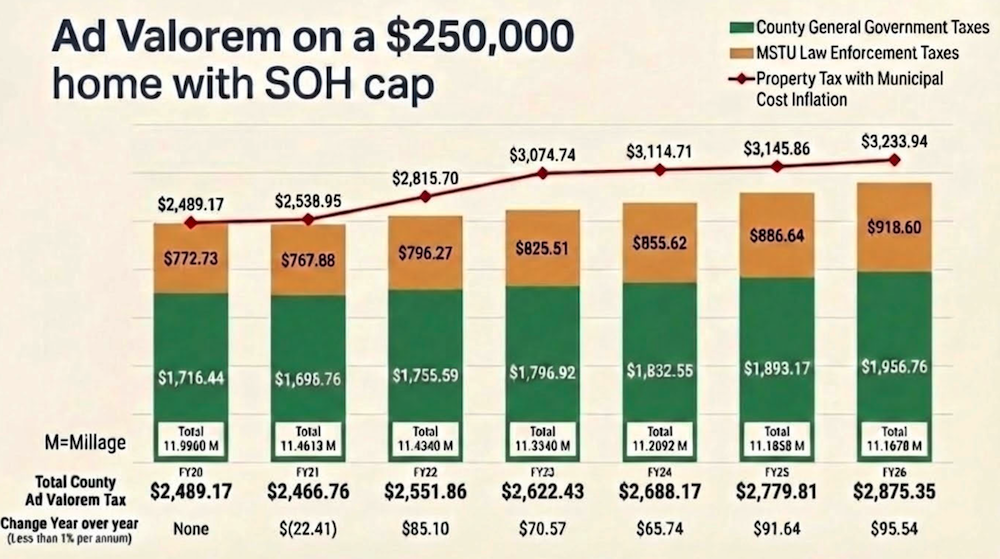
Referring to the slide shown above, Lieberman said that the property tax on a homesteaded property increased from $2,489.17 in FY20 to $2,875.35 in FY26, an increase of less than $100 per year.
Lieberman said the County’s inflation rate (the Municipal Cost Index or MCI) is higher than the CPI, which is linked to a consumer product index, so it’s not accurate to compare the County’s budget increases with the CPI. She said increases in employee benefits, waste hauling, construction costs, ambulance costs, fire trucks, and paving are considerably higher than the inflation rate.
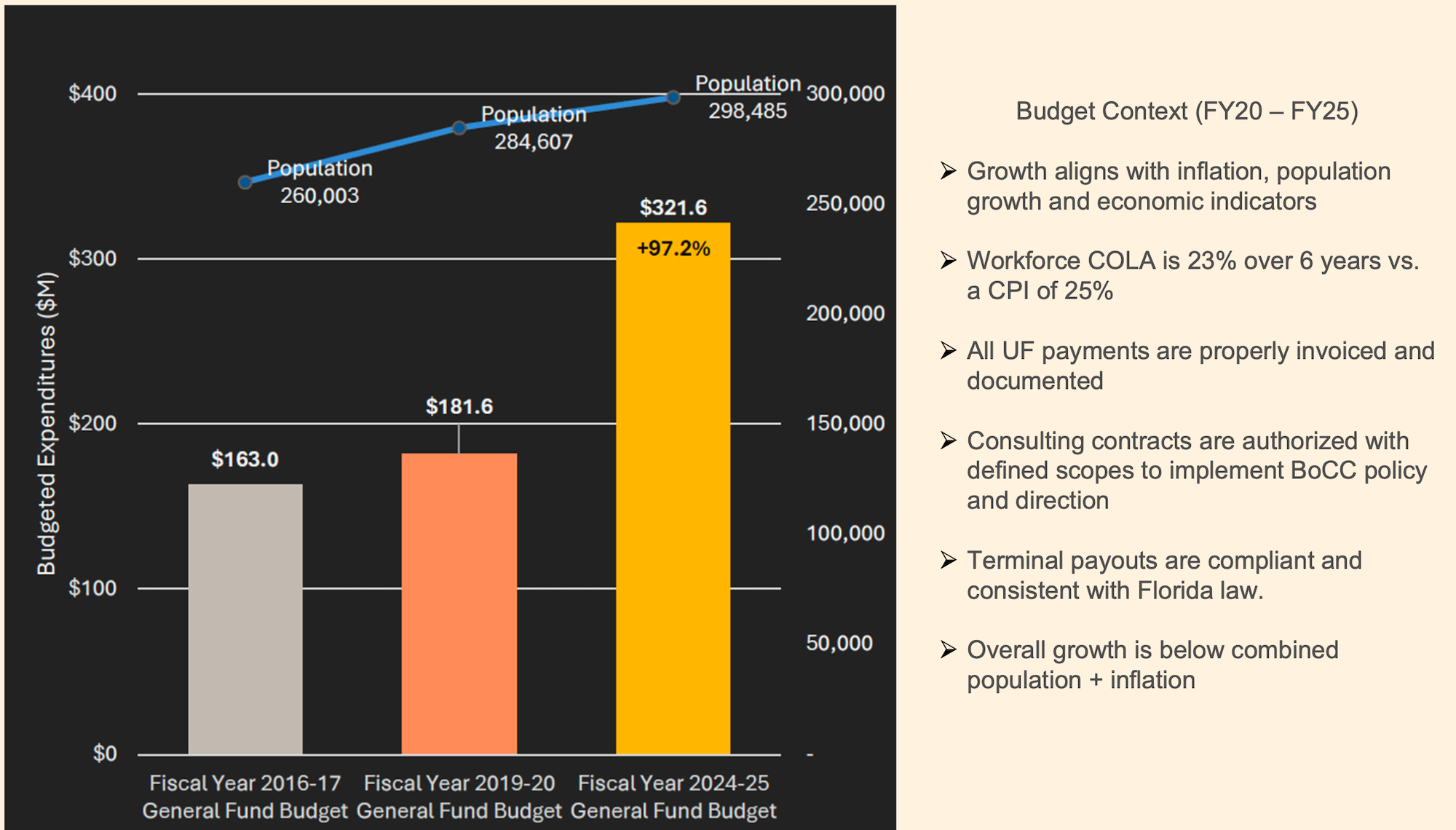
Assistant County Manager Tommy Cosby showed a chart from Florida DOGE report, demonstrating that Alachua County’s General Fund spending nearly doubled while the population only increased by 15%. Crosby said the growth in the budget was “more aligned with what we’re seeing in terms of true economic growth. Over that same period of time, we were seeing almost 30% growth in the economy, between inflation plus the population.”
The Florida DOGE report called out Alachua County’s across-the-board pay increases of 6%, 4%, 7%, and 3% in recent years, and Crosby said the County “actually provided [cost-of-living increases] of 23% over that six-year window, which is less than the cost of inflation. So I don’t think there’s any apologies needed for trying to recruit and retain good employees.”
Responding to an assertion in the Florida DOGE Report that the County had not kept any records of invoices or payment specifics regarding contracts with the University of Florida, Crosby said the Clerk’s office “has verified that any payment made had an appropriate invoice included with the payment and supported the consulting contracts.”
Regarding terminal payouts made to employees by the County that the Florida DOGE report listed as excessive, Crosby said, “I would like to remind the State — that is consistent with Florida law and how they pay terminal payouts as well… All those are in alignment with Florida’s statutes.” Lieberman added that Florida law requires the County to pay those terminal payouts.
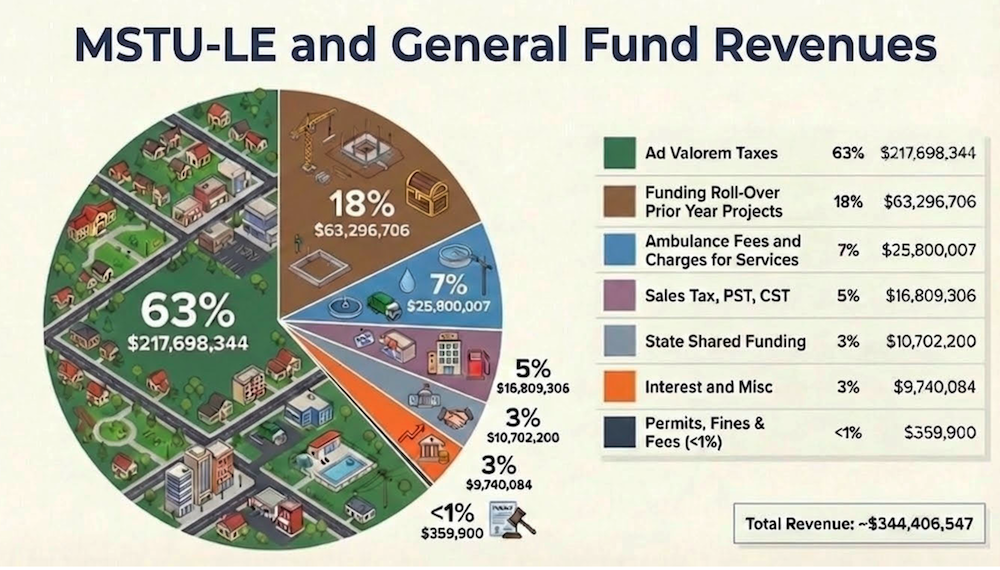
Referring to the chart above, Lieberman said that 63% of the MSTU-LE and General Fund revenues come from property taxes; the second highest source of revenue is rollover funding from prior years, and the third, at 7%, is ambulance fees.
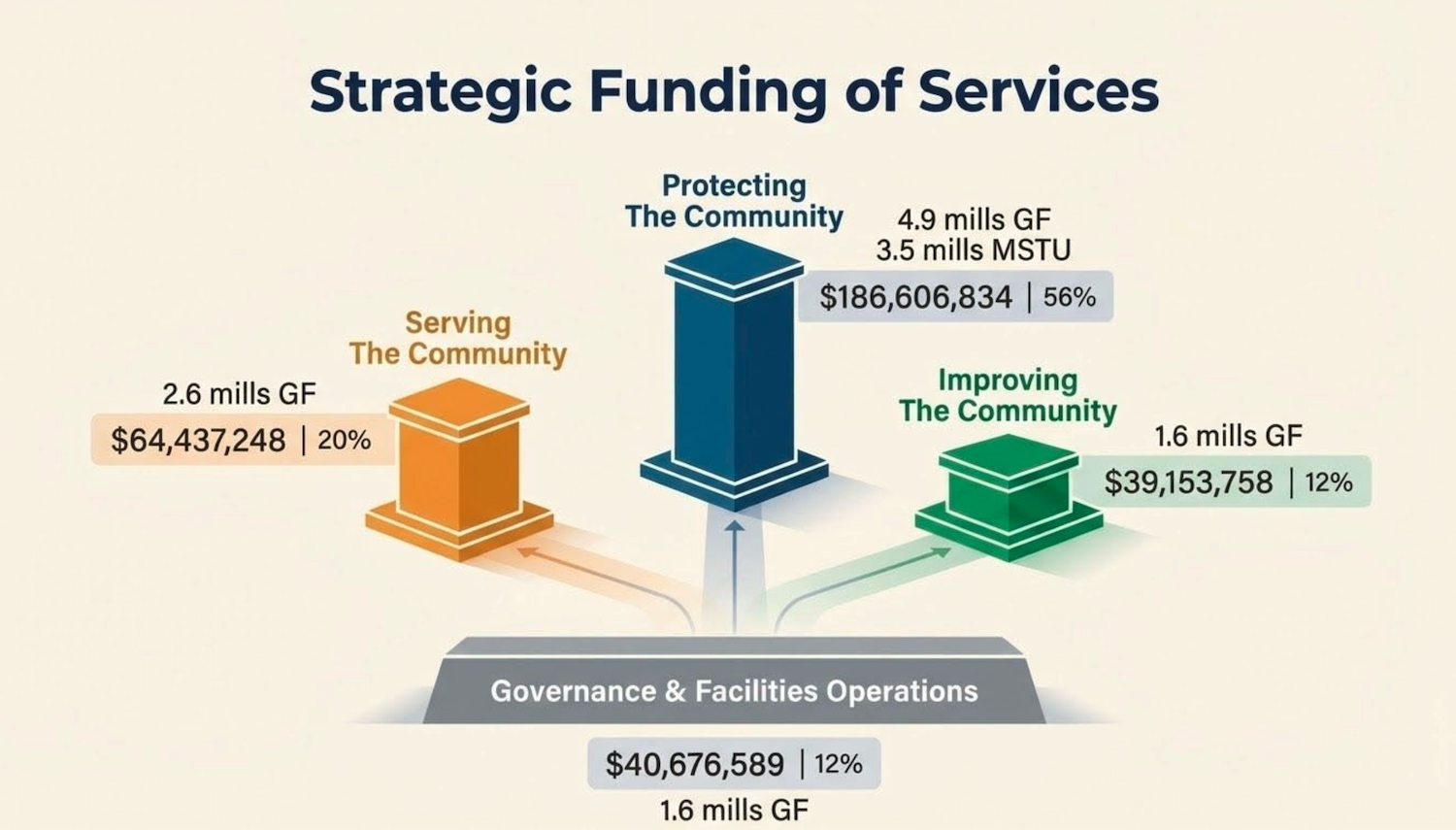
Referring to the slide above, Lieberman said the County spends $186.6 million a year on public safety, $64 million on serving the community, $39 million on improving the community, and $40.7 million on County and facility operations, “so a majority of County spending supports direct service delivery,… especially the protection and community-serving functions.”
Services mandated by the State include $6.2 million for the 8th Judicial Circuit (including court administration, court facilities, and the State Attorney and Public Defender offices) and $12 million for state-required services (including juvenile detention, Medicaid, the Medical Examiner’s Office, and the Health Department). The budgets for all of these entities are set by the State, and Lieberman said the County could cut the property tax rate by about 0.75 mills if the State paid for those services.
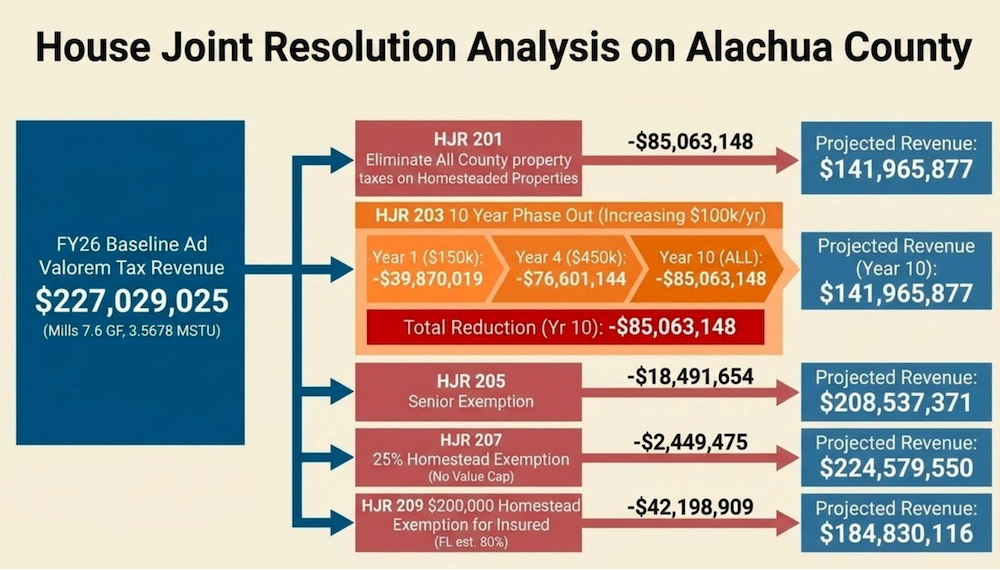
Lieberman said that under current House proposals, the County would lose between $2 million and $85 million in revenue per year. The worst case, which would be the elimination of all County property taxes on homesteaded properties, would cut the County’s property tax revenue to $142 million.
Chair Ken Cornell: “In the discussions I’ve had at the legislature with some of the Senators, they’re getting polling now from the Boomer generation that is terrified of a reduction of services, and they don’t think that this would pass.”
Chair Ken Cornell said, “In the discussions I’ve had at the legislature with some of the Senators, they’re getting polling now from the Boomer generation that is terrified of a reduction of services, and they don’t think that this would pass.” He said the County’s lobbyist thinks nothing will come out of the regular legislative session: “It’s going to come out of a special session. It’s all supposed to happen this summer.”
Lieberman said the next budget has to be passed by September 30, but the County won’t know the impact of any ballot resolution until November: “So we’re trying to be responsible in what we’re presenting to you, but we’re coming from a point of not exactly knowing.”
Commissioner Anna Prizzia said her understanding is that the legislative proposals require the County to “hold harmless” the public safety budget, but the County’s expenses for the Sheriff’s Office and Fire Rescue are higher than the $142 million projected under the worst-case proposal.
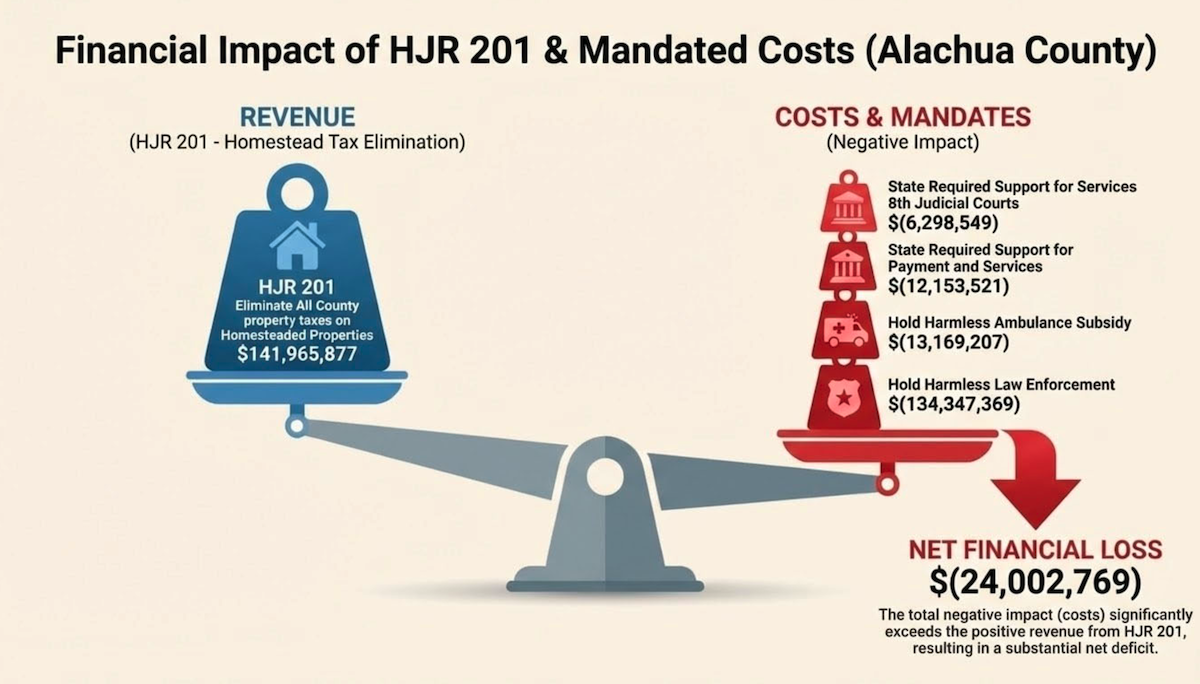
Lieberman said that the required expenses for the 8th Judicial Circuit, state-required services, the ambulance subsidy, and law enforcement add up to $24 million more than the $142 million in projected revenue that would result from eliminating property taxes on homesteaded properties. She also pointed out that not all of the County’s other revenue can be reallocated to those expenses because some funds are restricted to certain expenses.
Lieberman listed examples of General Fund expenses that would not be funded under the scenario above: Animal Services, Community Support Services, Parks, and the offices of the Property Appraiser, Supervisor of Elections, Tax Collector, and the County Clerk. She said other unknowns are how the Water Management Districts, Children’s Trust, and Library District would be funded. She said schools are not affected: “People will still pay school taxes under all of these proposals.”
Commissioner Mary Alford said she thinks property insurance is a bigger burden than property taxes, and “coming after us is, I think, a fool’s errand.”
County Manager Lieberman: “There is a very real recognition at the state level that many municipalities may not survive the elimination of property tax, which means that the County becomes responsible… for the municipalities who can’t survive.”
In response to a question from Commissioner Marihelen Wheeler about whether the State might reduce the mandated spending if property taxes are reduced, Lieberman said, “As a reminder,… the elimination of property tax also hits every municipality, and there is a very real recognition at the state level that many municipalities may not survive the elimination of property tax, which means that the County becomes responsible… for the municipalities who can’t survive.”
Commissioner Charles Chestnut said, “What the state has been doing to the cities and counties over the years hasn’t been fair. We all know that.” He said most legislators have never served in local government, so some of them don’t understand local budgets, “and then you’ve got politics. They’re playing politics. They’re playing to their leaders… If you’re going to judge us, okay, let us judge you, also, in terms of how you’re spending and what you’re funding… We’re not in a position to do that, but they are, and I think that’s the unfair part for us.”
Commissioner Charles Chestnut: “This is outrageous.”
Chestnut continued, “This is outrageous… If we have to start at a $24 million deficit to develop our budget,… how do we… continue the level of services that we provide to our citizens?… They’re using DEI as an example for this foolishness that they’re doing, which has nothing to do with it. When you really look at the DEI stuff that’s being spent across the state, it’s not very much.”
Chestnut expressed his frustration with legislators who have “no experience” and added, “It’s just frustrating to me. I just don’t think that people are really paying attention… Let’s hope that this doesn’t go far at all. I hope that the citizens wake up and start paying attention.”
Prizzia said, “I think it’s very clear, looking at this, the things that people rely on every day, whether that’s just road repaving or an ambulance showing up, could have really detrimental effects if some of these property tax proposals make their way through the legislature.”
Regarding schools, Prizzia said they have not been protected from the cuts “because the voucher system gutted our schools’ funding systems already… I’m also really frustrated with the hold-harmless for law enforcement. While — 100% — public safety and law enforcement are one of our most important duties in government, holding law enforcement harmless is saying… they don’t also have fat they could cut, or they don’t also have places where maybe they could be thoughtful about the way in which they’re expending funds… If you’re asking us all to take a hard look at our budgets and a hard look at the way in which we expend public dollars, then I think the largest expenditure of our budget should be the very first place that we look.”
Chair Cornell: “I’m actually kind of embarrassed for the State, to be honest.”
Cornell said he owed the other Commissioners an apology because when he heard the County was being audited, “I got really excited — like, this is gonna be great… So, first of all, I apologize for that. I mean, I’m actually kind of embarrassed for the State, to be honest. [The Florida Association of Counties (FAC)] put out a statement and said… ‘there are serious concerns about the accuracy of the data and the conclusions drawn from it. It relies on selective snapshots, one-size-fits-all formulas that do not reflect the full and correct range of services local governments are required to deliver.'”
Cornell said FAC “loaded this report into AI,” and “here’s what AI said about the report… Basically, what [the state] did is, they fed into AI what they wanted to say, and here’s the evidence that AI kicked back out from what the report said… It says there was a formulaic argument flow: nearly every section follows the same sequence — data, moral judgment, political framing, conclusion. That consistency across unrelated topics and jurisdictions strongly suggests automated narrative generation from structured inputs.”
Chair Cornell: “Despite what the appointed CFO from Florida says — which, by the way, he’s not a CPA, and he used to be the head of the Republican Party for the state — in my opinion, that report was an AI-generated political hit job.”
Cornell concluded, “[The Florida DOGE report] reused templates across cities and counties. We have 67 counties; they’re all different… Our county’s budgets are transparent. They’re fiscally responsible… Despite what the appointed CFO from Florida says — which, by the way, he’s not a CPA, and he used to be the head of the Republican Party for the state — in my opinion, that report was an AI-generated political hit job… I am grateful for the work that our staff has done, for the input that our citizens give us as we set our budget, and I’m sorry that the rest of the counties are going through this pain of how to fund the local services that your community desperately needs.”
Lieberman concluded by saying that state legislators are saying the people should have a say in limiting property taxes, but “people have a say when they go to our elections here in the community… And as a reminder,… because of where the population centers are, approximately eight-ish counties could pass a constitutional amendment for the other 59. So if it is important to keep your decisions on that local level, it’s important not to vote for this on a statewide level.”
This is a key point that should be emphasized: “only 67.36% of the assessed property value in the county is taxable, less than the state average of 84%.” Did the so-called intelligent voters pick up on that? That means almost 20% — TWENTY PERCENT — more property is not being taxed compared to the rest of the state.
Look at it another way: state average for exempt property is 16%, while Alachua County is at 32%+. That’s over twice the state average. Yet the County keeps buying as much property as they can and that in turn has a direct impact on the tax rolls. Hate to say I told you so, but I told you so. If it makes you feel better, you can go hug a tree.
UF owns 24% of taxable property in Alachua County. Alachua County owns 13%. I got these figures from Duck.ai, but they also give a figure of 32.6% for properties exempt from property taxes, which doesn’t add up.
A swamp off Hawthorne Road does not bring in much in taxes and the county is not buying prime real estate. A green Alachua County not only benefits citizens by providing more environmemtally sound conditions, but also for recreation and …….. ecotourism which brings in both economic gain for citizens, but tax dollars as well.
Stop thinking small.
That’s still too large for your pea-sized brain to comprehend Jazzmouth.
Such complete gaslighting by a commission that knows its gravy train is about to end. Since 2018, Alachua County’s population has increased 10.5%. The budget has increased 100% in that same time period. The cumulative rate of inflation over that same time period is 29%. So a reasonable person could expect the budget to rise by at most 40%, not 100%. And I don’t know about most folks in Alachua County, but my property is NOT valued at $250,000. About 52% of properties are valued over $250,000, but I acknowledge there are many poor people in this county, as well as many upper income people. On a personal level, I started paying property taxes here in 2022. It has risen from $11,828 to $12,864 in 2025. That’s a 8.75% increase in 3 years. And I am a retiree, not affiliated with UF in any capacity. So while the Alachua County Commission may be insulted that their Marxist experiments must end – end they must. Floridians DEMAND property tax relief. I am personally in favor of their complete elimination for homesteaded properties of full-time residents. At the very least, property taxes should be eliminated for full-time Florida residents that are retired. Others should also get significant property tax relief. Our homes are the only property that we have to pay the government rent to own. When you buy a TV, you pay a one-time sales tax. For your vehicle you pay an annual registration that is nominal. THIS ABUSE NEEDS TO END ONCE AND FOR ALL!
I agree, well said
Outrageous? Maybe they should cut $84,000,000 from the budget first. Then come back to us taxpayers. 🇺🇸🇺🇸🇺🇸🇺🇸
The same old tired arguments, the state isn’t fair. Someone needs to compare the amount of Preserves in this area that is owned by the city compared to other municipalities. A park on every street corner and a bike lane on every road is a great dream to have but you are taxing your residents out of your county. People that have been here are fleeing, the only ones moving here have no idea about the corrupt government that is Alachua county/Gainesville. City commissioners giving away tax money to developers that would have built here anyway (no tax incentives were needed, but now no revenue from all of those high rise apartments) but then you wouldn’t have gotten your kick backs right?
Wow, cut the crap! Name names and deals you think are corrupt or shut up.
Here’s a name for you, Jazzman: Johnathan Paul and all his MMTM cronies.
Please Tony, tell us about, or a link might do.
one example:
https://alachua.granicus.com/player/clip/4418?view_id=8&caption_id=13964847&redirect=true
start @ 1hr 25min
Thanks Tony. Can you give me a tip on what I’m looking for and where? The video is 3 hours long.
He did. Can’t you read?
I noticed she didn’t say anything about the amount of money they give marketplace. Or the amount of money they give the nonprofits every year cut every damn thing in the budget that has nothing to do with law-enforcement fire rescue streets sanitation does i for one is damn tired of paying rent to the government for a house I own.
We saw in plain view lat night how retaining a “good” county staff hurts Melrose.
How can the Wildflowers Music Park be a nonprofit is the land is owned by Wildflowers Music Park Finance LLC? Some real slight of hand going on between the Alachua County Commission, Robert “Hutch” Hutchinson and the New York investor.
They all take turns making typical claims meant to instill fear into the county residents if their money spigot gets turned off, when in reality it is their spending and social policies that have caused quality of life issues for Alachua County residents.
Also, “Commissioner Mary Alford said she thinks property insurance is a bigger burden than property taxes, and “coming after us is, I think, a fool’s errand.””
This comment shows how completely disconnected the CC board members are from reality. If I had a choice to pay one or the other, I would definitely pay my insurance as my property taxes are 3X higher than my insurance premium. And my property taxes are well below almost all of my neighbors.
“they’re getting polling now from the Boomer generation that is terrified of a reduction of services,” Thanks, that caused the first real laugh of the day.
Their numbers aren’t adding up. I own a home in Alachua county and one in Polk county. These were purchased within a couple years of each other and both homesteaded. The home in Alachua county is appraised at $100,000 less but the property taxes are over $1,000 more per year.
When are you leaving for Polk County? Enjoy their cultural life, educational opportunuties, world class sports, and those phosphate mines turned into parks.
I’ve been there for a few years now. I love it. Only came back here here because of family and my child attends UF.
Good for you and happy you’re happy there.
Over my long life I’ve lived in several other places rated by many as beautiful to great places to visit or live in and I still visit some of them. I usually note on returning here from trips what a beautiful and great place I live in now (though too hot in the summer!). Sorry your experience is different and given a growing population with most here transplants, I’m fairly confident that my experience is not unique. By the way, I first came here in 1963.
“Oh no” is right! Now who’s going to pay for their maxist indoctrination and criminals in the making centers?
Take away the trough of wasteful spending and the piggies start to squeal.
So maybe now you’ll NOT buy UF’s property for a million dollars for a new animal services place and instead use the land you already own?
Well… It appears that we really need a County owned and managed Grocery Store.
All of you Farmers, bring your products to us to sell for you. Karl
We must tame the beast that is county government by starving it. Bring on the revenue cuts. Leave the money with the people.
Chair Cornell: “Despite what the appointed CFO from Florida says — which, by the way, he’s not a CPA, and he used to be the head of the Republican Party for the state — in my opinion, that report was an AI-generated political hit job.”
Bingo. Florida DOGE didn’t even bother to supply the county with it’s “report” which is obvious political MAGA BS and which the MAGA crowd here is still sucking up like it was ambrosia.
Lieberman compared Alachua County millage rates to other counties that fund their fire and garbage service from their millage collection. Alachua county charges FEES for those services on top of their millage collection as an additional charge on your property tax bill. So not an apples to apples comparison.
I live in Melrose, but in the Putnam County area. I live very close to the Wildflowers Music Park. It is disgusting that the Alachua County commission has not only betrayed the residents of their county, but they have ruined the town for the adjacent counties of Putnam, Clay and Bradford, who are also part of Melrose, too.