
Bielarski: Fact or Fiction, Part 4

Letter to the editor
Purpose
As the general manager under the Gainesville City Commission for several years and the CEO under the nearly new GRU Authority (GRUA), I am uniquely qualified to provide perspective on the rhetoric you may be hearing about GRU’s current governance. To help navigate this rocky road, each week, I will address a new subject that I think needs clarification or, in some cases, is simply untrue. If you have specific questions about GRU or want to clear up something you’ve heard, please feel free to email me at bielarskiej@gru.com.
Claim
The Gainesville Regional Utilities Authority is responsible for the City of Gainesville’s fiscal year 2026 budget deficit of $9,808,945. In fact, it is a “General Fund structural revenue deficit created by Government Services Contributions (GSC) reductions.”
Facts
The Authority is not to blame for the City’s Fiscal Year 2026 budget shortfall, but the City Commission’s June 12 budget presentation helps us understand who and what is.
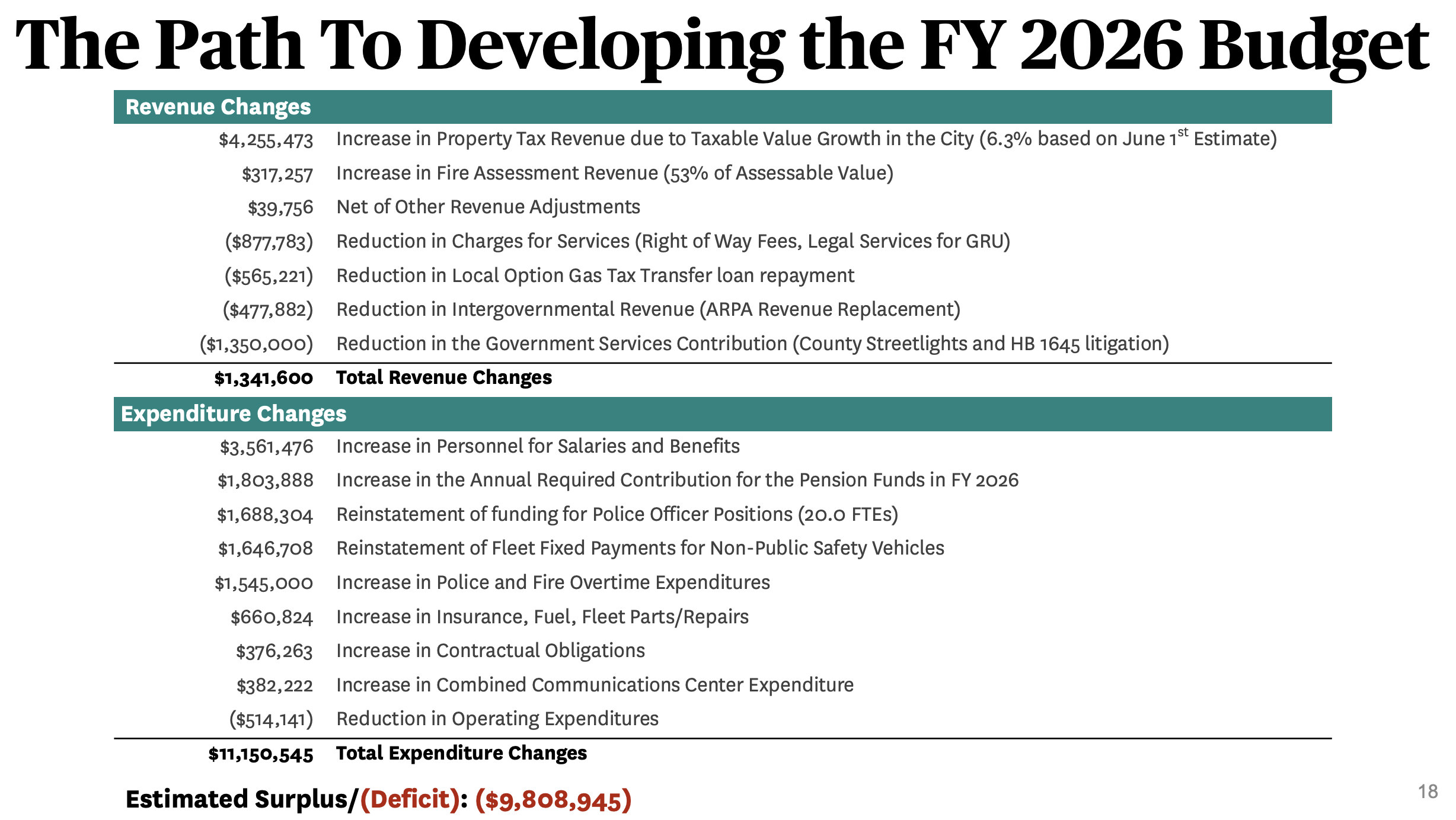
Key Point #1: GRU reduced its contribution to the City by $1.35 million while the City increased its expenditures by $11 million.
The year-over-year reductions in GRU’s general fund transfer (GFT) equal $1.35 million, much less than the City’s $10 million shortfall. However, the other items shown on the slide above expose the City’s real challenge: spending.
The first eight lines under “Expenditure Changes” document the City staff’s request for $11.7 million in additional expenditures for Fiscal Year 2026:
- $3.6 million in higher salaries and benefits
- $1.8 million in higher pension costs
- $1.7 million in 20 police officer positions
- $1.6 million in reinstatement of Fixed Fleet Payments (non-safety vehicles)
- $1.5 million in police and fire overtime
- $ 700,000 of insurance, fuel, and fleet repairs
- $ 400,000 in additional contract obligations
- $ 400,000 in Combined Communications Center expenditures
While the ninth line shows a proposed staff reduction of approximately $500,000 in operating expenditures, the reduction is less than one-third of 1% of their Fiscal Year 2026 budgeted expenditures.
What is most telling is that the net $11.2 million increase in expenditures represents a 7.2% increase over the City’s adopted fiscal year 2025 budget, an almost 10 times greater impact than the $1.35 million reduction from GRU’s general fund transfer payments.

Key Point #2: City revenue only grew by $1.3 million
While the City’s expenditures are increasing by over $11 million, its revenues increased by only $1.3 million, or less than 1% more than fiscal year 2025 (see slide above). Key factors include:
- $4.3 million increase in property tax revenue from Taxable Value
- $300,000 increase in Fire Assessments
- $1.9 million decrease in Local Gas Tax Transfer, Charges for Services, and ARPA Funding
- $1.35 million reduction in GRU’s general fund transfer
If GRU had not reduced its Fiscal Year 2026 general fund transfer, total revenues to the City would still be growing by only $2.7 million, or about 1.7% above its fiscal year 2025 budget. Again, the City’s budget crisis is not a GRU problem; it’s a spending problem.

Key Point #3: The City has not reduced expenditures between fiscal years 2024 and 2026.
While we’ve heard about the City’s purported budget cuts, the slide above tells a different story. After adopting a Fiscal Year 2025 General Fund budget that had been slimmed down by 0.7% from the Fiscal Year 2024 adopted budget (see page 18 in the FY2025 budget document), the City:
- Later increased that budget by 2%
- Increased its Fiscal Year 2026 budget by 7%
The bottom line is that there is no reduction in expenditures between Fiscal Year 2024 and the proposed Fiscal Year 2026 budget.
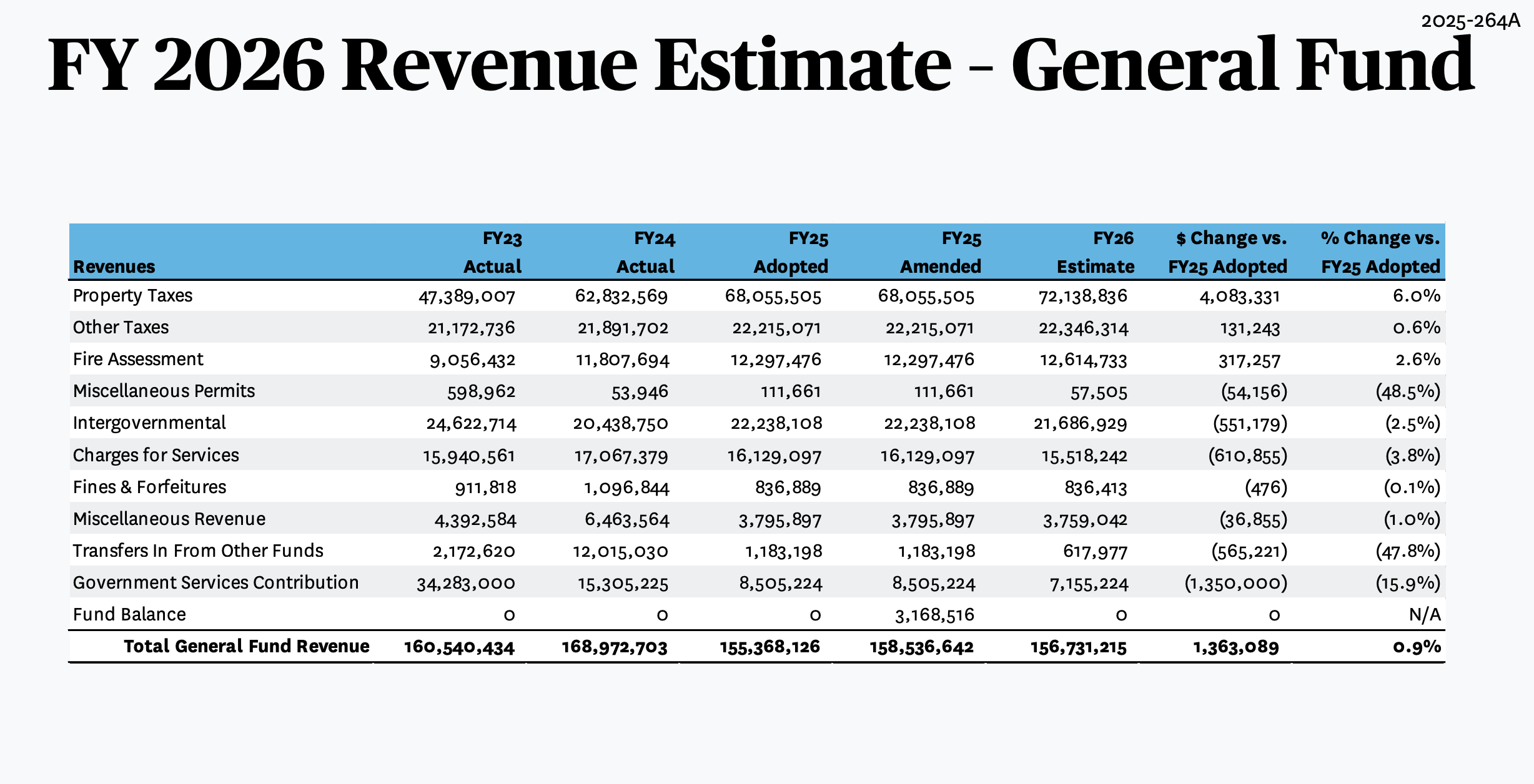
Key Point #4: The City has increased property taxes and the fire assessment rather than spend responsibly.
I can just imagine folks at City Hall complaining that I am taking a narrow view of the topic and complaining that GRU reduced the general fund transfer from $34,283,000 in Fiscal Year 2023 to $7,155,524 in Fiscal Year 2026. To that, I’d say, once again, your own presentation from March 27 (see slide above) shows that while GRU reduced the transfer by $27 million, the City has correspondingly increased property taxes and the fire assessment by over $28 million since Fiscal Year 2023.
The City doesn’t have a “General Fund Structural Revenue Deficit” because 100% of GRU’s reduction in its general fund transfer has been thrust upon City taxpayers, despite all the publicity and hand-wringing surrounding massive cuts to the City budget.
I have worked to make GRU the utility our community can afford and would suggest the City work to become the government our community can afford.
Bottom Line: HB 1645 and the creation of the Authority board have brought about a fundamental shift in how the City finances and funds its services. Gone are the days when GRU customers covered the bills for the City’s budget shortfalls. The City now has a choice:
- Cut expenditures
- Increase taxes and fees
- Do both.
Since the end of Fiscal Year 2023, their choice has been clear: The vast majority of those funds have come from City property taxpayers, not cut from City budgets. The City’s own presentations prove it.
Frankly, that’s the issue at play with the all the hoopla about GRU and the City. The City’s effort to remove the Authority as GRU’s governing body is simply about the money – money GRU is using to:
- Repay exorbitant debt brought about by prior City Commission actions
- Rebuild infrastructure to enhance reliability, affordability, and environmental benefits
- Keep utility bills as low as possible for its customers
- Fulfill GRU’s long-term fiscal sustainability plan
From my perspective, it makes sense for the City to provide services to the community on a budget paid largely by City taxpayers, not excessively funded by non-city residents who already pay surcharges on their electric and water bills for the privilege of using high-quality GRU services.
The blending of these two concepts provides accountability and fairness to people living inside and outside of the city. It is the basis of why the Authority was created.
GRU CEO Ed Bielarski, Gainesville
Click here to read Part 1 in the series.
Click here to read Part 2 in the series.
Click here to read Part 3 in the series.
The opinions expressed by letter or opinion writers are their own and do not necessarily represent the views of AlachuaChronicle.com. Assertions of facts in letters are similarly the responsibility of the author. Letters may be submitted to info@alachuachronicle.com and are published at the discretion of the editor.
Ed, you should know by now that no matter how many letters and opinions you write – you can’t and will never convince the liberal voting idiots the idiots they continue to elect will ever change their continued waste of GRU profits.
Since the dawn of time, it’s been proven over and over; you can’t fix stupid and you can’t teach it either. I do applaud your efforts though.
“You voted” rails against democracy again. Yeah, we get it, but it’s one thing to disagree with election results and another un-American thing to demand the end of elections as a solution and to applaud when they are cancelled by statist thugs from Tally.
Wrong. I rail against financial incompetence.
You want to continue kowtowing to their likes because it fits your political ideology vs doing what should be both morally and ethically right – that’s your choice.
You just wait Big Daddy Eddie B. I putting my boy Eastman on this to respond to you, and he’s going to use big words and his ciphering skills to show everybody how we are the most mostest more smarterest than you.
The city politicians never saw GRU as a utility that would always need new power plants in the future. They thought the biomass plant was a “one and done” — but only for their local careers at city hall. They planned for their ladder climbing to Tally and Washington, but not for GRU. Hence their taking GRU profits for unnecessary trendy projects, instead of paying down debt faster — allowing for new power generation in the future. Oh, and that’s what the solar feed-in was for too, to delay the inevitable until those green voters died off.
Belarski speaks the truth – his constituents aren’t the Gainesville citizens who own the place he works at, but “fairness” to the customers who don’t own it. Fine, but we live in a capitlist democracy and the main principles of our government is the owners of a business are responsible for it’s debts and profits, not the customers, and citizens (in this case the owners of the business) get to vote for their leaders, they aren’t assigned by statist thugs from the capital, who by the way, couldn’t be elected dog catcher in Gainesville or Alachu County without the votes of the residents of Marion, Levy, and Gilchrist county.
How he thinks anyone of principle – or who lives where the theft occurred – would buy this BS is amazing, yet he keeps trying. I guess that’s what $1/3 million a year is worth.
Given the BS a majority of Gainesville’s electorate keep believing from city leaders, it would appear Bielarski knows the audience pretty well.
The problem is our city is ran by a bunch of incompetent and corrupt leftists that couldn’t manage their way out of a wet paper bag yet along manage a city.
The City Commission should be the ones who have to pay down GRU’s debt for the Biomess plant before they GRU has to transfer another dime to them.
Dear Ed,
No one cares how you think the City of Gainesville should be governed. The voters demonstrated that, by a pretty large margin.
Nor should we trust your commentary and math, particularly given your long history of telling people only what they want to hear, or what you want them to hear, and the deeply ethically compromised position that you are currently in as GM of GRU.
Funny thing about this “highly accountable” Authority board: when they first started having their meetings and streaming them on YouTube, people who were watching could comment. Then I guess someone hurt Ed’s feelings with some of their comments and they discontinued that option.
Here’s what some commenters, including at least one former GRU employee had to say:
“…this is like a bad high school break up that Ed just can’t get over.”
“Ed’s intent is not education or the best for the utility… it’s retaliation, revenge, and retribution…Where was Ed on cutting O&M budget when he hired his friends for very lucrative positions without a competitive process?…Ed was the #3 choice for GM when he was hired. He also was not selected for CFO the prior year when he interviewed…”
“I hope the rest of the board realize Ed will be fixated on Tony as GM every meeting because he is a petty, petulant, scorned man…”
“Masterclass on handling a narcissist”
Couldn’t have said it better myself.
Sincerely,
Jason Bellamy-Fults
(who, unlike some of you trolls is not afraid to attach my name to my comments)
My “unique qualifications” include being a GRU critic when I’ve felt they deserved it, a GRU contractor on multiple occasions over the years, a former Utility Advisory Board Co-Chair, and someone whose spent 15+ years of his life helping GRU customers find ways to save resources and lower their utility bills. And unlike Ed, I have no financial stake in how GRU is governed; I just want my utility to be run by people who are actually qualified and accountable to the ratepayers.